







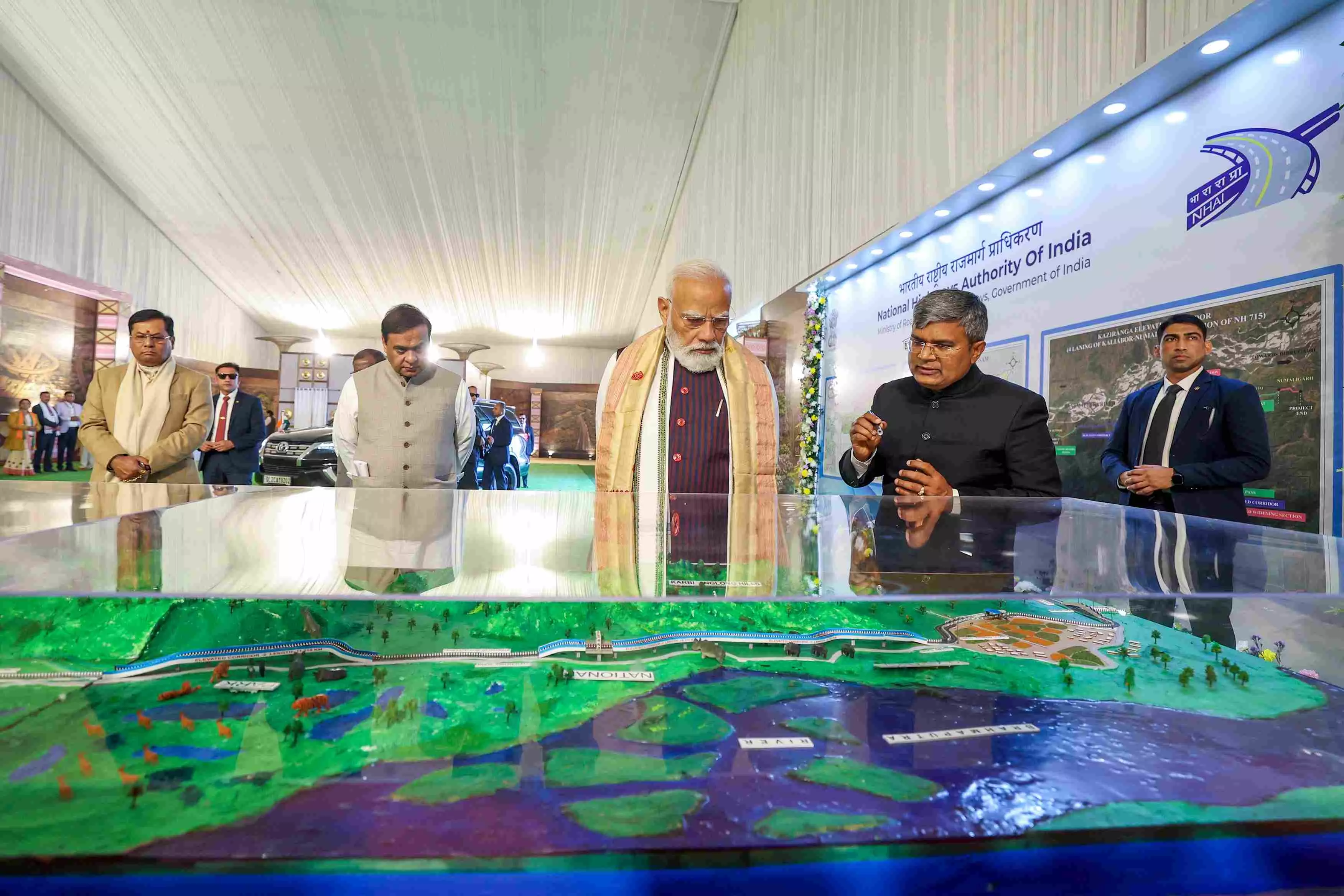
In this image received on Jan. 18, 2026, Prime Minister Narendra Modi looks at a model of Kaziranga Elevated Corridor during its foundation stone laying ceremony, in Nagaon district, Assam. Photo: PTI
Why Kaziranga Elevated Corridor Project is crucial for Assam's wildlife, connectivity
The 35 km wildlife-friendly corridor aims to prevent wildlife accidents involving animals from Kaziranga National Park and boost connectivity between Guwahati and Upper Assam

The ₹6,950‑crore Kaziranga Elevated Corridor project, for which Prime Minister Narendra Modi laid the foundation stone on January 18, is an environmentally conscious National Highway initiative in Assam, designed to safeguard wildlife even while improving regional transport.
The project which has been designed in compliance with Supreme Court directions and recommendations from the Wildlife Institute of India, is largely aimed at protecting the inmates of the Kaziranga National Park and Tiger Reserve, a UNESCO World Heritage Site.
Globally renowned for its biodiversity, the Kaziranga National Park is home to the world’s largest population of one‑horned rhinoceroses, along with tigers, elephants, wild water buffalo, and swamp deer. However, these animals were getting killed in accidents on the Kaliabor-Numaligarh section of NH-37 (New NH-715), which runs alongside this famed National Park. Between 2020 and 2024, over 80 large mammals (including rhinos and elephants) have been killed in accidents on this highway.
What's the project about?
Besides ensuring protection of the park’s rich biodiversity, this project will also be crucial in improving regional connectivity in Assam.
Firstly, the project involves the four-laning of the Kaliabor-Numaligarh section of NH-37 (New NH-715), which means that 30 km of the existing highway section of NH 715 is all set to be widened.
Also read: Modi flags off 2 Amrit Bharat trains, lays Kaziranga corridor foundation
Secondly, a 35 km elevated wildlife corridor will be built to pass through Kaziranga National Park, along with 21 km bypasses at Jakhalabandha and Bokakhat. This flagship infrastructure project will be implemented by NHIDCL under the Ministry of Road Transport and Highways, and the construction will be completed in 36 months.
The significance
Boosting connectivity to Upper Assam: Connectivity is expected to be significantly strengthened across Nagaon, Karbi Anglong, and Golaghat districts, linking Upper Assam, particularly Dibrugarh and Tinsukia, with Guwahati and is set to extend access to Arunachal Pradesh. The bypasses developed at Jakhalabandha and Bokakhat will help decongest the towns, improve urban mobility, and enhance the quality of life for local residents.
Moreover, the Kaziranga Elevated Corridor is expected to play a key role in economic growth of the region by strengthening connectivity, boost tourism to Kaziranga National Park and open new avenues for trade and industrial development. It will also generate employment opportunities for the local youths.
Reducing travel time
According to officials, the project will reduce travel time between Guwahati and Upper Assam (specifically Dibrugarh and Tinsukia) and support growing passenger and freight traffic.
Once completed, the Kaziranga Elevated Corridor, with its alignment integrating two major National Highways (NH-127 and NH-129) and one State Highway (SH-35), will provide seamless connectivity to key economic, social and logistics hubs across the state. PM Modi, while laying the foundation stone, remarked that the corridor will also improve connectivity between Upper Assam and Arunachal Pradesh, and along with new rail services, will open fresh opportunities for the people.
Ensuring safe wildlife movement
Most importantly, the elevated highway, which is part of this project, will help animals from the Kaziranga National park, like one-horned rhinoceroses, elephants, and tigers to pass safely underneath, especially during monsoon floods when they migrate to the higher ground of the Karbi Anglong hills.
Also read: Assam forest created by Padma Shri awardee set ablaze; probe ordered
The elevated corridor which spans nine identified animal corridors will ensure uninterrupted movement of animals thereby reducing human-wildlife conflict.
According to a PIB release, the existing Kaliabor–Numaligarh section of NH-715 (old NH-37) is currently a two-lane road, passing through the densely built-up areas of Jakhalabandha in Nagaon district and Bokakhat in Golaghat district.
A major part of the existing highway passes either through the Kaziranga National Park or along the southern boundary of the park, having restricted right of way (ROW) of 16 to 32 metres further aggravated by substantially poor geometrics.
During the monsoons, the area inside the park gets flooded leading to the movement of the wildlife from the park towards the elevated Karbi-Anglong Hills by crossing the existing highway. The heavy round-the-clock traffic on the highway results in frequent accidents and deaths of wild animals.
To address these challenges, the Kaziranga Elevated Corridor Project will involve the construction of around 34.5-km-long elevated corridor to facilitate the free and uninterrupted movement of wildlife between Kaziranga National Park and the Karbi Anglong Hills.
Economic Impact
The project is expected to generate over 35 lakh person-days of employment (direct and indirect) and boost ecotourism in the region as well.
Multi-modal integration
Apart from these benefits, the upgraded corridor will enhance multi-modal integration by connecting with 3 railway stations (Nagaon, Jakhalabandha, Vishwanath Charli) and 3 airports (Tezpur, Liabari, Jorhat) thereby facilitating faster movement of goods and passengers across the region.
Also read: Assam: Elephant death toll rises to 8 after Hojai train collision
By reducing travel time, boosting economic growth, and safeguarding wildlife, the corridor is poised to reshape connectivity in Assam while protecting one of India’s most treasured natural habitats.