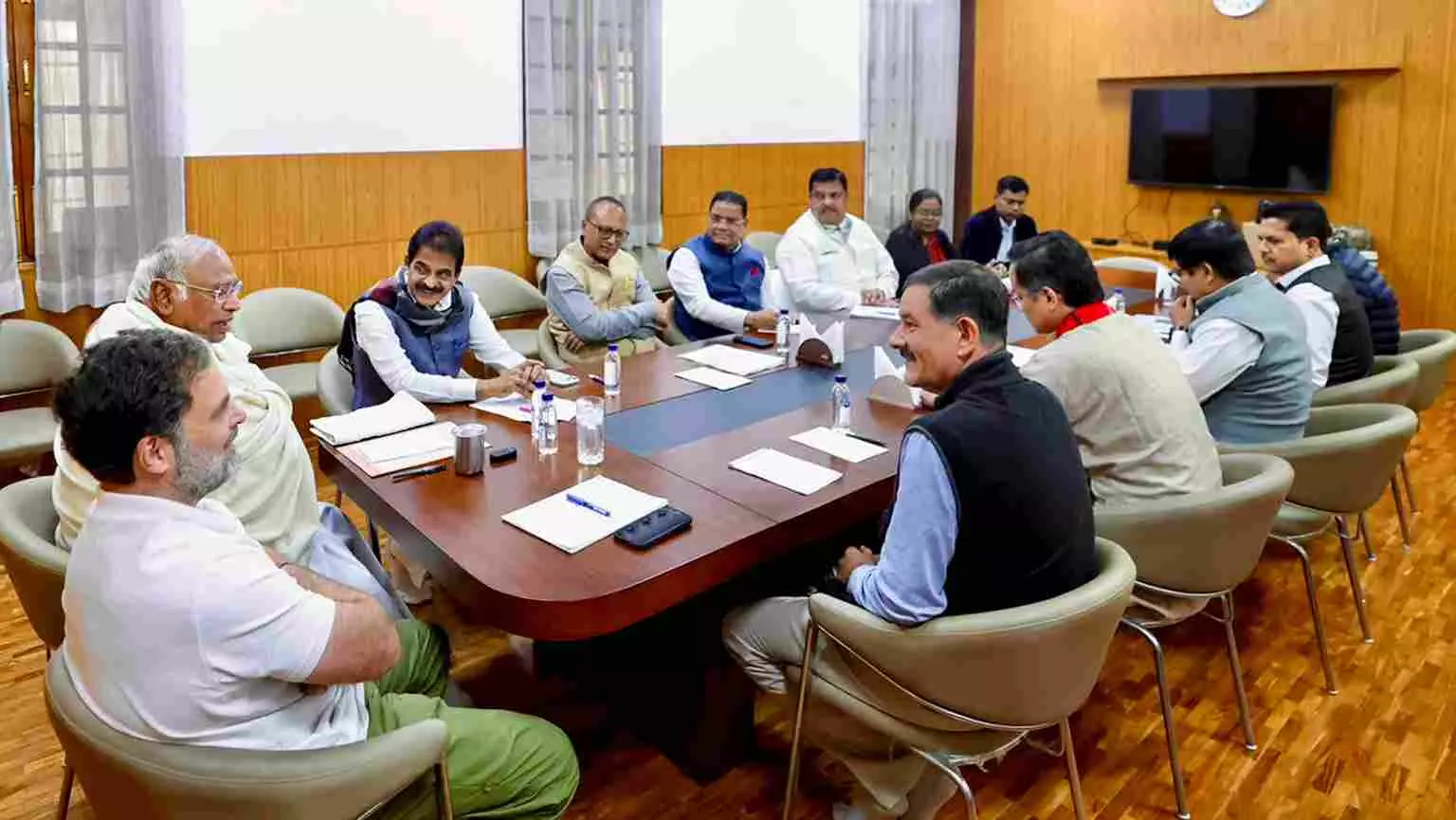
LoP in the Lok Sabha and Congress leader Rahul Gandhi, party President Mallikarjun Kharge and party MP KC Venugopal during a meeting with the Assam Leadership Team, in New Delhi. Photo: X|@INCIndia via PTI
Congress readies for Assam elections, seeks to end BJP's decade-long reign
Congress faces challenge of forming a narrative before elections on including six communities in ST list without upsetting existing groups; no alliance with AIUDF

Smarting under the poll drubbing it faced in Bihar last month, the Congress party has begun preparations for the assembly polls due in Assam in March-April next year, where it has the mammoth task of ending the BJP’s decade-long reign.
The immediate challenge for the party, which has been left weakened due to a steady attrition of leaders to the BJP over the past 10 years, is to revive its vote base beyond the Tai Ahom and Muslim communities of the state. The party also has its task cut out to ensure that its prospective pre-poll alliance in Assam doesn’t hit the turbulence that its Grand Alliance with the RJD, Left parties and other smaller outfits suffered from in Bihar.
The two issues, it is learnt, dominated the discussions during a meeting between the party high command and the Assam Congress leadership held in New Delhi last week.
Prickly issue
Among the issues that the party needs to carefully navigate, as identified during the poll-preparedness deliberations, was how it formulates its narrative and electoral plan on the prickly issue of bringing six indigenous communities of the state – the Tai Ahom, Moran, Motok, Chutia, Koch-Rajbongshi, and the Tea Tribes – under the Scheduled Tribes umbrella, without upsetting the share of notified tribals currently listed in Assam.
On November 29, chief minister Himanta Biswa Sarma had presented to the state assembly the report of a Group of Ministers (GoM) advising that the long-standing demand of bringing these six communities under the ST status be granted. What has, however, turned the recommendation into a politically polarising one is the GoM’s suggestion that this categorisation should be made without affecting the reservation for the existing tribal groups; something the Congress and existing tribal groups in Assam believe is impossible to achieve.
The ST communities in Assam are currently categorised as ST (Plains) and ST (Hills), with their share in reservation being 10 and five per cent, respectively. The GoM has reportedly recommended that while the Moran, Motok and Koch-Rajbongshis in the undivided Goalpara area should be included in the ST (Plains) list, a new category of ST (Valley) should be carved out to include the Ahom, Chutia, Tea Tribes and Koch-Rajbongshis (beyond the Goalpara region) which will have an additional reservation pie.
Also read: Gaurav Gogoi takes over as Assam Cong president, urges cadre to prepare for poll
This formulation by the GoM, the Congress believes, would trigger conflict among existing tribals and the Moran, Motok and Koch-Rajbongshis in the plains, as those currently benefitting from affirmative action may view the inclusion of new communities in the ST (Plains) category as an impingement on their constitutional right.
ST list expansion
Furthermore, things could get even more complicated in allocating reservations under the central quota, as there is a single national ST list, unlike in Assam, where the GoM is proposing a three-tier classification, which would invariably mean that all STs, existing and those freshly included, would have to vie for quota benefits within the existing central ST pool.
The BJP believes that the expansion of the ST list will help consolidate its electoral hold over the Moran, Motok, Chutia, Koch-Rajbongshi and Tea Tribes, who have already been gravitating away from the Congress in Assam for the past decade, while also chip away votes of the Ahoms, the state’s largest community.
The Ahoms have traditionally been the bedrock of Congress’ past electoral victories and both Assam Congress chief Gaurav Gogoi and legislative party leader Debabrata Saikia belong to this community.
Congress stand
For the Congress, however, the sustained protests by communities currently identified as scheduled tribes in the state against Sarma’s strident pitch for expanding the ST list has presented an opportunity for electoral revival. The Congress has gone back to a 2011 resolution that it had got passed in the Assam Assembly when Gaurav’s father, late Tarun Gogoi, was the state’s chief minister.
Also read: Assam Congress chief challenges CM Himanta: Will you resign if Gaurav Gogoi wins?
While supporting the inclusion of the six indigenous communities in the ST list, the resolution had also made a strong case for expanding the reservation pie so that previously notified communities do not feel that the new entrants were eating into their share of government jobs and admissions in educational institutions.
Soon after the GoM report was tabled in the Assembly, Gaurav Gogoi had posted on X that his party had “supported the claim that six indigenous communities of the State must be declared as ST without affecting the rights and privileges of the existing ST groups”.
The Assam Congress chief had also hit out at Sarma for being “unable to show that the rights of the existing ST communities (will) remain intact” and accused the chief minister for “stoking another conflict between six indigenous communities and the Scheduled Tribes of Assam”.
Sources privy to the discussions the Congress high command had last week with Gogoi, Saikia and other Assam Congress leaders told The Federal that when meeting members of communities currently identified as ST in Assam, the state leadership must emphasise that the GoM’s formulation, if adopted, would severely dent their chances of getting central government jobs or admissions in central educational institutions. This is because the central ST quota would remain fixed at 12.5 per cent for STs, while the population from Assam eligible for this quota would swell from the present 28 per cent to well over 70 per cent.
Congress's poll pitch
Likewise, when meeting members of the six indigenous communities the GoM proposes to include in the ST list, the Assam Congress leaders would assert that the BJP’s move, made less than six months ahead of the assembly elections, was “nothing more than an election stunt”.
Congress leaders told The Federal that the “existing quota (12.5 per cent under the central list) doesn’t even satisfy the requirement of the existing 28 per cent tribal population” of Assam and that “if these six communities are listed as STs, over 70 per cent of the state’s population will be fighting for the 12.5 per cent quota in central government jobs”.
Sources said the party leaders also discussed at length the question of alliance formation for the Assam polls.
On alliances
A senior party leader privy to the discussions confirmed to The Federal that unlike the 2021 polls, the party high command had decided against any alliance with former Dhubri MP Badruddin Ajmal’s All India United Democratic Front (AIUDF), but was keen to rope in Akhil Gogoi’s Raijor Dal.
Also read: Congress-Raijor Dal seat-sharing row hits Opposition alliance in Assam
An Assam Congress leader said the alliance with Ajmal’s AIUDF in 2021 was a “blunder” that had cost the party dearly as it helped the BJP in deepening communal polarisation in the state and weaponising it against the Congress. As such, the Congress is determined to steer clear of Ajmal this time round, particularly given how the BJP, under Sarma’s government, has relentlessly stoked communal passions in the state and targeted the Congress over Muslim appeasement.
The Assam leadership has been instructed to initiate alliance talks with potential allies such as Akhil Gogoi’s Raijor Dal, Rajya Sabha MP Ajit Kumar Bhuyan’s Anchalik Gana Morcha, the CPI-CPM, CPI-ML (L) and the Assam Jatiya Parishad.
The Congress high command, said sources, is keen that the alliance blueprint is finalised at the earliest, to avoid a re-run of the confusion that reigned in Bihar during the recent polls, when Grand Alliance members were left negotiating seats even after the notification for the first phase of polling was issued, and finally settled for friendly contests on nearly a dozen seats.