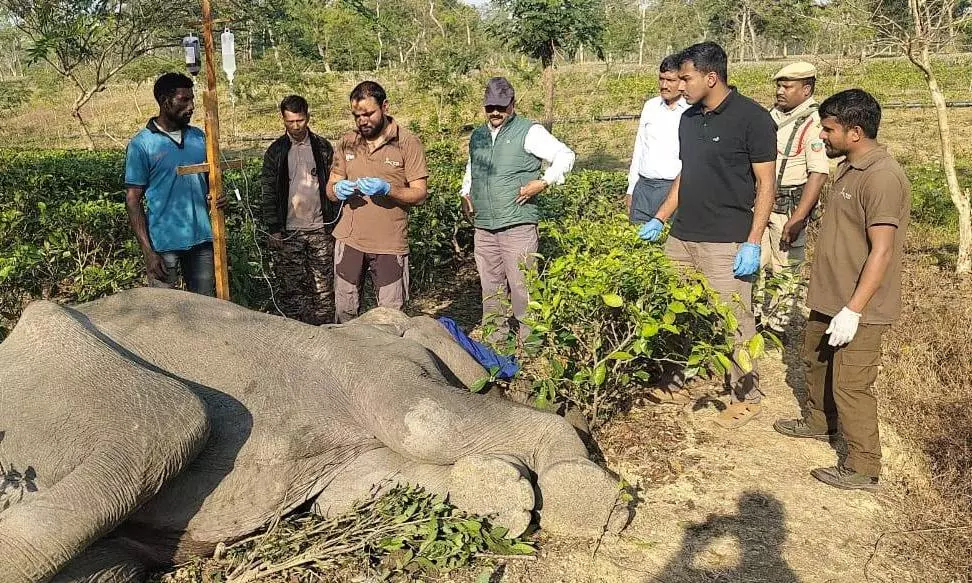
The death of an eight-year-old wild elephant after ingesting plastic waste in Assam has sparked widespread concern, bringing focus back on unchecked dumping inside sensitive wildlife corridors.
The incident took place on January 12 at Numaligarh Tea Estate in Golaghat district, near the ecologically crucial Deopahar Reserve Forest and Nambor-Doigrung Wildlife Sanctuary.
The details surfaced through an RTI filed by activist Dilip Nath.
Plastic ingestion: Cause of death
The post-mortem report paints a disturbing picture. The elephant had no visible injuries, no fractures, no signs of struggle. But inside, its stomach was packed with plastic. Traces of the waste were also found in its stool, confirming that the animal had consumed a significant quantity over time.
The vet's findings point to severe bloating, digestive failure and internal complications — all triggered by plastic ingestion — as the cause of death. Officials have linked this directly to garbage dumped along roadside stretches near forest areas.
'Stop dumping waste'
For conservationists, the case is not an isolated one, but a warning sign.
Environmental activist Apurba Ballav Goswami said elephants are increasingly being pushed to such desperate feeding behaviour as natural food sources have shrunk. “When forests stop providing enough, elephants turn to whatever is available — even if it is harmful,” he said.
He flagged the Deopahar–Numaligarh–Nambor belt as a particularly vulnerable stretch. According to him, roadside dumping along National Highway-39 has become routine, with plastic and other waste piling up dangerously close to elephant habitats.
“These are not just forests. These are active elephant corridors. Dumping waste here is like placing poison in their path,” he said.
Goswami added that the issue has been repeatedly highlighted on social media and flagged to authorities, but little has changed on the ground. He warned that unless dumping is stopped and these areas are cleaned up, more such deaths are inevitable.
Severe food shortage for elephants
Assam remains one of India’s most important elephant habitats. The state forest department’s 2024 estimation puts the population at 5,828, while a 2025 DNA-based survey by the Wildlife Institute of India estimates around 4,159 elephants. Despite differences in methodology, both underline the state’s significance for elephant conservation.
Experts say the larger crisis lies in shrinking forests. Over the past four decades, Assam has lost nearly 35 per cent of its elephant habitat due to deforestation, expansion of tea gardens, agriculture, mining and infrastructure projects. What remains are fragmented forest patches that cannot sustain large herds.
Dilip Nath said elephants today are facing a severe food shortage. “They need 150 to 200 kg of food every day. But forests are no longer able to provide that. So they move out, often into danger,” he said.
Gaja Mitra scheme
This has intensified human-elephant conflict across the state. Elephants frequently stray into villages and farmlands, drawn by crops, leading to damage, tension and at times, loss of life on both sides. Official data shows over 1,200 elephant deaths between 2000 and 2023, many linked to human activity.
The incident has also brought the spotlight on the state government’s Gaja Mitra Scheme, introduced to reduce human-elephant conflict by improving food availability and support systems in vulnerable zones.
The Gaja Mitra scheme, launched last year, focuses on habitat restoration, community involvement and early warning systems in conflict-prone areas. It includes plantation of elephant-friendly species, monitoring through technology and deployment of local volunteer teams.
However, Nath questioned its effectiveness on the ground. “The scheme covers districts like Golaghat. If food support and habitat work are being done as claimed, how did this elephant end up eating plastic?” he asked.