







Paschim Banga, again: Why previous bids to rename West Bengal ran into a wall
From Bangla to Paschimbanga, successive governments have tried to rename West Bengal over 27 years. History, politics and Delhi kept getting in the way

When news broke of the West Bengal government’s latest decision to rename the state “Paschim Banga”, many in the state let out a groan: “Oh dear, not again!” That's because the decision revived a debate that has repeatedly surfaced and faded over nearly three decades, without going anywhere.
On Monday (November 23), the state Cabinet approved a proposal to replace the English name “West Bengal” with “Paschim Banga”, which is already used in Bengali, in all languages. A resolution will be introduced in the Assembly during the winter session beginning in December.
If successful, it would achieve something that successive governments led by the Left Front and the Trinamool Congress failed to accomplish despite multiple attempts since 1999. Each proposal stumbled over a different obstacle, ranging from concerns about Bangladesh-related confusion to disagreements over how the state’s Partition-era identity should be remembered.
Left Front opened the debate
The question of renaming West Bengal first acquired political momentum under the Left Front government led by Jyoti Basu in 1999.
The Left was the first to propose “Paschim Banga”, arguing that the English name should better reflect the state’s Bengali identity. The Congress, then in the opposition, disagreed and suggested “Bangla” instead, contending that the prefix “West” had lost relevance after East Bengal turned into Bangladesh.
Although discussions advanced and an all-party delegation approached the Atal Bihari Vajpayee-led NDA government at the Centre, the proposal failed to gain traction. The concern was straightforward: “Bangla” sounded too similar to “Bangladesh”, potentially creating confusion in diplomatic and international contexts.
Also read: 6 months in, Bengal BJP turns to cross-constituency audits to rein in unruly MLAs
The idea was shelved, but the renaming debate never disappeared.
Mamata’s alphabet problem
After coming to power in the state in 2011, Mamata Banerjee’s Trinamool Congress revived the proposal, this time focusing on a practical grievance.
West Bengal’s position at the bottom of alphabetical lists in national meetings often meant state representatives had to wait until the very end to speak. The government believed a name beginning with a letter higher up in the alphabet could improve the state’s placement in official forums.
This time, Congress went with Paschimbanga, while the Left endorsed Bangla. After days of speculation, the proposed name was revealed after an all-party meeting: “Paschimbanga”. The proposal was forwarded to the Ministry of Home Affairs. But, as then chief minister Mamata Banerjee later stated in the Assembly in August 2016, the Centre simply left the file pending without moving a constitutional amendment under Article 3.
The then-TMC government also did not aggressively pursue the proposal with the then-UPA-II government in New Delhi, of which it was a part until September 2012. Beside, Mamata herself reportedly preferred Bangabhoomi or Bangla and Paschimbanga was a reluctant compromise.
Also read: 'Should India sit idle forever?': PM Modi recalls doubts over semiconductor mission
Moreover, policymakers argued that shifting from “W” to “P” offered only a limited alphabetical advantage. Therefore, the search for a more comprehensive solution continued.
The three-name formula that went nowhere
Five years later, the Trinamool government came up with the most innovative proposal yet.
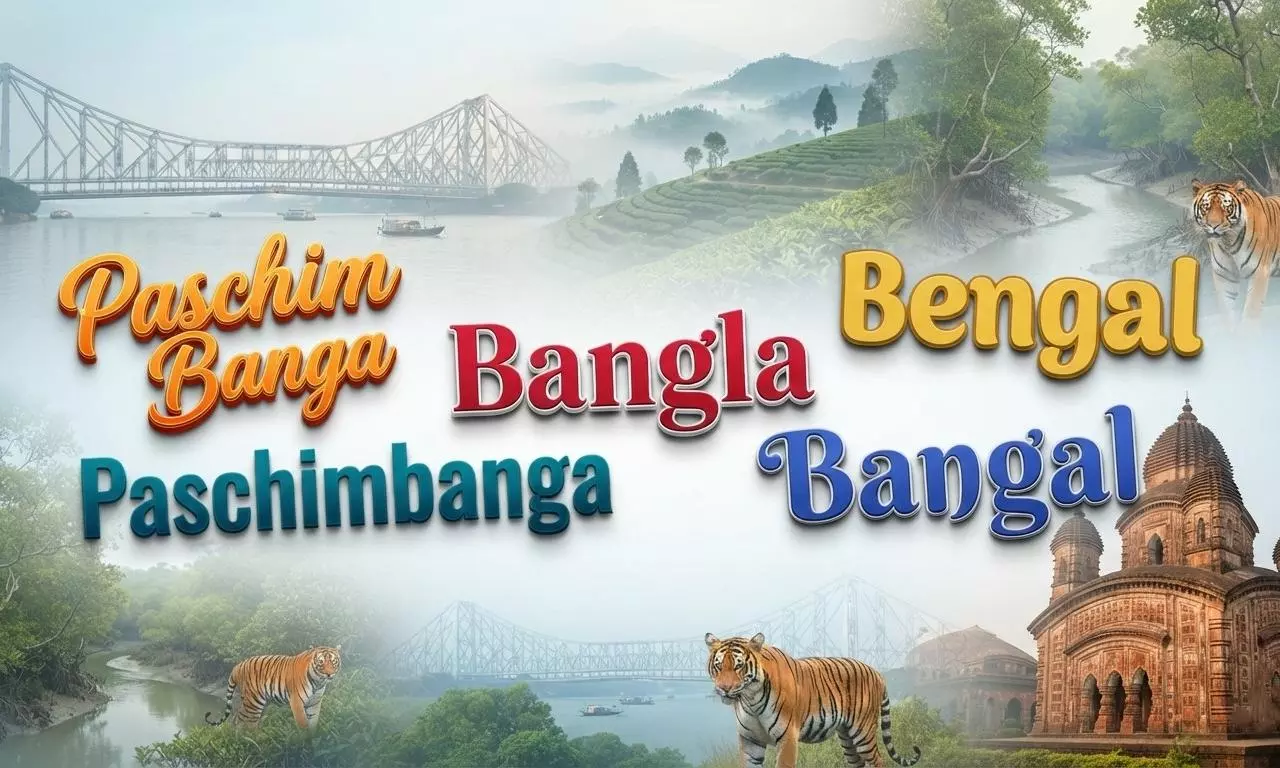
Seeking a compromise between linguistic identity and administrative practicality, the West Bengal Assembly adopted a resolution in 2016 proposing three different names: “Bangla” in Bengali, “Bengal” in English and “Bangal” in Hindi.
The logic was politically attractive. It removed the colonial-era “West”, retained familiar usage in English and highlighted the state’s cultural identity.
But the BJP government at the Centre rejected the plan yet again. The Home Ministry concluded that a state could not officially operate under three separate names in three different languages. It asked the government to return with a single, uniform name if it wished to proceed.
That requirement fundamentally altered the direction of the debate.
The ‘Bangla’ bid meets resistance
Responding to the Centre’s objections, the Assembly unanimously passed another resolution in 2018, proposing, once again, “Bangla” as the sole official name across all languages.
Yet this also ran aground. The Ministry of External Affairs reportedly objected, just like in 1999, that “Bangla” could easily be mistaken for “Bangladesh” at international events and bilateral meetings.
Also read: Bengal to include Syama Prasad Mookerjee in school curriculum, drop Singur chapter
Simultaneously, BJP leaders argued that dropping the word “West” would erase an important historical marker linked to Bengal’s Partition in 1947. For them, “West” represented more than geography. It symbolised the creation of a Bengali-majority state within India after the Partition vote led by Syama Prasad Mookerjee and others. Removing the prefix, they argued, would dilute that historical memory.
The Union government ultimately withheld approval, ending another attempt.
What makes the latest proposal different?
Now that the BJP is in power in both the state and the Centre, the latest proposal seeks to avoid many of the pitfalls that doomed earlier efforts.
Instead of dropping “West” altogether, it retains its Bengali equivalent, “Paschim”, just like the BJP wanted in 2018. It also adopts a single name for all official purposes, thereby addressing the Centre’s earlier objections to multiple-language naming conventions.
Politically, the proposal also carries a different ideological framing. The BJP argue that “Paschim Banga” preserves the historical legacy of Bengal’s Partition while giving the state a culturally rooted name across all languages. In that sense, it seeks to bridge two competing narratives that previously clashed: Bengali linguistic identity and the memory of 1947.
Also read: Hills divided, plains wary: Centre’s Gorkhaland talks off to a tricky start
Whether that will be enough remains uncertain.
The final hurdle lies in Delhi
Even if the Assembly passes the resolution next month, the name change will not happen automatically.
Under Article 3 of the Constitution, the proposal must be considered by the Union government and subsequently approved by Parliament. Any bill changing the state’s name would require passage in both the Lok Sabha and Rajya Sabha before receiving presidential assent.
West Bengal’s long renaming saga has already suffered four failed attempts under governments of different political colours. The latest “Paschim Banga” initiative may have been designed to overcome earlier objections, but it definitely won’t make everyone happy, as the debate over “why ‘west’ if there is no longer an ‘east’” is yet to be settled.