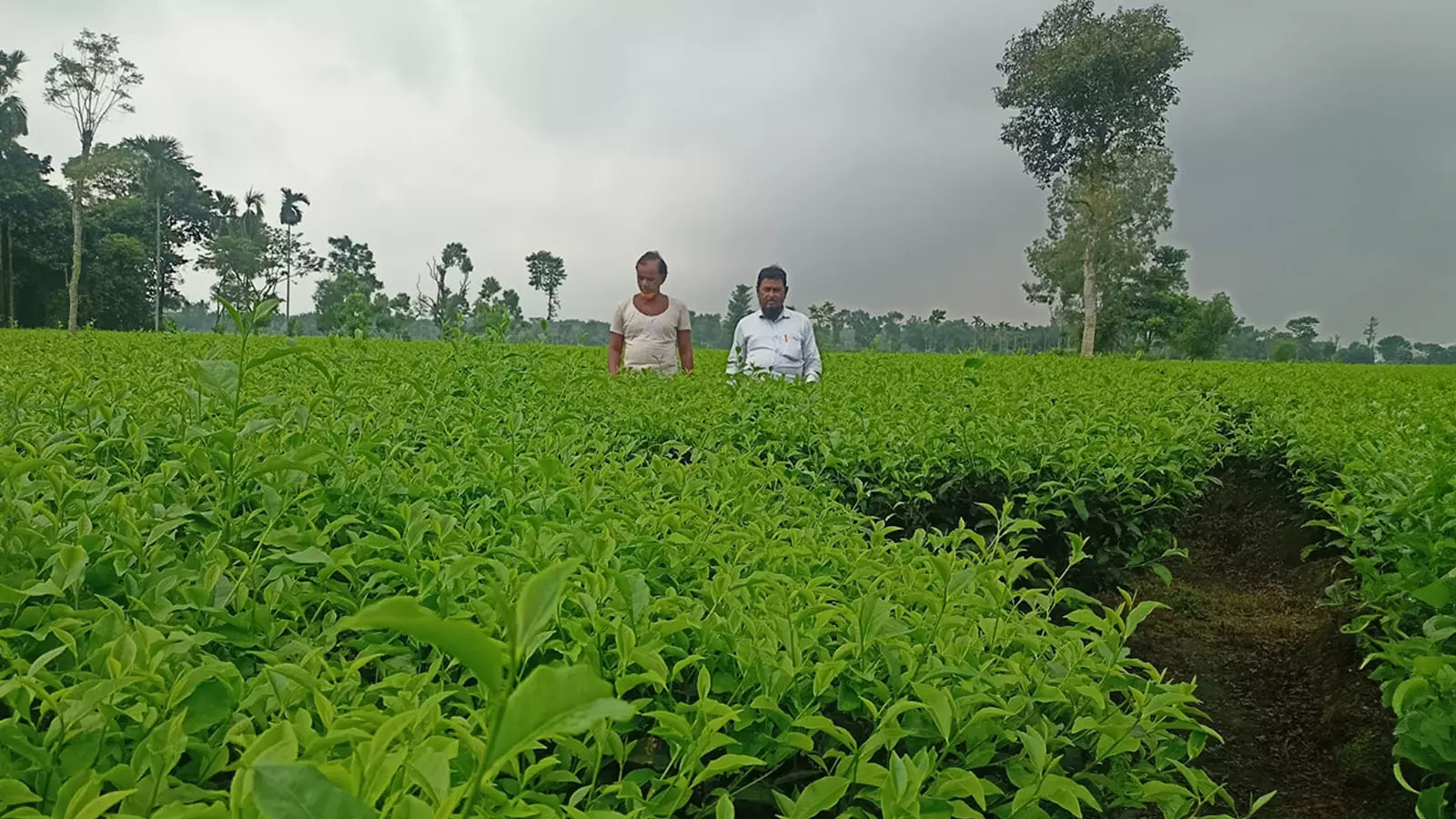
READING THE TEA LEAVES? Idris Alam (right) at his five-acre tea garden in North Dinajpur, West Bengal. With no buyers for his leaves, he's unsure he can even pay his son's school fee this year.
Bitter harvest: How a pesticide row is choking West Bengal's small tea growers
North Bengal's small tea growers, who account for over half of India's tea output, are staring at ruin after factories stopped buying leaves

When Idris Alam and his two brothers planted tea on five acres of ancestral land in West Bengal's North Dinajpur district more than two decades ago, they hoped it would secure the future of their 20-member-strong joint family.
Today, the plantation that once symbolised hope has become the family's biggest source of anxiety.
Also read: How ‘unfair pricing’ of leaves is brewing a storm in Assam’s small tea gardens
Freshly plucked leaves are piling up in the garden after leaf factories across North Bengal suspended procurement from small growers over concerns about pesticide residue levels and stricter quality requirements imposed by major tea buyers. The crisis is also an early test for the new BJP government and its promise to revive Bengal's tea economy.
50 lakh lives at stake
"We have survived years of low prices and rising production costs, but we never imagined a day when nobody would buy our leaves," said Alam, whose family converted 16 bighas (around 5 acres) of once-barren ancestral land into a tea garden in 2003 after taking a bank loan of Rs 8 lakh.
Distressed tea-growers in North Bengal dump leaves in a market
"Since the factories stopped buying our leaves, we have already lost around Rs 50,000. I still have to pay my labourers this week even though there has been no income. On August 5, the bank will deduct an EMI of Rs 17,800 on another Rs 10 lakh loan I took for the garden in 2024. I do not even know whether I will be able to pay my son's school fee," Alam told The Federal.
His predicament is now shared by nearly 50,000 small tea grower families across North Bengal after the North Bengal Tea Producers Association (NBTPA) directed bought leaf factories not to procure green leaves without certification from approved laboratories confirming that pesticide residue levels are within permissible limits.
The Confederation of Indian Small Tea Growers Associations (CISTA) estimates that the livelihoods of nearly 50 lakh people dependent directly and indirectly on the region's small tea economy could be at risk if procurement does not resume soon.
While the dispute centres on pesticide residue norms, growers and industry representatives say it has exposed inadequate testing facilities, weak technical support and the difficulty small farmers face in meeting stricter quality standards.
If this continues, I will have to borrow from local moneylenders just to pay my workers. The plants will continue to produce leaves. But without buyers, what are we supposed to do?
Unlike large plantations, which process their own leaves, small growers depend entirely on bought leaf factories. Because green leaves must be processed soon after plucking, the procurement halt has left them with few alternatives.
Partha Debnath, another small tea grower who owns a 12-acre tea garden in Sariam village in Jalpaiguri district in North Bengal, said the procurement halt could not have come at a worse time as the tea industry enters its peak production season.
"June, July and August account for nearly half our annual production. This is the season that keeps us afloat for the rest of the year," he said.
Debnath said nearly 5,000 kg of green leaves, around 40 per cent of his previous week's harvest, had already perished after factories stopped buying.
"I have 14 staff, including a driver who transports leaves from the garden. Every week I have to pay around Rs 19,000 in wages. I can somehow manage this week's payment, but if the suspension continues, I will not be able to pay them from next week. If growers are unable to pay workers, labour unrest across the tea belt will become inevitable," Debnath said.
Major tea buyers concerned over pesticide residue levels
The procurement halt followed communications from major tea buyers, including Hindustan Unilever Ltd and Tata Consumer Products Ltd, expressing concerns over pesticide residue levels in tea manufactured by bought leaf factories.
In response, the NBTPA asked its member factories to accept green leaves from small growers only if they were accompanied by residue compliance certificates from approved laboratories.
Growers said the requirement is virtually impossible to meet because green leaves must be transported and processed soon after plucking, while laboratory residue tests take much longer and the cost of testing every consignment is beyond the means of most small growers.
Also read: Bengal BJP eyes 'Assam model' to upgrade North Bengal tea estates
CISTA, which represents growers across tea-producing states, said 'bought leaf' factories are themselves under pressure from buyers and food safety regulations but argues that requiring an MRL (maximum residue limit) certificate for every consignment of green leaves is impractical because of the crop's highly perishable nature.
The growers' body has urged the Food Safety and Standards Authority of India to review the implementation of a March 2024 directive on pesticide residue testing.
It said the present system has created a regulatory gap under which tea manufactured using certain pesticides permitted for use in tea cultivation is being declared non-compliant because corresponding residue limits have not yet been formally notified.
According to Tea Board data, small tea growers account for about 55 per cent of India's tea production. Unlike large plantations, however, they have little access to affordable residue testing, scientific extension services or structured training on pesticide management.
While saying that they support stricter food safety standards, growers argued compliance cannot rest solely on their shoulders.
"We are not against producing safe tea. If anyone is using banned pesticides, action should be taken. But growers cannot be expected to produce laboratory certificates for every consignment when the infrastructure itself does not exist," CISTA President Bijoy Gopal Chakraborty said in a representation to the Centre and the West Bengal government.
Alam said the economics of tea cultivation had already become increasingly difficult long before the procurement halt.
"When we started, producing one kilogram of green leaf cost around Rs 5 or Rs 6 and we used to get between Rs 11 and Rs 15. Now the production cost is around Rs 25, while prices fluctuate between Rs 12 and Rs 25," he said.
Challenge for Suvendu Adhikari govt
The suspension has further become an early test for the state's Suvendu Adhikari-led Bharatiya Janata Party (BJP) government’s promise to revive its tea economy.
The challenge before it is to preserve North Bengal's reputation in global tea markets while ensuring that stricter food safety norms do not push thousands of small tea growers into financial distress.
Unlike the government's efforts to revive closed tea estates by attracting investors and restoring employment, the present crisis presents a far more complex policy dilemma because it affects a much larger and structurally different segment of the tea economy.
It impacts the rapidly expanding small grower. These growers own or lease small plots but lack processing facilities of their own, making them almost entirely dependent on bought leaf factories.
Any disruption in procurement immediately cuts off their only route to the market, with ripple effects extending beyond growers to transporters, factory workers and thousands of others whose livelihoods are tied to the region's tea economy.
The issue also carries political significance. North Bengal has emerged as the BJP's strongest electoral base in West Bengal, and the tea belt has played an important role in the party's rise in the region over the past decade.
Also read: Girls of Assam's tea gardens fight for education to stop plucking leaves like their mothers
A prolonged procurement crisis affecting nearly 50,000 small growers and the wider rural economy could have political ramifications in one of the BJP's strongest support bases.
Industry representatives warn that if procurement does not resume quickly and growers become unable to pay workers, the disruption could spill over into labour unrest across the tea belt, adding to the political pressure on the government.
CISTA seeks CM intervention
Reflecting those concerns, CISTA has written to Adhikari seeking his immediate intervention. In its representation, the growers' body described the bought leaf factories' decision to suspend purchases before a government-convened meeting as "hasty" and "unrealistic".
While reiterating its commitment to producing residue-free tea that meets international standards, the CISTA argued that preventing the sale and use of banned pesticides should primarily be the responsibility of the state's agriculture department.
It called for stricter enforcement, greater farmer awareness and action against illegal pesticide dealers, effectively placing the onus on the government to address the problem.
While calling for factories to resume procurement immediately, the CISTA also urged the state government to look beyond the immediate crisis.
It said the proposed tripartite talks should lay the groundwork for a long-term system that protects both food safety standards and growers' livelihoods.
Chakraborty told The Federal that the immediate disruption had also exposed structural gaps that required sustained government intervention.
He called for affordable residue-testing laboratories, stricter enforcement against the sale of banned pesticides, stronger agricultural extension and scientific training for growers, and a traceability system that enables tea to be tracked back to individual producers before it enters the manufacturing chain.
Also read: How climate is driving down tea production, increasing hardships for plantation workers
He said these measures would help small growers comply with increasingly stringent quality requirements without jeopardising their livelihoods.
Representatives of grower organisations, bought leaf factories and the Tea Board meanwhile met on Thursday (July 30) to explore ways to restore procurement and evolve a longer-term mechanism to ensure compliance without crippling small growers.
For Alam, however, the debate over MRLs and certification remains secondary to a more immediate concern.
"If this continues, I will have to borrow from local moneylenders just to pay my workers," Alam said.
"The plants will continue to produce leaves. But without buyers, what are we supposed to do?