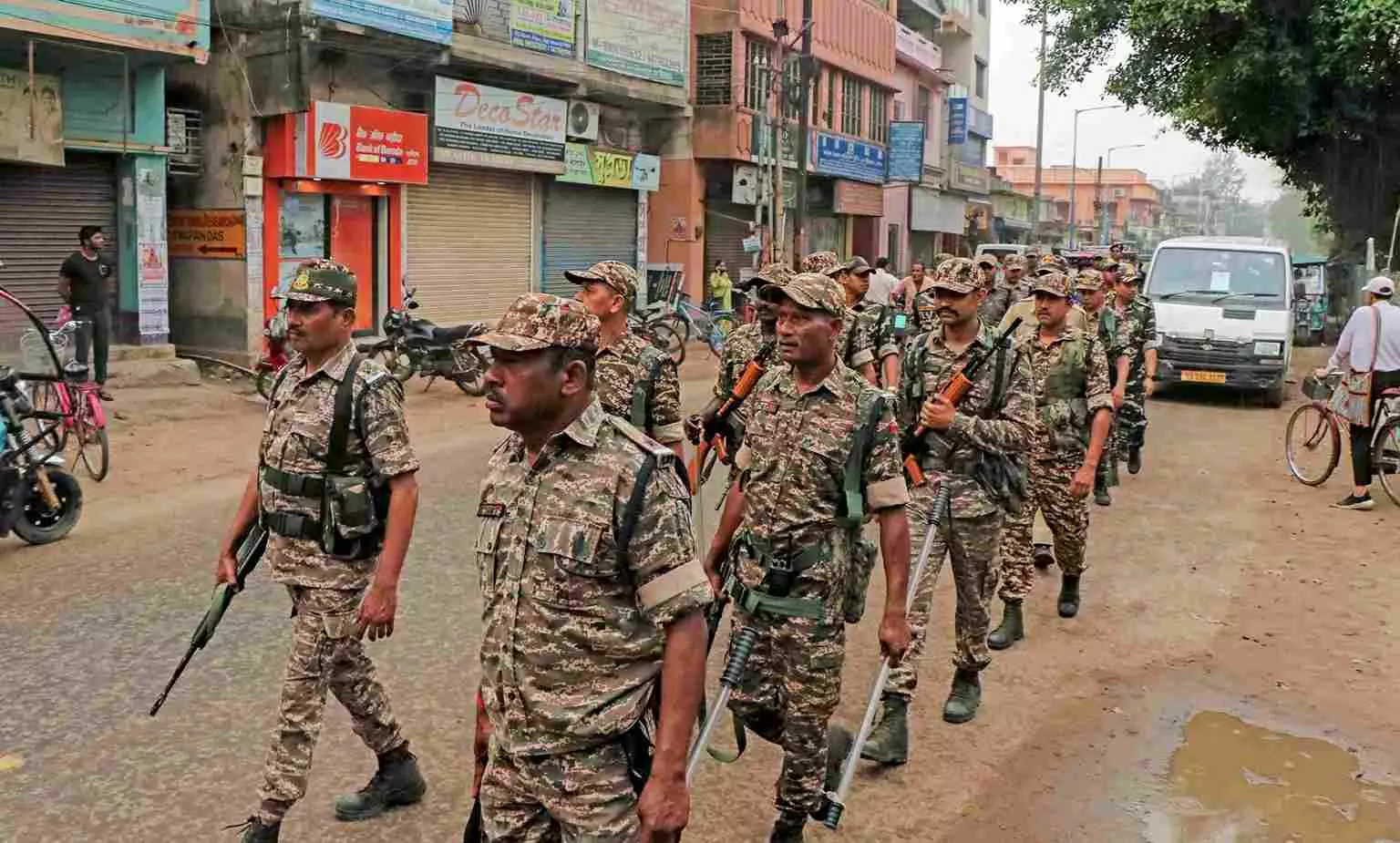
West Bengal schools disrupted as central forces occupy classrooms ahead of elections
Parts of school campuses are being used for CAPF stay, disrupting regular classes, forcing hybrid learning, and raising serious concerns among teachers and parents

The arrival of Central Armed Police Forces (CAPF) in West Bengal ahead of the Assembly election schedule is disrupting normal school routines, with several institutions forced to suspend classes to house security personnel.
In politically volatile Bhangar in South 24 Parganas district, normal functioning is disrupted due to the presence of security forces in at least two schools.
Also read | ‘Don’t dare question judicial officers’: SC warns West Bengal govt, ECI over SIR
Refugee Colony Government Primary School and Polerhat High School have been turned into temporary shelters for security personnel deployed to ensure free and fair elections in the Bhangar assembly constituency, an area characterised by a history of intense electoral violence.
Schools bear election brunt
Manasi Kundu, headmistress of the primary school, said the school has suspended classes since March 2 to accommodate a large contingent of security personnel.
Nearby Polerhat High School has also allotted a portion of its building to accommodate security personnel. Headmaster Sandip Sarkar said several classrooms have been earmarked for the forces, prompting the school to manage academic activities through a hybrid mode.
“There are about 4,600 students. Eleven classrooms have been allotted for the forces. With so many rooms blocked, we are somehow continuing classes through a mix of offline and online arrangements,” he said.
Similar disruptions are being reported from other parts of the state as schools make arrangements to accommodate security personnel ahead of the elections. At Joykrishnapur ABS Vidyapith, a higher secondary school located in the Samserganj block of Murshidabad district, authorities said the school building has been requisitioned to house a company of central forces, affecting regular classes for scores of students.
Headmaster Humayun Ali said officials have informally indicated that the forces may continue to occupy the premises until the end of the election process, which could disrupt classes for about two-and-a-half to three months.
Academic schedule thrown off
Ali said exams for Classes 5 to 10 had been planned for April, though the schedule now appears uncertain. “Preparations to station central forces in school campuses began even before key examinations were completed,” he added.
St Peter’s School in central Kolkata has issued a revised routine limiting classes to three days a week after a section of its campus was taken over by central forces for an indefinite period, prompting the authorities to switch to an alternate-day schedule.
A parent said the arrangement has raised concerns about academic preparation, adding that students had already lost valuable time in recent months as many teachers were drafted as booth level officers for the voter list revision exercise.
Also read | No eligible voter’s name to be removed; Bengal polls to be free, peaceful: CEC
Educationists say the timing is particularly problematic because it coincides with the internal school assessments and higher secondary practical examinations.
School authorities say the logistical challenges extend beyond the shortage of classroom space.
“When security personnel stay on campus for prolonged periods, parts of the school infrastructure, such as playgrounds, corridors and classrooms, often become inaccessible for regular academic use, forcing institutions to explore temporary arrangements,” said Arundhuti Roychowdhury, a Kolkata-based educationist.
Classes halted, concerns grow
Another difficulty arises when schools attempt to move to online or hybrid teaching to cope with the situation, she added. While some urban institutions are able to adjust to such arrangements, many government schools cater to students from economically weaker families who lack reliable internet access or personal digital devices, she pointed out.
Several retired teachers and educationists have also raised the issue publicly, urging authorities to prevent school buildings from being used as accommodation for security forces during the election period.
“Past experience shows that when security forces are housed in schools, classes are often suspended and academic activities come to a standstill, effectively sidelining education,” said Baizid Hossain, a retired headmaster from Domkal in Murshidabad district.
Teacher organisations echoed similar concerns. Sanjay Mukherjee of the West Bengal Trinamool Secondary Teachers' Association said classes had already been disrupted when many teachers were engaged in the voter list revision process. “With schools now being requisitioned to accommodate central forces, teaching is likely to be affected once again,” he said.
A teachers’ platform, Shikshanuragi Oikya Mancha, has urged election authorities to arrange alternative accommodation for central forces instead of using school premises.
Call for alternative arrangements
In a representation submitted to the office of the Chief Electoral Officer of West Bengal, the organisation’s general secretary, Kingkar Adhikari, said government schools are routinely turned into barracks during elections, often forcing institutions to remain closed for extended periods.
Also read | Bengal poll review turns into heated spat as TMC raises SIR concerns
The teachers’ body said prolonged occupation of school buildings disrupts teaching and undermines students’ access to education.
It also suggested that unused government buildings such as auditoriums or market complexes could be used to house security personnel, or temporary camps could be set up in open spaces to avoid affecting academic activities.
West Bengal education minister Bratya Basu also raised concerns over the use of school buildings to accommodate security personnel, saying such arrangements could adversely affect students and disrupt their studies. He urged the Centre to take into account the impact on children’s education while making deployment plans.
Around 480 companies of central forces have been deployed across West Bengal as part of a two-phase induction so far.