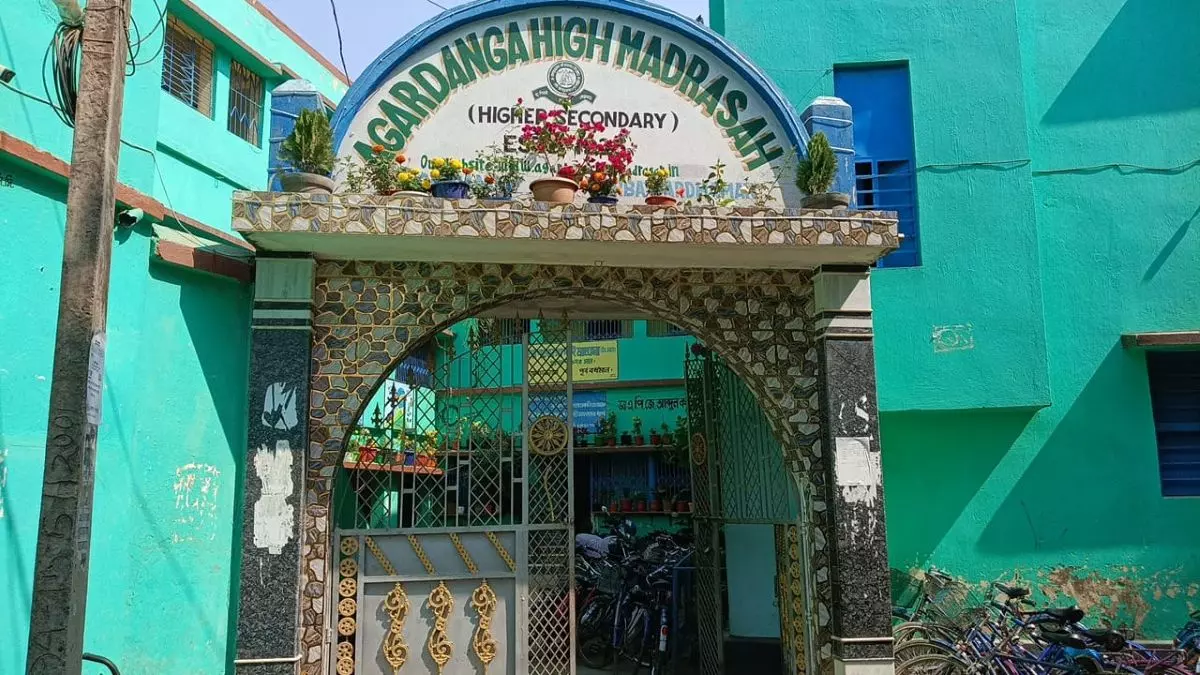
Babar Ali, a gunner with the 237 Field Unit of the Indian Army’s Artillery Regiment, credits the Agardanga High Madrasah in West Bengal for the values that were instilled in him as a student. Photo: By special arrangement
Why in West Bengal, govt-recognised madrasas aren’t the isolated religious hubs as portrayed by BJP
West Bengal has 614 recognised madrasas. According to the state’s madrasa education board data, non-Muslims account for about 17% of students and 11% of teaching and non-teaching staff in high madrasas.

Babar Ali, 28, is counting the days to his upcoming field posting in Jammu and Kashmir, his second stint in the troubled region.
“The order has come. [His movement order is for March 20.] I am itching to get back to the field. Every soldier looks forward to a posting in a high-stakes security environment. After all, we sign up for the army because we want to be on the front line for the country and I am no exception,” Ali tells The Federal over the phone, the passion unmistakable in his voice.
A gunner with the 237 Field Unit of the Indian Army’s Artillery Regiment, Ali, currently based at Sikandrabad in Uttar Pradesh, credits the madrasa (also spelt as madrasah) in a pastoral village in West Bengal, where he studied in his formative years, for instilling in him this sense of duty to the nation
“Whatever I am today, I owe to the values my teachers instilled in me at the madrasa,” he says.
An inclusive picture of madrasa education
Ali’s journey from the classrooms of Agardanga High Madrasah in Keturgram, East Burdwan district, to an Indian Army artillery unit underscores a reality that contradicts the political narrative pushed by the Bharatiya Janata Party (BJP) in West Bengal.
During a debate on the interim budget in the state assembly last week, BJP MLA Agnimitra Paul took exception to funds allocated for madrasa education, claiming such institutions “produce criminals rather than doctors, engineers and teachers”.
Also read: Amid SIR row, Kolkata civic body sees massive surge in domicile certificate pleas
While her comment was expunged for its “divisive tone”, following protests from the treasury benches, the controversy has opened a larger debate on how madrasas are portrayed in the state’s political discourse.
A closer examination of enrolment patterns, staff composition and student outcomes presents a far more inclusive picture of madrasa education in West Bengal.
“Former students of our institution are employed across a wide range of professions, including medicine, engineering, teaching, the police and the armed forces,” Sibaram Saha, a senior administrative staff member at Agardanga High Madrasah, told The Federal. Saha himself is an alumnus of the institution.
Agardanga High Madrasah has 375 Hindu students out of a total enrolment of 884, while nine of its 21 staff members are Hindus. Photo: By special arrangement
At present, the madrasa has 375 Hindu students out of a total enrolment of 884, while nine of its 21 staff members are Hindus.
“Since its inception in 1925, Hindu students have been an integral part of this madrasa, like many other such institutions in West Bengal,” said Saha. “There are three high schools in the area, yet our institution attracts the largest number of students, from both Hindu and Muslim communities,” he claimed.
Not just Islamic-theology-based study
Far from functioning as isolated religious spaces, as is often portrayed by leaders of the BJP and its allies, madrasas in West Bengal are integrated into the mainstream education system and follow the state secondary board’s syllabus almost in its entirety, barring two Arabic-language subjects, and draw a substantial number of students from non-Muslim communities.
According to West Bengal Board of Madrasah Education data, as of 2025, non-Muslims account for about 17 per cent of students and 11 per cent of teaching and non-teaching staff in high madrasas (similar to secondary school, or till class X), and also constitute a significant share of members on managing committees.
In several institutions across districts, such as the Orgram Chatuspally High Madrasah in Burdwan, Kasba MM High Madrasah in Uttar Dinajpur, Chandrakona Islamia High Madrasah in West Midnapore, Dabra High Madrasah in Hooghly and Sagar Moniruddin High Madrasah in South 24 Parganas, Muslim students are in fact a minority, show madrasa education board records.
Also read: Muslim voters in flux ahead of 2026 Bengal polls as SIR fuels fear
Last year, of the 47,376 candidates who appeared for the high madrasa (Class X) examination, 1,046 were non-Muslims. While the share of non-Muslim examinees was lower than their overall presence in the madrasa education system, the figures nonetheless challenge the narrative that madrasas impart Islamic theology-based education confined to a single religious community.
“I am not sure I would have been able to pursue an education at all if there had been no madrasa in my locality. It would have been difficult for my father, a daily wage earner, to support the education of all four of our siblings,” said Murshid Alam, an alumnus of Baro Naldhondra H.K High Madrasah in Coach Behar district.
Last year, Alam cleared the National Eligibility cum Entrance Test (NEET) and secured admission to Malda Medical College and Hospital to pursue a degree in medicine.
According to Alam, his madrasa education never stood in the way of his academic ambitions or his entry into the MBBS course. On the contrary, he said the grounding he received at the madrasa helped him build the academic foundation required to compete in a highly demanding national-level examination such as the NEET.
‘No discrimination based on gender, caste or creed’
“I find it painful that madrasa education continues to be misunderstood and misrepresented,” said Khurshid Alam, a teacher at Baro Naldhondra H.K. High Madrasah. “A false narrative is repeatedly pushed about these institutions, even though they serve thousands of poor students across communities in the state. Madrasas do not discriminate on the basis of gender, caste or creed, and they have played a crucial role in giving children a chance to study and build a future.”
Girls outnumbered boys in last year’s High Madrasah examination, with 28,653 female candidates compared to 15,420 males who sat for the examination. Girls also outperformed their male counterparts, as of the 15 students featured in the top ten merit list, 12, accounting for 80 per cent, were girls.
As of today, the state has 614 recognised madrasas. Of these, 102 operate under the Senior Madrasah Education System (similar to higher secondary, class XII), while 423 are part of the High Madrasah Education System.
Also read: Bengal BJP borrows rival Mamata's 'Dimbhaat' route to woo voters
The West Bengal interim budget allocated about Rs 5,713 crore to the department that covers minority affairs and madrassah education.
While BJP MLA Agnimitra Paul objected to the size of the allocation, the amount does not represent spending on madrasa education alone. The allocation is meant to cover a wide range of expenditures, including scholarships, welfare schemes, hostels and administrative costs, with no separate figure publicly specified for madrasa education in the interim budget.
Officials of the West Bengal Board of Madrasah Education refused to comment on the issue, but some argue that the BJP MLA’s remarks appear to conflate government-recognised madrasas with Khariji Madrasas, which operate with their own curriculum and rely on private or community donations for funding, and are outside the mainstream education system entirely.
Rather than objecting to state-run madrasah education, the focus should be on bringing even Khariji Madrasas under the government’s fold to ensure better regulation, pointed out Israul Mandal of the Bengal Madrasah Education Forum.