



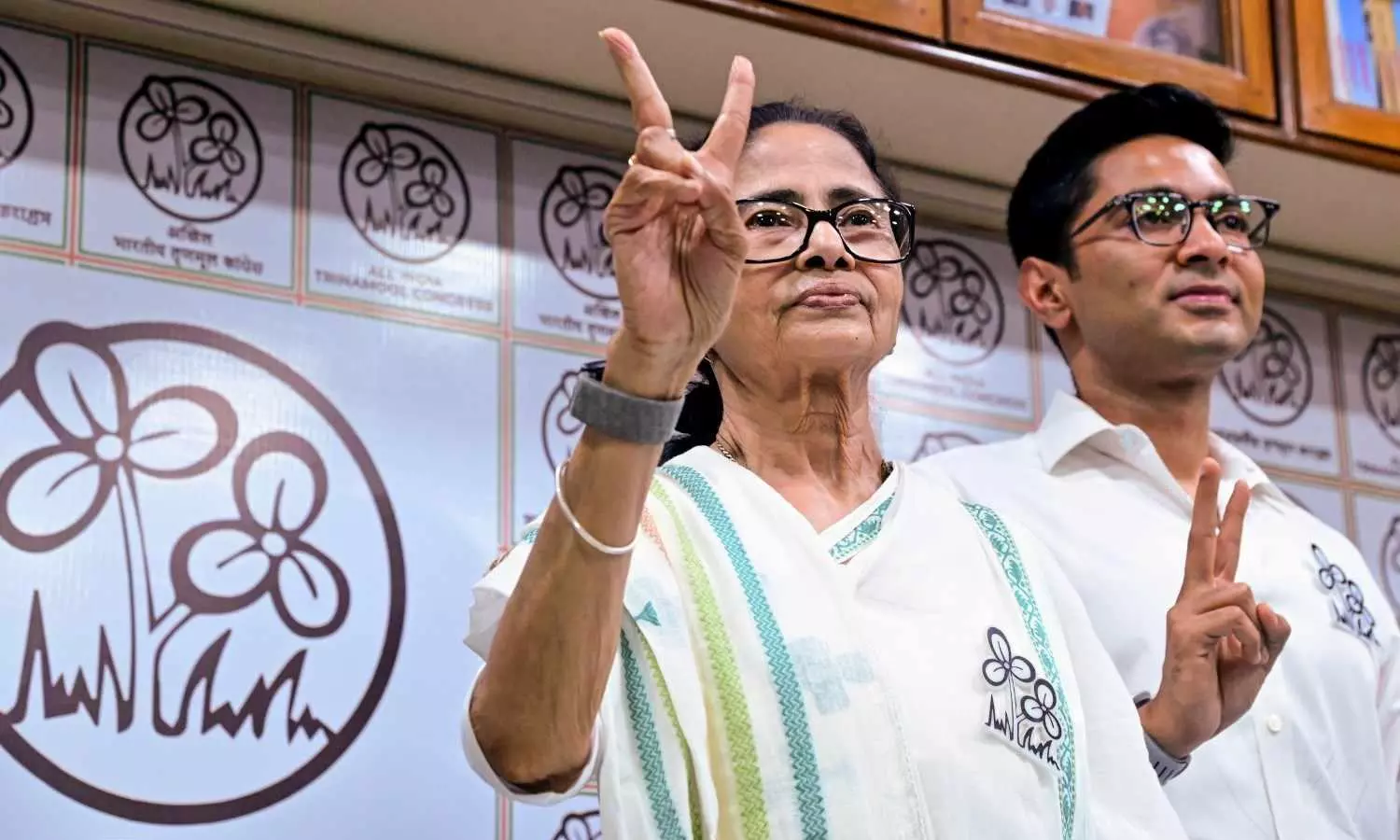
West Bengal Chief Minister Mamata Banerjee and TMC MP Abhishek Banerjee at the launch of TMC's election manifesto in Kolkata on Friday (March 20). Photo: PTI
TMC bets on women-minorities-SC/ST coalition in manifesto with '10-pledge' roadmap
With Lakshmir Bhandar hike at its core, Mamata's election manifesto seeks to consolidate key social coalitions and win a fourth straight term countering BJP’s challenge

Kolkata, Mar 20 (PTI) Betting on the social coalition that has powered Mamata Banerjee’s political dominance over the past 15 years, the TMC’s 2026 poll manifesto focuses on women, minorities and SC/ST communities in a calculated bid to blunt the BJP’s challenge and secure a fourth straight term.
Unveiled with 10 "pratigyas" (pledges), the manifesto blends welfare expansion, minority outreach and targeted tribal initiatives- a political mix analysts say reflects the electoral arithmetic that has repeatedly delivered victories to the TMC since it ended the Left Front's 34-year rule in 2011.
At the centre of the document lies the Lakshmir Bhandar scheme- widely regarded as the ruling party's most politically potent welfare programme.
Banerjee announced a Rs 500 hike in the scheme, taking the monthly assistance to Rs 1,700 for SC/ST women and Rs 1,500 for women in the general category.
The move is seen as a direct appeal to women voters, who constitute nearly half of West Bengal's electorate and have increasingly turned out in larger numbers than men.
"The Lakshmir Bhandar hike is not just an economic decision- it is a political signal. Women voters have consistently stood by Mamata Banerjee, and the party wants to reinforce that trust," a TMC leader said.
Beyond financial assistance, the manifesto promises to increase women's labour force participation from 44.7 per cent to 50 per cent in the next five years by expanding employment opportunities, strengthening self-help groups and increasing credit circulation in the SHG ecosystem.
Other proposals include working women's hostels in every district under the Karmanjali scheme, enhanced recruitment of women personnel in police force and stronger safety mechanisms through the 'Rattirer Sathi' mobile application.
The manifesto also promises 'Pink Booths' run by women police officers at key intersections in Kolkata and all-women night patrol teams on major roads.
If women represent the emotional and welfare axis of the manifesto, the minority community forms its electoral arithmetic.
Muslims constitute nearly 30 per cent of the electorate. Concentrated in districts such as Murshidabad, Malda, South 24 Paraganas, and Uttar and Dakshin Dinajpur, the community plays a decisive role in more than 114 assembly constituencies. The TMC had made a nearly clean sweep in these seats in 2021.
In the 2021 polls, the TMC won 20 of Murshidabad's 22 seats, eight of 12 in Malda and four of six in Uttar Dinajpur.
The manifesto's minority outreach includes promises to protect and utilise Waqf properties for community welfare, expand job-oriented courses at Aliah University and introduce soft-skill training in 27 industrial training institutes located in minority-dominated areas.
The focus on Waqf properties comes against the backdrop of political turbulence surrounding the issue over the past year.
Violent clashes during protests against the amended Waqf law in Murshidabad's Samserganj, Suti and Dhulian areas in April last year left at least three people dead.
At the time, Banerjee assured the Muslim community that her government would "not implement the new Act in West Bengal".
The controversy resurfaced recently after the state's Minority Affairs and Madrasah Education Department directed district magistrates to upload details of around 82,000 Waqf properties to the Centre's UMID portal by December 6.
Alongside women and minorities, the manifesto also seeks to consolidate support among Scheduled Castes and Scheduled Tribes.
In the 294-member assembly, 84 seats are reserved for these communities- 68 for Scheduled Castes and 16 for Scheduled Tribes- making them crucial battlegrounds between the TMC and the BJP.
The manifesto promises expansion of educational and livelihood opportunities through strengthened Yogyashree coaching, 100 per cent scholarship coverage for SC, ST and OBC students and expansion of SC-ST hostels in every block.
It also pledges to intensify efforts to secure ST status for Mahato community and Kisan Jatis, while strengthening Large Area Multi-Purpose Cooperative Societies (LAMPS) to support tribal self-help groups and improve financial inclusion.
The outreach to tribal and backward communities is politically significant given the intense contest between the TMC and the BJP in the western districts of Bankura, Purulia, Jhargram and parts of Paschim Medinipur.
In the 2024 Lok Sabha elections, the ruling party wrested back seats such as Bankura, Jhargram and Medinipur from the BJP, although the saffron party retained Purulia.
In the 2021 assembly polls, the TMC won 36 of the 68 SC-reserved seats and nine of the 16 ST seats, while the BJP secured 32 SC seats and seven ST seats.
For the BJP, which has been attempting to expand its base among welfare beneficiaries while consolidating Hindu votes, the TMC's social coalition presents a formidable electoral barrier.
Political observers say the 2026 assembly contest may once again hinge on whether Banerjee succeeds in holding together this coalition.
"If Mamata Banerjee retains the women vote, minority support and makes inroads among SC-ST voters in the western belt, it becomes extremely difficult for the opposition to dislodge the TMC," a political analyst said. PTI