



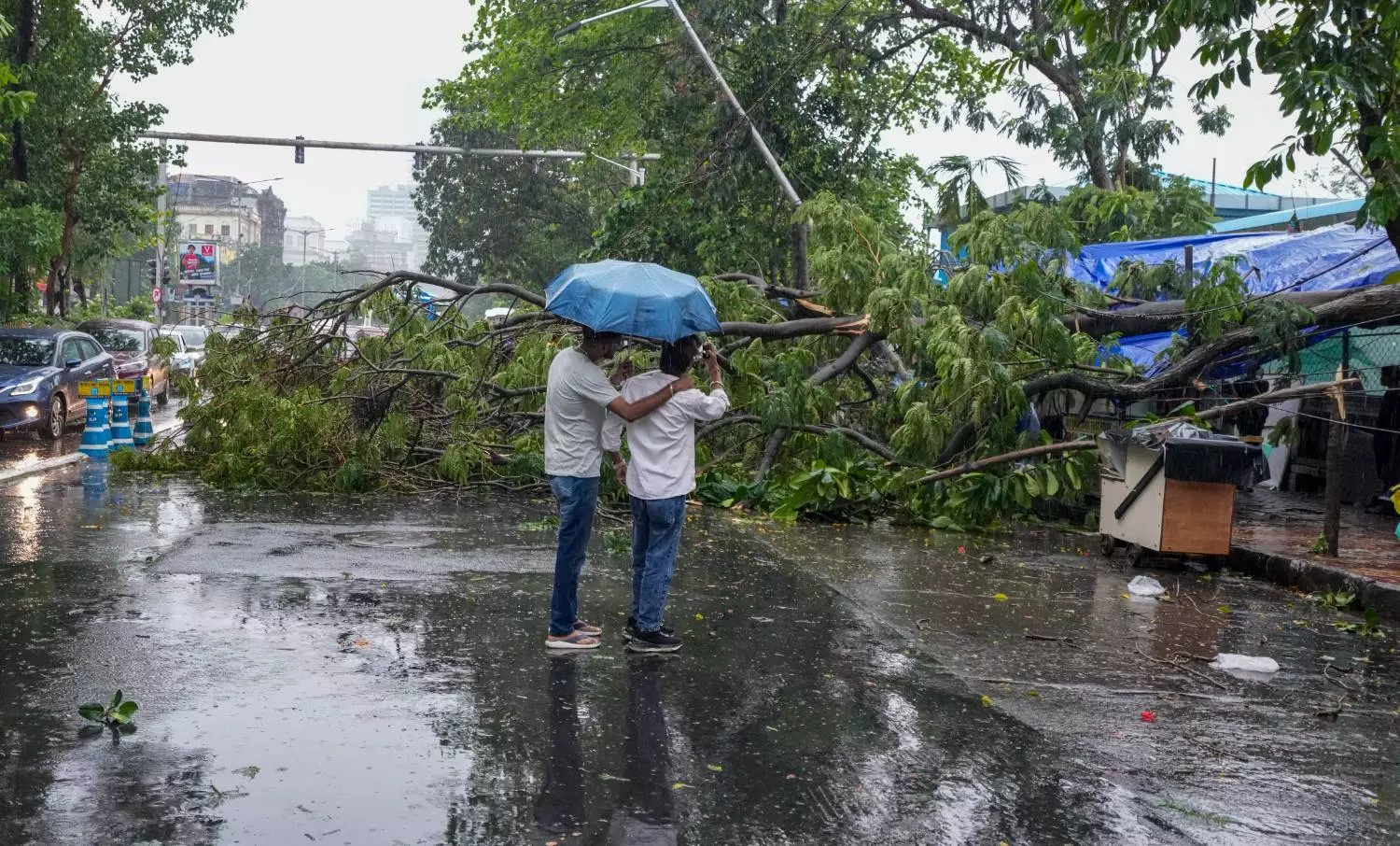
Men take photographs of an uprooted tree blocking a road during rain, in Kolkata, West Bengal, on May 29, 2026. Photo: PTI
Thunderstorms batter Kolkata, South Bengal with heavy rain and squalls
The violent pre-monsoon storm offers a sudden break from the scorching heatwave, but halts flights, disrupts metro lines, and uproots trees

A powerful spell of pre-monsoon thunderstorms accompanied by heavy rain and blistering winds swept across Kolkata and several districts of South Bengal on Friday (May 29) afternoon. While the downpour brought sudden, desperate relief from days of gruelling heatwave conditions, it rapidly evolved into a severe logistical challenge, leaving a trail of uprooted trees, stranded commuters, and waterlogged infrastructure in its wake.
Transit grounded
The sheer intensity of the squall immediately paralysed major transit arteries across the state capital. At the Kolkata airport, flight operations were entirely suspended for over an hour as heavy, relentless downpours left airstrips heavily waterlogged, delaying both arrivals and departures.
On the ground, suburban commuters faced massive delays after uprooted trees crashed onto overhead electrical wires and railway tracks along the Bangaon section of the Sealdah South section. Within the city itself, the storm caused significant infrastructural damage to the public transit system. High-velocity winds tore away a portion of the overhead shades at the Shahid Khudiram Metro station in South Kolkata. Rainwater quickly gushed onto the platforms, causing immediate disruptions to services along the busy Blue Line.
Heavy urban toll
The storm struck with such sudden violence that visibility across the metropolis dropped to near-zero during the mid-afternoon hours, forcing motorists to navigate roads with their headlights on. Winds reaching speeds of 50 to 60 kilometres per hour tore down commercial hoardings and snapped massive tree branches across Kolkata and adjacent Salt Lake.
In multiple neighbourhoods, parked cars were crushed under the weight of collapsing trunks, causing heavy traffic gridlocks. Local emergency services responded quickly, deploying personnel from the Kolkata Municipal Corporation and state disaster management groups with tree cutters and bulldozers to clear the choked thoroughfares. While no fatalities were reported, the severe weather left a two-wheeler rider in Salt Lake hospitalised after being struck by a lightning bolt.
The Science
According to meteorologists at the Alipore-based Regional Meteorological Centre, this dramatic weather shift was triggered by a complex atmospheric alignment. A cyclonic circulation tracking from central Pakistan over to Odisha, coupled with twin trough lines, created a massive influx of moisture directly from the Bay of Bengal.
This unstable combination caused rapid thundercloud formation over West Bengal, culminating in widespread storm activity. In some pockets, it was particularly concentrated; Salt Lake alone recorded a staggering 44.7 millimetres of rainfall in a short span, providing a stark mathematical picture of the storm's localised power.
Agriculture threatened
While urban centres grappled with traffic issues, the state administration (Nabanna) turned its focus toward rural vulnerabilities, issuing an orange alert for heavy rainfall over the next 48 hours. According to a United News of India report, the alert specifically highlights high risks for East Burdwan, widely recognised as the rice bowl of the state.
With the crucial farming season underway, the sudden threat of deep waterlogging in low-lying fields and open agricultural zones has sparked severe anxiety among local farmers over widespread crop damage. Despite these deep economic concerns, the weather office noted that the regional system will offer a temporary break from the elements, as daytime temperatures across South Bengal are expected to slide down by two to four degrees Celsius over the coming days.
With more intermittent showers forecast to continue into early June, authorities have urged citizens to stay indoors during active lightning storms and strictly warned fishermen against venturing out into the volatile coastal waters.