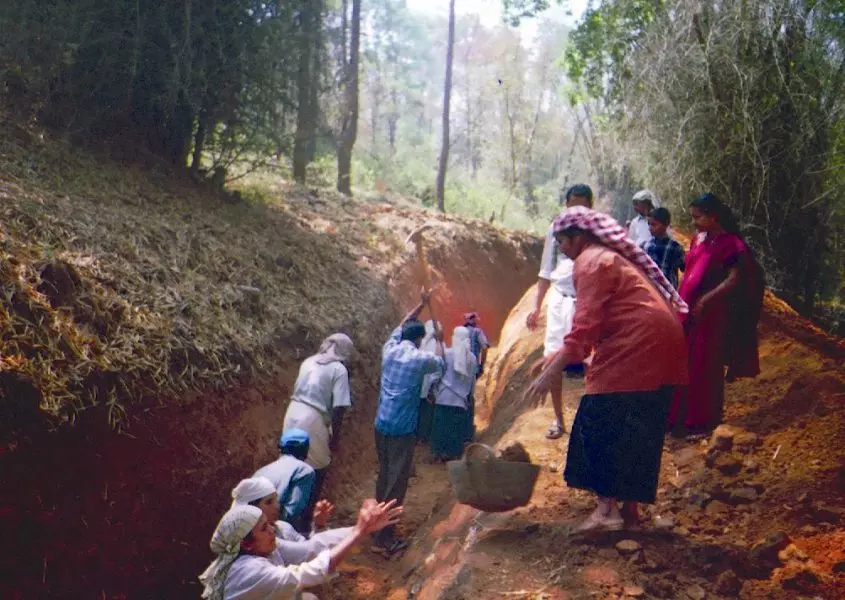
With the scheme dormant since 2022, an estimated 70 lakh MGNREGA workers in Bengal have had no access to guaranteed employment or wage payments for nearly four years, deepening distress and fuelling migration. File photo
Centre defies SC orders; MGNREGS remains frozen in Bengal, hitting 70 lakh workers
Accusing Centre of using 'delaying tactics', TMC accuses Centre of “weaponising welfare” as other states with higher irregularities face no freeze

Four years after the Centre abruptly froze MGNREGA in West Bengal, the scheme remains stalled despite clear directives from both the Calcutta High Court and the Supreme Court to resume the 100-day rural employment programme.
Despite clear court orders to resume the 100‑day rural jobs scheme, the prolonged freeze has sparked questions in political circles ver whether West Bengal is being deliberately singled out for political reasons.
In June 2025, a division bench of the Calcutta high court directed the Union government to restart MGNREGA work in Bengal from August 1, emphasising that workers could not be indefinitely deprived of their statutory rights. When the Centre challenged that order, the Supreme Court dismissed its appeal in late October, making the high court’s directive final and binding.
Yet months later, the scheme remains stalled on the ground.
'Delaying tactics'
Instead of releasing funds or authorising new work, the ministry of rural development recently asked the Bengal government to submit another “Action Taken Report” (ATR), claiming deficiencies in previous submissions, according to sources in the state’s panchayats and rural development (P&RD) department.
They pointed out that the freeze continues even though senior officials of the Panchayati Raj Ministry, during a Public Accounts Committee meeting in Parliament on November 13, assured that the scheme would soon be resumed in Bengal, albeit without providing any timeframe.
Also read: Upset over MGNREGS workers’ plight in Bengal, Rahul urges PM to release funds
State officials claimed that more than two dozen ATRs have already been submitted, and that the fresh demand is merely a delaying tactic to stall compliance with the court’s order.
Pradip Majumdar, minister-in-charge of the department of West Bengal Panchayat &Rural Development, told The Federal, “Demanding yet another ATR is nothing more than a deliberate tactic to delay the resumption of the 100 days’ work programme and to stall compliance with the court’s order. It is simply a new way to deprive Bengal under the guise of fresh, baseless claims."
Labour groups such as Paschim Banga Khet Mazdoor Samity (PBKMS) have echoed this view, calling the Centre’s position “administrative non-cooperation” despite judicial clarity.
The PBKMS stated that it will move a contempt petition if the Centre fails to promptly restart the scheme in compliance with the court’s directive.
Process to restart scheme
The process of restarting the scheme hinges on the crucial first step of securing approval of the state’s labour budget by the ministry.
The state government has already approached the ministry for the required clearance, but to no avail, as they are still awaiting the ministry’s response, a senior official told The Federal.
The labour budget is a yearly projection that estimates the demand for unskilled work and identifies the projects to be executed under the scheme. The budget is then examined and approved by an empowered committee headed by the Union rural development secretary.
Also read: Centre blocks Rs 6,366 crore in MGNREGS funds, West Bengal worst hit
Once the labour budget receives approval, states become eligible to generate fund requests through NREGASoft, the scheme’s Management Information System (MIS). The ministry then disburses funds in accordance with the sanctioned labour budget.
“Securing approval for the labour budget is a crucial prerequisite for restarting MGNREGS activities in the state,” the official stated.
The state government has also begun completing other formalities to restart the scheme, instructing districts to verify job cards and update e-KYC data. However, without the release of funds and official approval from the Union government, these administrative preparations will not serve any purpose, according to officials.
Centre halts MGNREGS
The Centre halted MGNREGS funding to West Bengal in March 2022, citing “non-compliance with central directives” under Section 27 of the MGNREGA Act, 2005.
In a reply to a question in Rajya Sabha on August 1 this year, the Centre acknowledged that it “owes West Bengal over Rs 3,000 crore” under MGNREGA, covering wages, material, and administrative costs.
Also read: TMC govt’s failure to meet CSS norms gives Centre upper hand in Bengal fund standoff
Before the Centre suspended MGNREGA funding in 2022, West Bengal was among the top-performing states, with 51 to 80 lakh families benefiting from the scheme annually between 2014–15 and 2021–22.
'Weaponising' welfare schemes
What has sharpened the controversy is the data emerging from other states. According to the latest central government figures for 2024–25, West Bengal identified only two fake job cards statewide. In contrast, BJP-ruled Uttar Pradesh reported over 4.5 lakh fake or ineligible job cards deleted over the past two years.
Also read: Ground report | Rampant corruption choking MGNREGA in Madhya Pradesh
Other BJP-governed states, including Madhya Pradesh, have also recorded high volumes of deletions and procedural irregularities. Yet none of these states have faced a freeze in central funds or a complete suspension of the scheme.
This uneven treatment has fuelled allegations from the Trinamool Congress that the Centre has “weaponised” a welfare programme to politically target an Opposition-ruled state.
The party national general secretary Abhishek Banerjee argued that if irregularities were the basis for withholding funds, states with substantially higher numbers should have faced greater scrutiny. In his view, Bengal, which ranks among the lowest in “fake job card” detection does not qualify for this kind of treatment.
TMC spokesperson Kunal Ghosh, citing another set of data presented in Parliament, highlighted that 11,07,814 fake MGNREGA job cards were deleted across India between 2022 and 2025. “BJP-governed Uttar Pradesh alone accounted for 4,50,172 deletions, or 40.6 per cent of the total. Other top states included Odisha, Bihar, Rajasthan, and Madhya Pradesh, all double-engine states. West Bengal, by contrast, saw just 5,984 deletions, a mere 0.5 per cent,” he pointed out.
“Yet, it is Bengal, whose MGNREGA funds were cruelly blocked based on allegedly bogus claims of irregularities,” Ghosh added.
Human costs
Meanwhile, the human cost of the impasse continues to mount. With the scheme dormant since 2022, an estimated 70 lakh MGNREGA workers in Bengal have had no access to guaranteed employment or wage payments for nearly four years.
“For many rural families, this has meant the loss of their primary fallback source of income during lean agricultural periods, deepening distress and fuelling migration,” said Khokon Mardi, a prominent indigenous rights and environmental activist from the state.