



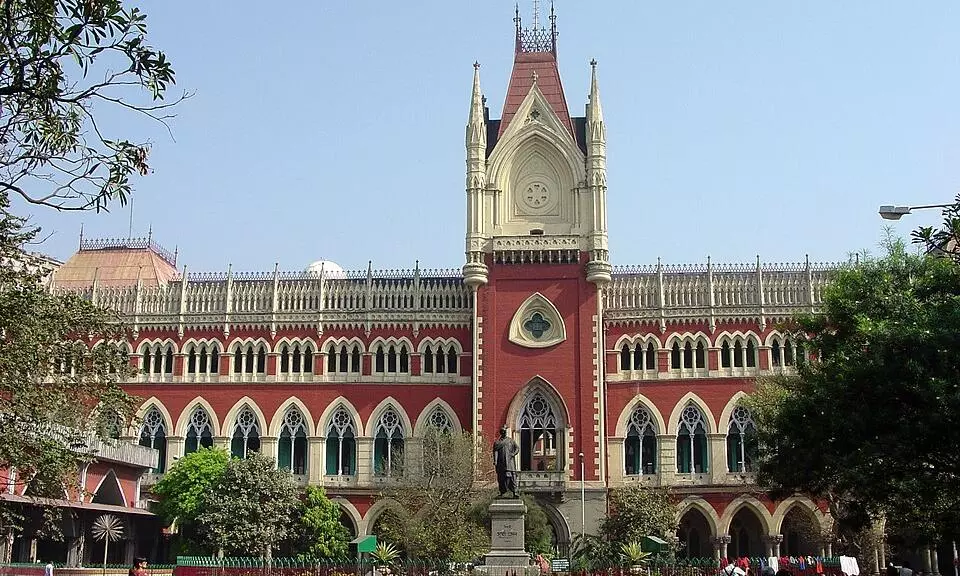
Calcutta HC questions EC over reassignment of ISF’s envelope symbol, flags ‘connivance’
Court asks whether there was collusion between the poll panel and Democratic Trinamool Congress as ISF challenges loss of its ‘envelope’ symbol ahead of Nandigram bypoll

Kolkata, Sep 28 (PTI) The Calcutta High Court on Monday observed that the authorities should be "fair" before the court while hearing the ISF’s challenge to the EC's reassignment of the ‘envelope’ symbol to another party, and questioned whether there was any "connivance" between the poll body and the newly formed outfit.
During a prolonged hearing over the reassignment of the symbol to the Democratic Trinamool Congress (DTC), Justice Krishna Rao asked why the Election Commission (EC) did not consider the ISF’s application for the 'envelope' symbol, which was before it on September 17.
The EC counsel submitted that allotment of symbols was within the commission’s discretion and that it had acted according to law in allotting the 'envelope' symbol to the DTC and the ‘almirah’ symbol to the ISF.
Petitioner’s counsel Bikash Ranjan Bhattacharya argued that discretion must be exercised reasonably and rationally and "cannot be absolute like an autocrat".
"It’s appearing on the conscience also of this court what is the connivance," Justice Rao said.
Justice Rao said the conduct of advocates appearing for the parties appeared to reveal "what the connivance is" between them.
"If the EC has been guided by the private respondent, what remains further?" the court asked.
"The authorities should be fair before the court," Justice Rao observed.
The EC counsel said he was not being prompted by the DTC’s counsel, to which Justice Rao said he would state what he had observed in court.
Justice Rao told the EC counsel that since he was appearing for a constitutional body, he should be ready with answers to all questions posed by the court and could not take anyone else’s assistance.
The EC counsel said the private respondent’s lawyer had not told him anything.
He also said it was "not a correct observation" by the court that he was being dictated by a political party and that there was no reason for such an allegation.
During the arguments, Justice Rao said the ISF might not have a right to the 'envelope' symbol and its application could be rejected, "but that rejection should be reasoned".
Counsel for the DTC submitted that both factions of the TMC -- the Mamata Trinamool Congress and the Democratic Trinamool Congress -- had been recognised as parties by the poll panel.
He argued that the ISF did not have any inviolable right to a particular symbol.
Bhattacharya said the bypoll was a continuation of the 2026 election and questioned how the 'envelope' symbol could be taken away from the ISF during the by-election.
He claimed that the EC’s decision to reassign the 'envelope' symbol to another party was illegal and that the power had been exercised arbitrarily.
Justice Rao asked how far the court could interfere when the election process was already underway, with nomination, scrutiny and withdrawal of candidature for the October 6 bypolls completed.
Bhattacharya submitted that the Supreme Court had clarified in a judgment that the court had the authority to facilitate the proper conduct of elections.
He sought deferment of the bypoll in the interest of justice, saying it would not affect the constitution of the Assembly or create any constitutional crisis.
The EC counsel, however, claimed that the ISF was already campaigning for the Nandigram bypoll with the newly allotted ‘almirah’ symbol and said the petitioner’s intention was to stall the election.
Bypolls to the Nandigram and Rejinagar Assembly constituencies in West Bengal are scheduled to be held on October 6, with counting on October 9.
The ISF, which is contesting from Nandigram, moved the High Court claiming that the 'envelope' symbol, with which it contested the 2024 Lok Sabha and 2026 Assembly elections, was reassigned to the DTC despite its application for allotment.
The court asked the EC counsel what provision the authorities had considered while allotting the symbol to the DTC.
The EC counsel said there were specific provisions under the Symbols Order and The Conduct of Election Rules for allotment of free symbols in bypolls.
He said the allotment of the 'envelope' symbol to the ISF ended with the conclusion of the West Bengal Assembly elections and declaration of results on May 4.
He further said filing a nomination did not confer any right on the petitioner, which had claimed that it filed its papers with the 'envelope' symbol before the EC’s September 18 order allotting the symbol to the DTC.
Justice Rao asked whether the EC could allot any symbol to anyone citing exigencies of time and whether the petitioner would not be allotted the same symbol after it had already been given to the DTC.
EC lawyer Jishnu Chowdhury said the commission had, on September 17, closed the reserved ‘flower and grass’ symbol of the Trinamool Congress following an internal party split.
Since nominations for the bypolls to the two seats had ended on September 16, candidates from both factions would have faced rejection of their nominations, he said.
He said that following requests from the two factions, the EC exercised its powers under the rules to allot free symbols on September 18.
He argued that no party could claim an absolute right over a free symbol.
"The authority should act (in a manner) to avoid future complications, so that the court should not be burdened with all these litigations," Justice Rao observed orally.
Chowdhury said there was no impediment to allotting a symbol to a party in a bypoll and maintained that the decision was correct.
He said dissolution of a House results in a general election, while a vacancy in a seat leads to a bypoll, and the two are different under the Representation of the People Act.
Chowdhury said after the conclusion of a general election, symbols allotted to unrecognised parties become free and can be allotted to anyone.
The hearing in the matter was concluded, and the court reserved its order. PTI