



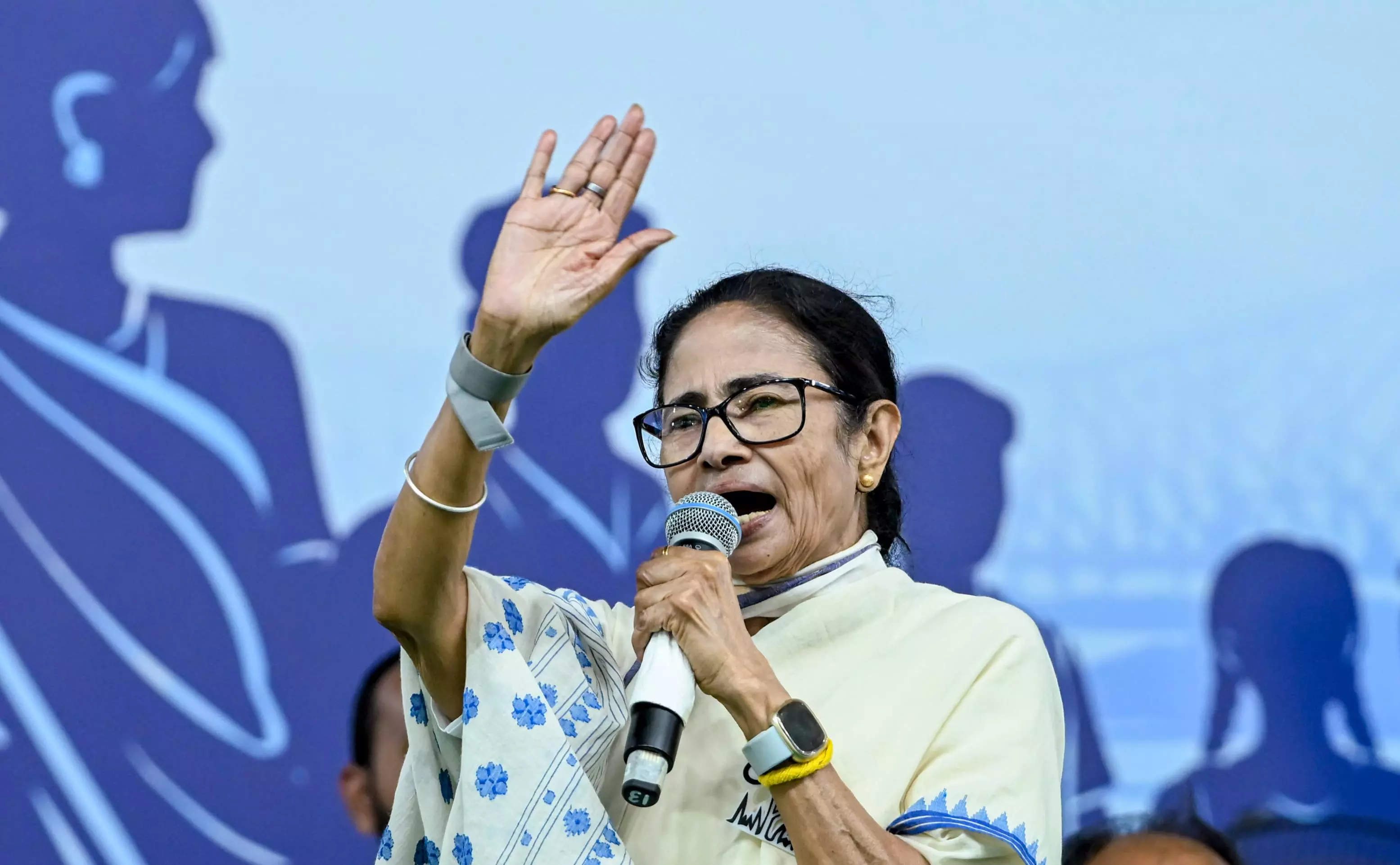
West Bengal CM Mamata Banerjee addresses a rally amid a political clash over the voter list revision. Photo: PTI
Bengal SIR row erupts: Mamata, BJP clash over 91 lakh deleted names
EC’s voter roll revision ignites a fierce political battle, with Mamata alleging targeting of minorities and BJP framing it as a purge of illegal voters ahead of 2026 polls

Kolkata, Apr 7 (PTI) The EC’s disclosure on Tuesday that around 91 lakh names had been deleted from West Bengal’s electoral rolls after the Special Intensive Revision triggered a political slugfest, with Chief Minister Mamata Banerjee accusing the BJP of targeting Matuas and minorities, and opposition leader Suvendu Adhikari claiming the exercise had merely exposed “Muslim infiltrators” protected by the ruling TMC.
The EC figures, which pushed the total deletion to over 90.83 lakh names from an original voter base of 7.66 crore, injected a new edge into an already polarised campaign, turning the SIR from a bureaucratic exercise into the defining political faultline of the 2026 assembly polls.
Addressing a rally in Chakdaha in Nadia district -- a Matua heartland where the voter list revisions have caused unease -- Banerjee alleged that the deletions were neither random nor administrative, but a deliberate attempt to target social groups seen as politically inconvenient to the BJP.
"Why this discrimination? You are excluding Matuas, Rajbanshis and minorities. Do you think people do not understand this?" Banerjee said, accusing the Centre of using the SIR to redraw Bengal's political map before the elections to be held on April 23 and 29.
Standing before a crowd in Chakdaha, with Matua-dominated localities and refugee colonies spread across Nadia and adjoining North 24 Parganas forming the backdrop, the chief minister sought to turn anxiety into resistance.
"This election is a fight to save your democracy, language and respect so that no one can ever call you a foreigner," she said.
Banerjee claimed that names in Muslim-majority districts such as Murshidabad, Malda and North Dinajpur were being "picked and removed like lice", while also alleging that large numbers of names had vanished in the Bhabanipur seat in Kolkata, from where she is contesting.
"In Bhabanipur alone, 40,000 names have been struck off," she claimed.
The TMC supremo said the party would provide legal help to those whose names were still missing, and asserted that after her intervention in the Supreme Court nearly 32 lakh names out of around 60 lakh cases placed under adjudication had been restored.
Banerjee also sought to broaden the issue beyond communities traditionally seen as the TMC's support base. She claimed that names of around 300 members of the Missionaries of Charity had disappeared from the rolls, along with those of monks associated with the Ramakrishna Mission and Bharat Sevashram Sangha.
The chief minister repeatedly returned to the Matua question, aware that the community, spread across Nadia and North 24 Parganas, could prove decisive in dozens of constituencies.
Trying to blunt the BJP's efforts to consolidate the Matua vote through the citizenship plank, Banerjee accused the saffron camp of engineering deletions precisely in those districts where the community has a sizeable presence.
Her charge found some resonance in the EC's district-wise figures. In percentage terms, Nadia -- which has a substantial Matua population -- recorded the maximum deletions, with 77.86 per cent of the adjudication cases ending in removal. North 24 Parganas, another Matua-heavy district, saw 55.08 per cent of such cases deleted.
Yet the BJP dismissed Banerjee's charges as an attempt to shield illegal immigrants.
Adhikari said the TMC was worried because the SIR had begun to expose what he described as its "infiltrator vote bank".
"Those who are genuine voters can later submit Form 6 and apply. But why should Bangladeshi Muslims who are infiltrators remain on the electoral rolls?" Adhikari said.
"The Hindu refugees have nothing to worry. The SIR was meant to clean the electoral rolls. TMC is worried because its infiltrator vote bank is under threat," he added.
The BJP leader's remarks reflected the party's larger attempt to frame the election not as a contest over deleted names, but as a battle over identity, citizenship and illegal immigration.
If Banerjee is trying to turn the SIR into a narrative of exclusion and discrimination, the BJP is equally determined to project it as an overdue cleansing exercise.
The significance lies in where the deletions occurred.
The highest number of names placed under adjudication had earlier come from minority-dominated Murshidabad, followed by Malda, South 24 Parganas and North 24 Parganas. After judicial scrutiny, more than 27 lakh of the 60 lakh adjudication cases were deleted.
But while the minority-dominated districts accounted for large numbers in absolute terms, the steepest percentage deletions came from Nadia, Hooghly and North 24 Parganas -- districts where Matua and refugee politics intersect sharply with the BJP-TMC battle.
With the final voter base now reduced to around 6.77 crore, the SIR has redrawn Bengal's electoral arithmetic. More importantly, it has given both Mamata Banerjee and the BJP a new political weapon -- one side invoking the fear of being branded a foreigner, the other invoking the fear of infiltration.
As the campaign enters its decisive phase, the battle over Bengal's missing names may now become as politically explosive as the battle for votes. PTI