Bengal SIR crisis deepens as BLOs quit, voters resort to violence
Around 30 officials resign in Farakka citing workload and public hostility, while 14 lakh voters face hearings due to software flaws in the SIR process

The Special Intensive Revision (SIR) of electoral rolls is facing a deepening crisis in West Bengal, as political disputes over the exercise are compounded by local resistance.
While the ruling Trinamool Congress (TMC) and the opposition Bharatiya Janata Party (BJP) are engaged in a war of words over the intent and impact of the exercise, the process is now escalating into administrative disruption and public unrest, which could affect its scheduled completion.
BLOs’ protest
Around 30 booth level officers (BLOs) in Murshidabad’s Farakka block withdrew from SIR duties on Wednesday (January 14), citing workload pressure, procedural confusion, and rising hostility from voters.
Their exit highlights the operational strain during a politically sensitive exercise that relies heavily on field-level staff.
At a sit-in protest outside the Farakka Block Development Office, a group of BLOs submitted resignation letters en masse to the electoral registration officer.
Disgruntled BLOs alleged that frequent changes in instructions from the Election Commission of India (EC) had made their job “unmanageable” and feared they could be blamed for errors.
“We already became unpopular with locals after issuing repeated hearing notices. Voters are being harassed, and we are overloaded and unable to continue anymore,” BLO Syd Taj Islam told reporters, capturing the frustration among rank-and-file officials.
Another BLO echoed similar concerns, saying, “As primary teachers, we are not very tech savvy. At first, the EC instructed that no documents were required to be collected. Now, we have to verify originals and submit them. After school duties, it is impossible to continue such a hectic job.”
Agitated voters
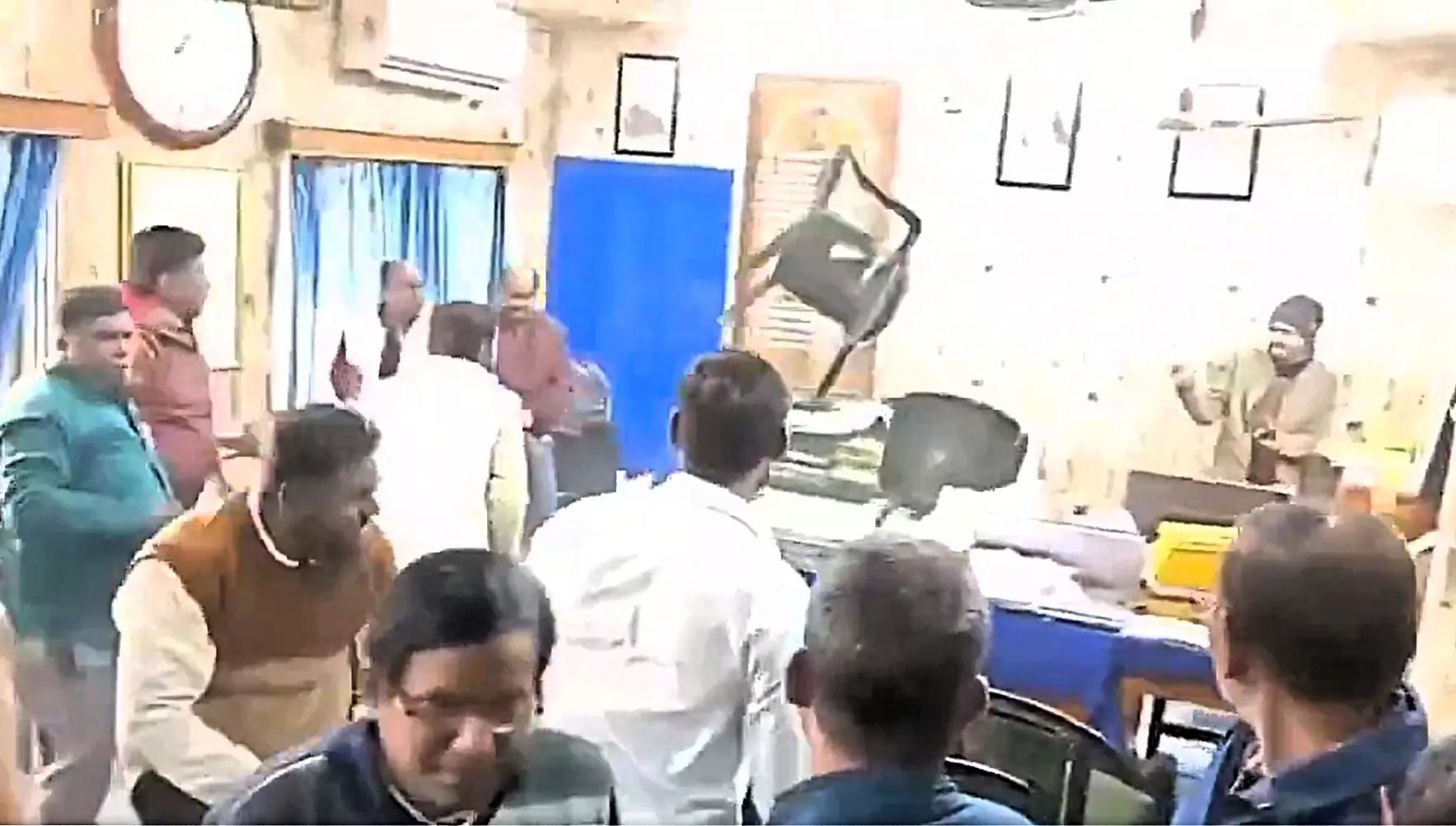
The situation escalated later in the day when agitated voters entered the hearing camp at the BDO office and ransacked it, forcing suspension of the process for over two hours.
Police brought the situation under control and registered an FIR against unknown persons, even as TMC MLA Manirul Islam, present at the site, denied his party’s involvement and described the agitation as a “spontaneous agitation” by distressed residents.
Islam further alleged that notices were being selectively issued to target minority voters. He was referring to growing allegations of disproportionate scrutiny in minority-dominated areas.
There are allegations that the SIR’s software-driven “discrepancy” detection system has flagged voters in Muslim-majority polling stations at a much higher rate, often marking legitimate voters as “suspicious” despite such people submitting valid documents.
Software flaws
At least 14 lakh voters are reportedly being forced to attend hearings unnecessarily, while the software failed to recognise proper submissions, sources said.
Voters in border districts such as Murshidabad, North and South 24-Parganas, and Nadia have been particularly affected, according to accounts of several BLOs.
They noted that even after uploading verified documents, the system continues to generate hearing notices, creating confusion and distress among residents.
These developments have intensified concerns that the process could inadvertently disenfranchise large numbers of minority and border-area voters.
Security boosted
BJP MLA Gauri Shankar Ghosh, meanwhile, condemned the ransacking of the BDO office, claiming it was a staged drama to deflect attention from the SIR’s implementation issues.
Police later stated that two persons were arrested in connection with the Farakka incident, as an FIR was registered under various sections of the Bharatiya Nyaya Sanhita and the Prevention of Damage to Public Property Act after the BDO office was vandalised during the hearing.
Authorities said they have stepped up security for officials involved in the revision exercise amid rising tensions.
Pattern of dissent
The unrest in Farakka is not an isolated incident and is part of a broader pattern of dissent.
Similar violence continued to be witnessed in other parts of the state. Unrest spread on Thursday (January 15) to Chakulia in North Dinajpur, where residents, angered by repeated SIR hearing notices, blocked a state highway and staged demonstrations outside the block development office.
The agitation escalated as protesters vandalized government property, forcing police to resort to a baton charge to restore order.
Eyewitnesses said many locals demanded the withdrawal of these notices, describing the process as causing undue hardship and confusion, particularly for those who had already submitted valid documents.
Reports also indicated that nearby areas, including Beharia and Shirsi Bhuidhar, saw similar protests, highlighting the growing public discontent over the SIR exercise.
Elderly, migrants feel harassed
Earlier on Monday, residents of Ganguly Danga village in East Burdwan district blocked the Katwa-Burdwan state road for more than three hours after nearly half the villagers were summoned for SIR hearings due to alleged “logical discrepancies” in the rolls.
Around 1,100 villagers, many of them women and elderly, demanded that hearings be conducted in their local polling booths instead of requiring them to travel long distances to block development offices.
One protester said migrant workers and the elderly were “being harassed” by the notice system, an assertion that resonates with wider public unease over the process.
In Kolkata, civil society voices have also entered the fray.
A coalition of artists and activists, including actor Parambrata Chattopadhyay and director Indraadip Dasgupta, protested at the Chief Electoral Officer’s office, warning that the rushed SIR timeline was causing “widespread confusion and chaos” and could lead to disenfranchisement of vulnerable groups.
BJP’s unease
The Farakka resignations and village protests have also exposed unease within the BJP, which initially supported an intensive revision of electoral rolls to address alleged irregularities.
State BJP president Samik Bhattacharyya has sharply criticised aspects of the process, warning that his party would not allow the 2026 assembly elections in the state to take place if objections related to the draft voter list were ignored.
He further reiterated his demand that the chief election commissioner visit the state and ensure that the process is carried out transparently.
“If the SIR process ends in West Bengal in this manner, we will not allow elections to take place here,” Bhattacharyya told the media, stressing the need for fair conduct and acceptance of objections submitted through Form 7.
Senior BJP leader Dilip Ghosh, previously supportive of the revision, argued that the SIR deadline should be extended.
TMC’s attack on EC
The TMC has been scathing in its criticism of the SIR.
Chief Minister Mamata Banerjee has accused the poll panel of causing unnecessary distress, stating that the exercise has resulted in deaths and hospitalisations, branding the process “inhumane”. In public rallies, party leaders have broadened the attack.
TMC national general secretary Abhishek Banerjee paraded a group of people who were allegedly declared dead in the draft electoral roll as a result of the SIR, accusing the EC of taking away voting rights of citizens.
“All of them were born and brought up here, but they were declared dead by the BJP’s stooge Election Commission,” he said.
The EC has defended its actions, describing accusations of bias as “baseless, unfounded and politically motivated”, and reiterated that the SIR is a constitutionally mandated exercise to ensure accurate voter lists.
It also instructed heightened security for electoral staff amid rising threats and protests.