



Bengal BJP chief rejects Bageshwar Baba’s call to shun non-veg during Durga Puja
Samik Bhattacharya says no outsider can dictate Bengal's food habits, invokes Swami Vivekananda and tradition of offering goat meat to Maa Kali

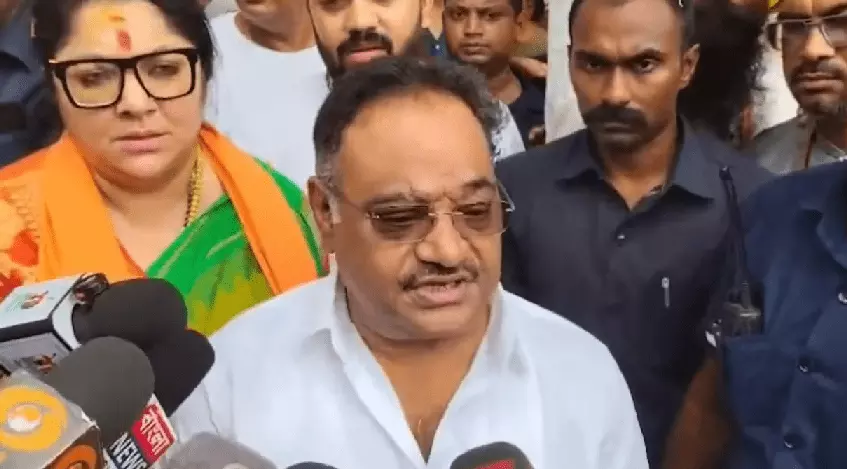
Kolkata, Sep 7 (PTI) West Bengal BJP president Samik Bhattacharya on Monday rejected self-styled godman Dhirendra Shastri's appeal to Bengalis to give up non-vegetarian food during Durga Puja festivities, asserting that no visiting religious figure can prescribe what people in the state should eat or wear.
Reacting to Shastri, popularly known as Bageshwar Baba, describing those who consume non-vegetarian food during the festive season as "pakhandis" (heretics) and urging them to give up the practice, Bhattacharya said Bengali food habits and traditions cannot be changed at the behest of an outsider.
"Let me live the way I want to. Bengalis will eat what they have been eating. Can Bengalis not eat fish and meat? Swami Vivekananda has said it. Who is above him?" Bhattacharya said.
"Here, goat meat is offered as an offering to Maa Kali," he added.
The BJP state president said eating 'luchi' (puris) on Ashtami and goat meat on Navami has been part of Bengal's long-standing cultural tradition and there is no question of asking people to abandon it.
"We generally eat 'luchi' on Ashtami and goat meat on Navami. We will continue to do that. Nobody can tell the people of West Bengal what they should eat," he said.
Shastri's remarks have triggered a debate in West Bengal, where food, religion and cultural practices have historically coexisted in ways that do not always conform to a strictly vegetarian religious framework.
The controversy comes days after Shastri, during his visit to West Bengal, made an appeal against consumption of non-vegetarian food during Durga Puja and termed those who eat such food during the festival as heretics.
Shastri's visit has itself acquired political overtones as the religious preacher was able to hold religious programmes across the state under the BJP government, despite allegedly facing difficulties in obtaining permission during the previous Trinamool Congress regime.
However, the BJP's state leadership has sought to distance itself from any prescription that could be perceived as an attempt to dictate Bengal's traditional food habits.
Bhattacharya said he respected Shastri as a religious figure but made it clear that his personal views could not be imposed on Bengali society.
"A saint or a doctor may have the right to advise people to become vegetarian. But nobody coming from outside can sit in Bengal and decide who will eat what and who will wear what," he said.
Bhattacharya stressed that Shastri's remarks were his personal views.
The BJP leader invoked Swami Vivekananda and Bengal's religious traditions to underline his argument, pointing to the practice of offering goat meat to Goddess Kali at several temples in the state.
His remarks are likely to resonate in a state where fish and meat form an integral part of the traditional Bengali diet and where Durga Puja itself has historically been marked by diverse customs across communities and regions.
Bhattacharya also weighed in on another controversy surrounding Durga Puja, this time over a West Bengal government advertisement that depicted Goddess Durga with 11 hands.
The BJP state chief advised against turning, what he described as, a "possible technical or printing error by the advertising agency" into a political controversy, saying the mistake should simply be corrected.
The remarks come at a time when the BJP, which has sought to expand its political footprint in West Bengal by combining its Hindutva plank with appeals to Bengali cultural identity, faces the delicate task of balancing the two narratives.
Bhattacharya's intervention seeks to draw a distinction between religious faith and, what he described as, Bengal's distinctive cultural practices, while also signalling that the party's state leadership does not endorse attempts to prescribe food habits to the state's population.
Shastri's comments, meanwhile, have opened up a familiar faultline in West Bengal's political discourse -- whether religious observances should determine personal food choices, and to what extent cultural practices should be subjected to prescriptions from religious figures.
The BJP state president's response has effectively put the party's West Bengal unit on record against any blanket diktat for vegetarianism during Durga Puja. PTI