'Babri-style mosque': Security up; all eyes on West Bengal's Murshidabad
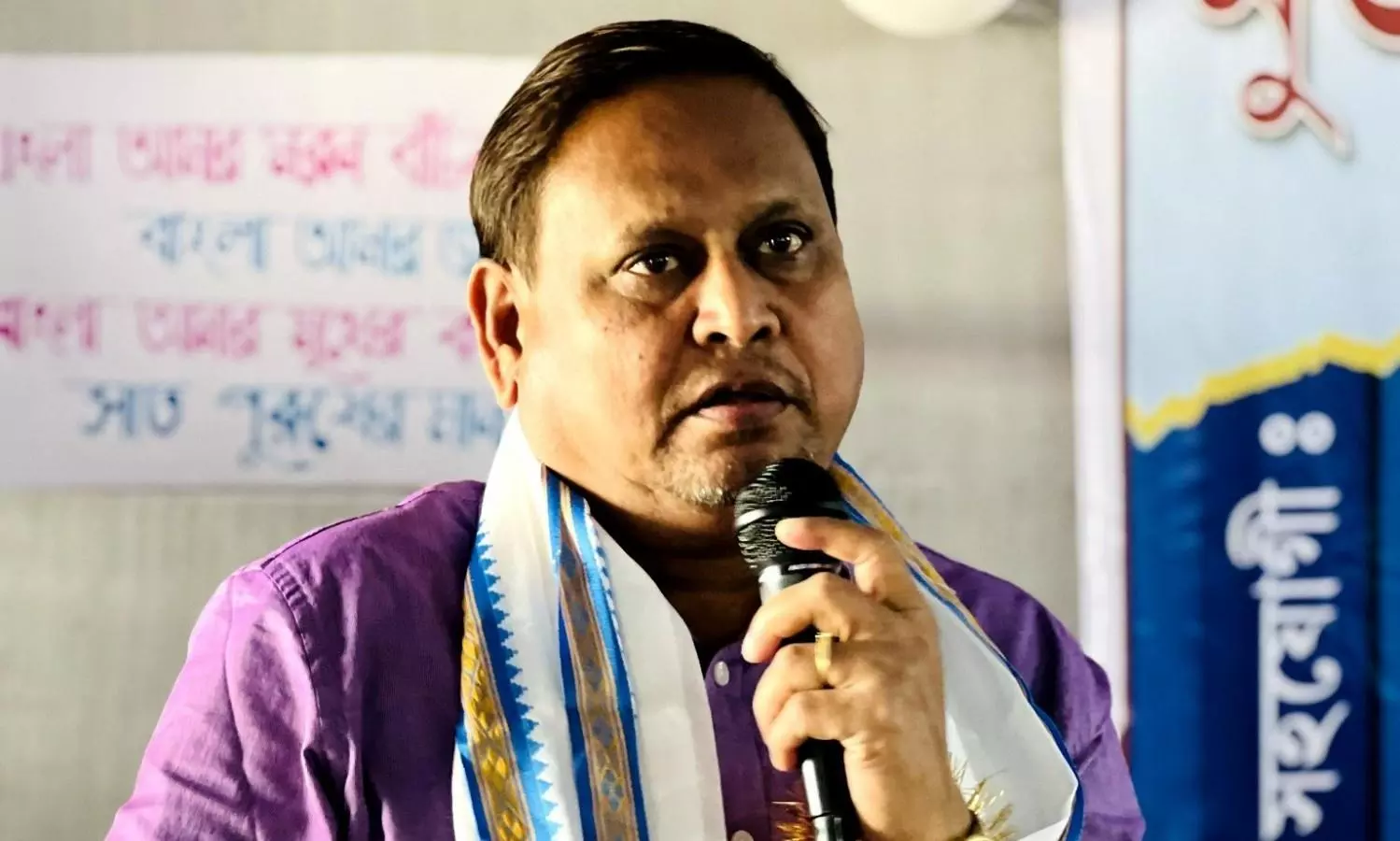
Suspended TMC MLA Humayun Kabir will lay the foundation stone for what he described as a “Babri Masjid-style” mosque in Beldanga on December 6

Thirty-three years after the demolition of the Babri Masjid on December 6, 1992, the spectre of that event has resurfaced to dominate politics in West Bengal as the state gears up for Assembly elections early next year.
The trigger was a decision by rebel and now-suspended Trinamool Congress (TMC) MLA Humayun Kabir to lay the foundation stone for what he described as a “Babri Masjid-style” mosque in Murshidabad district’s Beldanga on December 6, the move clearly aimed at using “Ayodhya memory” as a political lever.
Calcutta HC refuses to halt event
With the Calcutta high court on Friday (December 5) deciding not to intervene while hearing a case seeking to halt the event, all eyes are now on Saturday’s (December 6) foundation‑laying ceremony, which has already seized the political narrative.
Also read: Trinamool suspends MLA Humayun Kabir over plan to build Babri replica
A two‑member Division Bench of the court directed the state to ensure that law and order is maintained during the event and asked the Centre to assist in upholding security and peace.
After the court cleared the decks for the event, Kabir told The Federal that the programme would start at 12 noon on Saturday with a two-hour recitation from the Quran, the Islamic holy book. He added that 2,000 volunteers would be deployed to ensure there is no 'breakdown of law and order” and that cooperation has also been sought from the district administration.
The state government is taking both administrative and political measures to ensure that the contentious event passes off peacefully.
In addition to the adequate deployment of state police, 19 companies of central forces have also been mobilised in the area to maintain law and order and safeguard communal harmony, a senior district police officer said. Central forces have already started conducting route marches in sensitive areas, the official added.
Communally sensitive area
Senior TMC leaders, including elected representatives, are also working to mobilise public opinion against falling prey to any form of provocation.
Also read: Caught between BJP and minority anger, TMC risks backlash over Waqf data
The proposed construction predictably escalated into a statewide flashpoint due to the mosque’s name evoking Babri Masjid and its timing coinciding with the anniversary of the original mosque’s demolition, an event that irrevocably reshaped India’s political and communal landscape.
Another notable aspect of the development is the location of the upcoming mosque in Beldanga, one of the state’s most communally sensitive areas, which has witnessed communal flare-ups in the recent past.
It witnessed serious communal violence in November 2024, when an “objectionable” message appeared on a digital display board near a Kartik Puja pandal, sparking clashes between two groups.
That violence left several people injured, shops and homes damaged, and resulted in at least 17 arrests. The episode left the town tense and deeply divided.
“Anyone can build a mosque, and we have nothing against it. But one has to understand the hidden political agenda behind the mosque’s name, its location, and the date of the event,” TMC’s Beldanga MLA Hasanuzzaman Sk said over the phone.
TMC’s delicate balancing act
The planned mosque, with its deliberately chosen name, date, and location, now adds a volatile symbolism to an already charged political environment.
Also read: Congress hits back at Rajnath: ‘No evidence Nehru wanted Babri funds’
Failing to dissuade its Bharatpur MLA Kabir from changing his mind, the ruling TMC suspended him on Thursday, describing his actions as “provocative” and an “unnecessary attempt” to communalise politics at a sensitive moment.
The party’s public distancing from Kabir, an influential minority leader, reflects the political hornet’s nest his decision has stirred in state politics.
A senior TMC functionary, speaking on condition of anonymity, said the party had “no choice but to take swift action”, given the sensitivity of the matter. “The government cannot be seen as permitting anything that could disrupt harmony, especially with elections around the corner,” the leader said.
The TMC, which relies heavily on minority voters for its electoral success, finds itself navigating a delicate balancing act in managing the situation.
“Suspending one of its senior minority leaders so close to the election cycle is politically risky. Yet allowing him to remain in the party without action would expose both the TMC and its government to accusations of inflaming communal tensions and indulging in minority appeasement, a label the TMC is desperately trying to shed through a series of Hindu outreach initiatives, such as constructing temples, to counter the steady rise of the BJP in the state," said Debashis Chakrabarti, a political columnist and Commonwealth Fellow.
Governor Bose’s advice
The BJP state president Samik Bhattacharya was quick to seize the opportunity to raise its communal rhetoric, stating that the party would not allow the construction of any ‘Babri Masjid’.
As political pressure builds, the state administration comes under further scrutiny, with Governor CV Ananda Bose advising the state government to consider the 'preventive arrest' of Kabir.
As the countdown to December 6 begins amid political manoeuvring and administrative calculations, it remains to be seen how the event will play out, particularly on the political front.
Kabir to launch new party
Kabir said he would launch a new political party on December 22, asserting that the proposed mosque would represent “Muslim-community pride”. He also accused the TMC of betraying the community’s aspirations.
Kabir claimed that various political parties, including the CPI(M) and Asaduddin Owaisi’s All India Majlis-e-Ittehadul Muslimeen (AIMIM), have expressed their willingness to form an alliance with his new party, which he said would contest 135 of the state’s 294 Assembly seats.
Ahead of announcing the launch of his party, Kabir said he would resign from the Assembly to sever all ties with the TMC.
Meanwhile, the TMC has launched a damage-control exercise to discredit Kabir’s mosque overture, in a bid to ensure that his exit does not affect its minority vote base.
“No Namazi Muslim will support a politically motivated mosque construction aimed at dividing minority votes. People are already aware of his game plan, and we will continue to expose him,” Hasanuzzaman said. “It is the BJP that is behind the entire drama. We all know about Kabir’s proximity to BJP’s Suvendu Adhikari.”