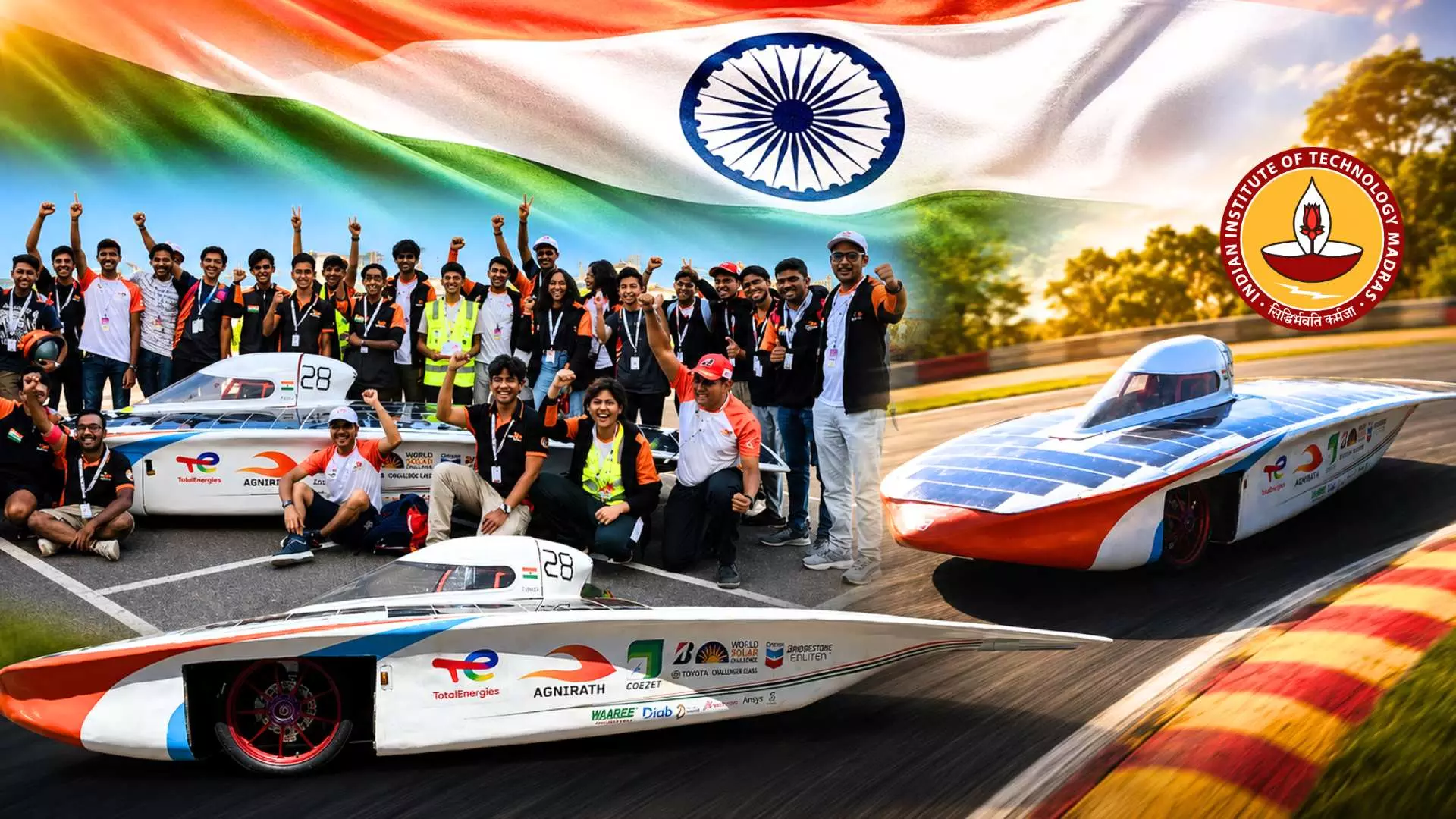
How IIT Madras students are driving India's solar mobility future
Team AgniRath's solar-powered race car heads to South Africa after making history in Australia. Can student innovation help drive India's clean mobility future?

Team AgniRath, a multidisciplinary group of more than 45 students from the Centre for Innovation at IIT Madras, is designing and building world-class solar-powered race cars entirely from scratch. What began as a project involving six students in 2021 has grown into one of India's most ambitious student-led engineering programmes.
Also read: India’s solar ambitions face headwinds as China, US shift policies
Their latest creation, Aagneya, is a lightweight solar race car weighing around 240 kilograms and equipped with a six-square-metre solar array. While the team's immediate goal is to compete internationally, the larger ambition is to push the boundaries of sustainable mobility technology.
Australia milestone
Last year, Aagneya competed in the Bridgestone World Solar Challenge in Australia, one of the world's toughest solar endurance races.
Team AgniRath became the first Indian team in more than 12 years to successfully qualify and race in the prestigious competition. During the event, Aagneya travelled more than 650 kilometres powered entirely by solar energy, setting the highest distance covered by an Indian team in the competition.
The experience also helped the team identify areas for improvement rather than simply celebrating participation.
"Competing in World Solar Challenge Australia helped us build a much better car for this year's Solar Challenge in South Africa." — Ritkriti Krishna, Team AgniRath member
Next challenge
The team's next destination is the Sasol Solar Challenge in South Africa this September.
Unlike Australia's long, relatively flat roads, the South African route features steep mountain climbs and sharp elevation changes. Success will depend not only on speed but also on how efficiently the car uses every unit of energy generated by the sun.
Also read: TN will create transparent, policy-driven environment for energy investors: Minister
"The biggest challenge over here is the terrain. It is not about building a fast car; it is about building one that is efficient, reliable and can handle demanding conditions." — Ritkriti Krishna, Team AgniRath member
For the engineering team, energy management and reliability are expected to be just as critical as vehicle performance.
Beyond racing
The larger question extends beyond motorsport. Can technologies developed in student competitions eventually find practical applications on public roads?
Shubashree Desikan, Associate Editor at IIT Madras' Shaastra magazine, believes these projects are much more than academic exercises.
"I certainly don't think they're just a platform for innovation. You need to develop solar-powered charging infrastructure for this technology to become practical."
Experts say Team AgniRath has already demonstrated that a solar-powered vehicle can successfully operate. The greater challenge now lies in making the technology commercially viable beyond the racetrack.
Infrastructure gap
Unlike conventional electric vehicles, solar-powered cars cannot rely entirely on solar panels mounted on the vehicle. The amount of sunlight available changes depending on weather conditions, time of day and location.
As a result, experts believe solar-powered mobility will require dedicated charging infrastructure, including parking and charging hubs fitted with rooftop solar panels, allowing vehicles to recharge using clean energy before continuing their journeys.
Also read: Andhra Pradesh leads solar manufacturing push, Jupiter plans Rs 2,700 cr facility
In other words, the challenge is no longer just about building a solar-powered car. It is about creating an ecosystem that supports solar mobility on a larger scale.
Future roadmap
Projects such as Team AgniRath demonstrate how engineering students are tackling some of the biggest challenges facing future transportation.
Their work explores questions such as how to build lighter vehicles, maximise every unit of solar energy and develop the infrastructure needed to support solar-powered mobility.
This September, Team AgniRath will test Aagneya once again across South Africa's demanding terrain. While the competition will evaluate the car's capabilities, the bigger challenge lies ahead. If solar-powered mobility is to become a practical reality in India, innovation alone will not be enough. The country will also need to build the infrastructure that makes it possible.(The content above has been transcribed from video using a fine-tuned AI model. To ensure accuracy, quality, and editorial integrity, we employ a Human-In-The-Loop (HITL) process. While AI assists in creating the initial draft, our experienced editorial team carefully reviews, edits, and refines the content before publication. At The Federal, we combine the efficiency of AI with the expertise of human editors to deliver reliable and insightful journalism.)