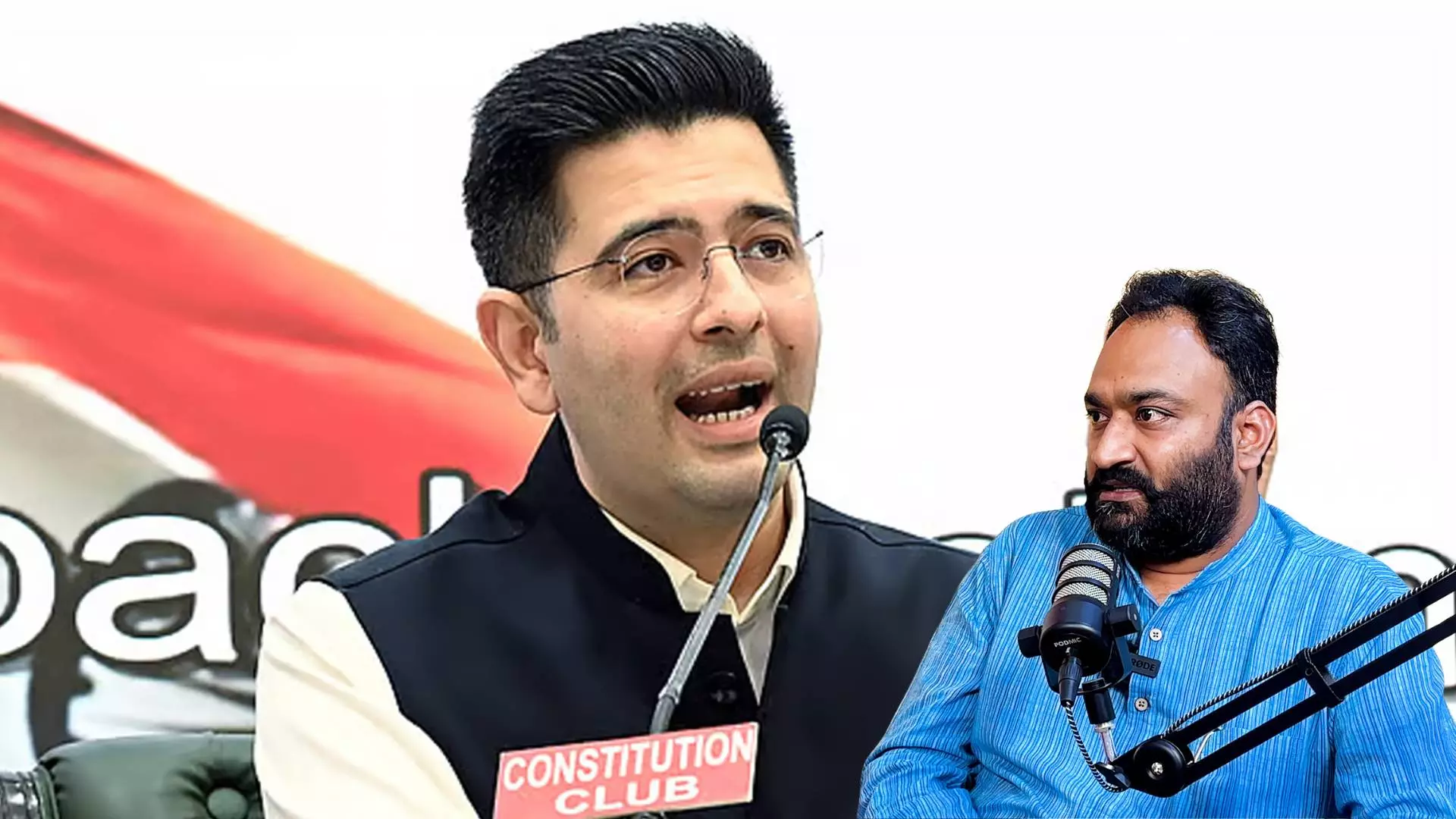
Why Chadha-led exodus presents an existential crisis for AAP and Kejriwal
Beyond numbers, the exit of 7 Rajya Sabha MPs is about perception, organisational stability, and leadership credibility at AAP, says Puneet Nicholas Yadav

A dramatic political churn is underway after a high-profile exit from the Aam Aadmi Party (AAP), with multiple Rajya Sabha MPs walking out in a coordinated move that could reshape politics in Punjab.
The scale and timing of the development have raised serious questions about AAP’s internal cohesion and its future electoral prospects. Puneet Nicholas Yadav, Political Editor of The Federal, unpacked the implications of this unfolding crisis.
How do you see the sudden exodus of Raghav Chadha and six other MPs from AAP?
I think while the trajectory of such a move was anticipated, the speed at which it has happened has surprised many. When Raghav Chadha was replaced by Ashok Mittal as deputy leader in the Rajya Sabha, there was already speculation that he might eventually move to the BJP. But what is striking is that others like Sandeep Pathak and Ashok Mittal, who were seen as key figures within AAP, have also joined this group.
For several months, there had been talk in Delhi’s political circles that a section of AAP MPs might defect. What likely delayed this was the requirement under the anti-defection law to reach the two-thirds mark. Now that seven out of ten MPs have moved, that threshold has clearly been met.
This is a major blow to AAP. It is not just about numbers, it is about perception, organisational stability, and leadership credibility. For Arvind Kejriwal, this is a deeply challenging moment.
How big a challenge does this pose for AAP going forward?
This is a huge challenge on multiple fronts. First, it comes at a time when AAP has already lost its core base, Delhi. The top leadership has lost elections, and now losing Rajya Sabha MPs further weakens the party’s structure and morale.
Second, Punjab elections are approaching in less than a year. Six of the seven MPs who have exited have strong Punjab links. That directly impacts AAP’s only remaining stronghold.
Third, funding becomes an issue. At least three of these MPs were major financial backers. Elections require resources, and now AAP will have to rebuild that network.
Finally, there is the perception battle. This creates a narrative that the party is imploding. The real concern is whether this will trigger more defections at the MLA or grassroots level.
Does the BJP stand to gain from these defections?
It depends on how you define 'gain'. Electorally, these leaders are not mass vote-pullers, so the immediate impact may be limited. However, perception-wise, it weakens AAP ahead of crucial elections. It also gives BJP more organisational resources and local influencers, especially in Punjab.
Figures like Raghav Chadha or Harbhajan Singh may not win elections on their own, but they do carry influence among certain voter groups. BJP could leverage that.
That said, Punjab has historically been a difficult state for BJP. Even at its peak nationally, it has not made deep inroads there. So electorally, this may not be a game-changer.
Will this shift the balance in the Rajya Sabha?
Yes, numerically it strengthens BJP further in the Rajya Sabha, making it easier to pass legislation. But beyond that, it does not drastically alter how the House functions since the ruling alliance already had a comfortable position.
Does this indicate a larger churn within AAP?
It certainly points in that direction. The use of the term merger by Raghav Chadha is interesting, but technically this is not a party split like we have seen with Shiv Sena or NCP.
This is a group of MPs moving together to avoid disqualification under the anti-defection law. Calling it a merger may be overstating it.
However, it does raise the question, will more leaders follow. AAP has many leaders without deep ideological grounding, and that makes the party vulnerable to such shifts.
Are we seeing a broader unravelling of AAP after its defeat in Delhi?
That is one way to look at it. The party has had a tough few years, legal troubles, leadership setbacks, electoral losses, and now this exodus.
But in politics, no party is ever fully written off. The real question is how AAP responds. Does it rebuild, reorganise, and redefine its politics. Kejriwal may need to rethink his strategy, his positioning, his engagement with opposition parties, and his overall political messaging.
One key factor is that AAP has now lost its earlier claim of being different from other parties. It used to criticise others for defections, but now it faces the same issue.
This could also push AAP closer to opposition alliances in the future. Whether that happens remains to be seen, but what is clear is that these are extremely challenging times for the party.
The content above has been transcribed from video using a fine-tuned AI model. To ensure accuracy, quality, and editorial integrity, we employ a Human-In-The-Loop (HITL) process. While AI assists in creating the initial draft, our experienced editorial team carefully reviews, edits, and refines the content before publication. At The Federal, we combine the efficiency of AI with the expertise of human editors to deliver reliable and insightful journalism.