Rahul impressive in Kota, but can he convert Gen Z cheers into votes? | Capital Beat
Panellists debate whether Rahul Gandhi’s Kota outreach to students can become a sustained movement and reshape youth politics ahead of 2029

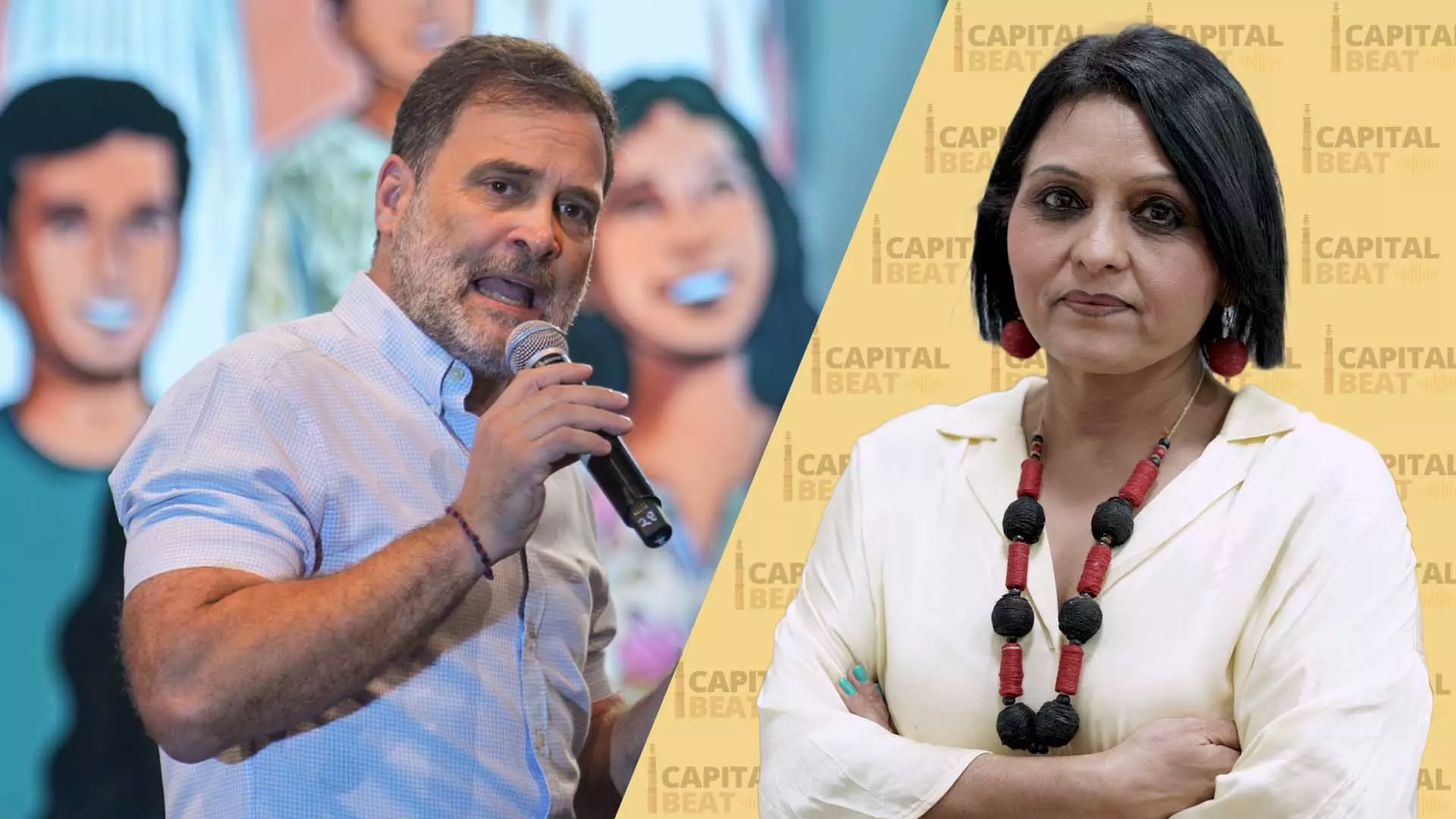
“Rahul Gandhi is pushing a lot of buttons. He is reaching out to students, OBCs, Dalits and emerging as the most consistent critic of the RSS and BJP,” senior journalist Javed Ansari said while assessing the significance of the Congress leader’s Kota rally on Wednesday (June 17).
The remarks came amid growing political discussion around Rahul’s student-focused convention in Rajasthan’s Kota, where he positioned himself as a defender of students affected by paper leaks, examination controversies and broader concerns within India’s education system.
In this episode of Capital Beat, The Federal spoke to Ansari and another senior journalist TK Rajalakshmi about whether Rahul’s outreach to students can evolve into a sustained political movement, whether the Congress can convert youth support into electoral gains, and how education has emerged as a central political issue.
A new outreach
The discussion began with an assessment of the Kota event, which featured a large-scale production rarely seen at Congress rallies.
Ansari said the rally’s presentation reflected a conscious effort to communicate with younger voters in a language and format they understand. According to him, the event’s optics, stagecraft and messaging suggested that significant planning had gone into its execution.
Also read: Rahul at Kota rally: 'India's education system is an extortion machine'
“What I saw yesterday was very impressive. I was impressed. The optics were very good. Rahul’s content was good,” Ansari said.
He argued that the Congress leadership appeared to recognise the importance of connecting with Gen Z through imagery, design and communication styles familiar to younger audiences.
At the same time, he cautioned against drawing sweeping conclusions from a single event.
“One sunny day doesn’t make a summer,” he remarked, stressing that the real challenge would be sustaining the momentum.
Sustaining momentum
Ansari noted that Rahul Gandhi has often initiated campaigns that struggle to maintain continuity because of organisational weaknesses within the Congress.
According to him, the success of future student conventions planned in cities such as Patna, Prayagraj and Delhi will depend on how effectively local organisations build upon the Kota event.
He said the Congress cannot simply replicate the Kota format everywhere because student demographics and local concerns differ across regions.
Also read: CBSE OSM row: Rahul slams re-evaluation process, says students pay for Board’s errors
“What worked in Kota may not work in Prayagraj,” he observed, arguing that the party would need to innovate and adapt its approach.
While describing the Kota convention as a promising beginning, Ansari emphasised that only sustained engagement could determine whether the initiative evolves into a meaningful political movement.
BJP criticism
The discussion also examined criticism from the BJP, particularly concerns that the rally was held just days before the NEET examination. BJP spokesperson Sambit Patra had argued that political mobilisation around exam-related issues could create anxiety among students preparing for a major national test.
Responding to that criticism, Rajalakshmi rejected the argument outright. She said democratic politics requires governments to face criticism and accountability, particularly on issues affecting students.
According to her, raising concerns about examination systems, paper leaks and educational governance cannot be postponed simply because examinations are approaching. “This argument does not hold merit at all,” she said.
Also read: CBSE OSM row | ‘Chat with fellow anti-national Soros agents’: Rahul posts clip with students
Rajalakshmi argued that opposition parties have a responsibility to question government policies and decisions rather than remain silent in the face of public concerns.
Beyond paper leaks
While welcoming Rahul’s focus on education, Rajalakshmi stressed that paper leaks represent only one symptom of deeper structural problems. She argued that debates around education must also address public spending, privatisation, affordability, and access.
According to her, both present and past governments have questions to answer regarding educational reforms and funding priorities. She highlighted the burden of out-of-pocket expenditure faced by families and said governments have increasingly retreated from direct investment in education.
“Paper leaks are just one manifestation of the rot that has set in over the years,” she said.
Rajalakshmi suggested that any serious political campaign on education must tackle the entire spectrum of issues affecting students rather than focusing solely on examination controversies.
Rahul’s evolution
The panel also discussed Rahul Gandhi’s political evolution and his changing public image. Ansari argued that adversity has shaped him into a more mature political leader.
Also read: CBSE OSM row debate | ‘Students are losing trust in the government’
After electoral setbacks and years of criticism, he said, Rahul Gandhi appears to be drawing lessons from past failures and broadening his outreach across multiple social groups. “He’s lost two general elections. He’s suffered huge setbacks. But he’s drawing the right lessons,” Ansari observed.
He pointed to Rahul’s engagement with students, OBCs, Dalits and other sections of society as evidence of a broader political strategy.
According to Ansari, today’s Congress increasingly carries Rahul’s imprint, with the leader playing a stronger role in shaping organisational and political decisions.
Looking to 2029
A major theme of the discussion was whether Rahul’s current initiatives are part of a long-term strategy aimed at the 2029 Lok Sabha elections.
Ansari argued that electoral success remains essential for any political movement seeking to implement its agenda. “If it’s not about power, then it will amount to nothing,” he said.
He maintained that opposition parties must ultimately win elections to translate ideas into policy and institutional change. At the same time, he described the Congress’s preparations as a work in progress rather than a finished project.
Also read: Why Rahul Gandhi, flaws and all, remains the Opposition’s best bet
According to him, the party is attempting to rebuild after years of decline and requires time to strengthen its organisational machinery.
Will Gen Z rally behind Rahul?
Rajalakshmi said the Congress appears to have recognised the political potential of issues such as paper leaks and student dissatisfaction. She noted that India’s demographic profile makes youth outreach increasingly important for all political parties.
However, she cautioned against reducing educational concerns to electoral calculations alone. The real test, she argued, is whether the Congress and its student wing can sustain engagement after immediate controversies fade from public attention.
She also pointed out that Left student organisations have historically maintained more consistent involvement in educational issues.
According to Rajalakshmi, any long-term campaign must connect examination-related grievances to wider questions about public education, social policy and inequality.
Politics in education
Towards the end of the discussion, Rajalakshmi argued that education is inherently a political issue because policy decisions directly shape educational outcomes.
Also read: 'Grew up in a family where women were bosses': Rahul tells students
She rejected suggestions that opposition parties should refrain from raising concerns about education during politically sensitive periods. “These issues have to be raised in this country,” she said.
While stopping short of describing Rahul Gandhi as a hero for Gen Z, she acknowledged that sustained engagement with educational issues could strengthen his appeal among younger voters.
For now, the Kota rally has succeeded in putting education firmly at the centre of political debate. Whether that momentum translates into lasting political gains remains an open question, but both panelists agreed that the issue is unlikely to disappear from national discourse anytime soon.
(The content above has been transcribed from video using a fine-tuned AI model. To ensure accuracy, quality, and editorial integrity, we employ a Human-In-The-Loop (HITL) process. While AI assists in creating the initial draft, our experienced editorial team carefully reviews, edits, and refines the content before publication. At The Federal, we combine the efficiency of AI with the expertise of human editors to deliver reliable and insightful journalism.)