



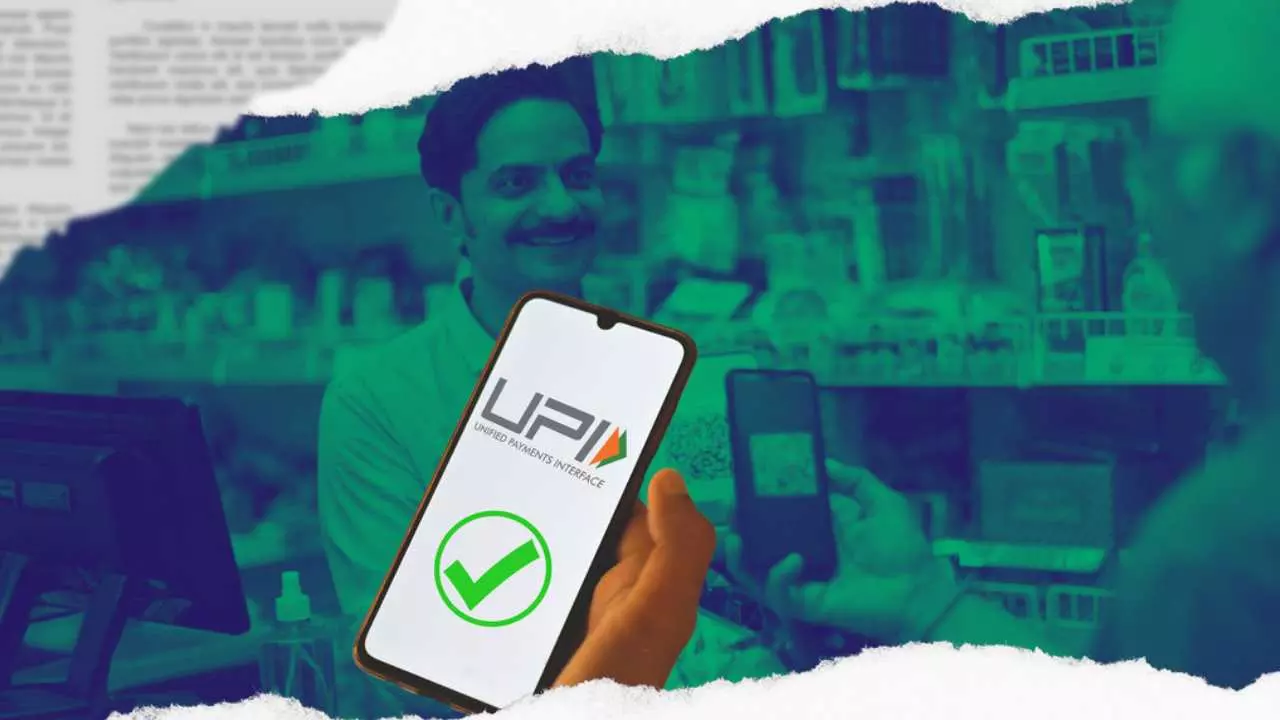
Free to fee: What new UPI MDR means for you and your kirana store
Why is govt introducing MDR for UPI payments? Does it mean cash is better? Should you be looking at credit or debit cards? Here's a breakdown of the facts

India’s UPI payment system is entering a new phase.
From October 15, person-to-merchant (P2M) UPI transactions above Rs 2,000 will attract a Merchant Discount Rate (MDR) of 0.4 per cent. The Centre's move to introduce the MDR has raised much concern among traders, industry bodies, retailers and consumers. What exactly is happening? We give you the lowdown.
What exactly is MDR?
MDR is a fee associated with processing a digital merchant payment. It is distributed among participants in the payment ecosystem, including banks, payment service providers and other entities involved in processing and settling the transaction.
Also read: New UPI charges: Paytm shares jump 3.5 pc; Pine Labs, One Mobikwik pare early gains
MDR is not unique to UPI. It has long been part of card-payment systems, helping cover costs related to payment infrastructure, technology, security, fraud prevention and settlement.
UPI, however, followed a zero-MDR model for years. The new framework changes that for a limited category of higher-value merchant transactions.
What changes from October 15?
In simple terms, if you send Rs 5,000 to a friend, there is no MDR. If you pay a merchant Rs 1,500 through UPI, there is no MDR.
But if you make an eligible Rs 3,000 payment to a merchant, the merchant will incur an MDR of Rs 12, or 0.4 per cent of the transaction value.
For a Rs 10,000 transaction, the MDR will be Rs 40. At Rs 75,000, it reaches the maximum of Rs 300. Even if the transaction is Rs 1 lakh, the MDR remains capped at Rs 300. Utility bill payments like phone, electricity, gas and water bill payments above Rs 2,000 may attract a nominal MDR, depending on the applicable category.
The important point is that the MDR is a merchant-side charge, not a new fee that the customer has to pay separately. The government has advised banks to ensure that merchants do not pass the charge on to customers. How far this will be implementable at the ground level remains to be seen.
For instance, shopkeepers and businesses often pass on MDR charges to the customers or simply refuse to accept credit or debit cards citing the fee. This may happen with UPI, too.
Who remains exempt?
Small-value UPI payments remain outside the new MDR framework. National Payments Corporation of India (NPCI) says more than 95 per cent of P2M transactions below Rs 2,000 will remain free.
Qualifying small merchants receiving up to Rs 1 lakh a month through UPI QR codes will also continue to enjoy zero MDR.
Also read: Why it took 4 years for ATM cash withdrawals via UPI to take off
Certain sectors have a separate flat-rate structure. Payments above Rs 2,000 involving railways, telecom, insurance, fuel and specified essential categories will attract a flat Rs 5 MDR instead of 0.4 per cent. For mutual funds, securities, stockbrokers and dealers, the rate will be 0.02 per cent, capped at Rs 300.
This means the new system is not a single fee applied to every UPI payment. The rate depends on the type and value of the transaction.
Why introduce MDR now?
UPI has grown from a digital-payment experiment into critical financial infrastructure. With transaction volumes now running into billions every month, the system requires continuous investment in technology, cybersecurity, fraud prevention, reliability and capacity.
The government argues that the ecosystem needs a more sustainable revenue model as UPI expands. The new MDR is intended to create that revenue without charging consumers for everyday payments.
A portion of the MDR collections will also go towards a fund intended to support wider UPI acceptance and the inclusion of small businesses in digital payments.
Also read: 'Major turning point in India’s digital payments journey': Modi as UPI turns 10
Vivek Iyer, Partner and Regulatory Eco leader, FS Risk Advisory at Grant Thornton Bharat, told The Federal the change addresses the question of how a rapidly expanding payment infrastructure can continue to fund innovation. Iyer described the move as a shift “from a subsidy-based model to a market-focused model”.
Will consumers feel the impact?
Technically, a customer paying Rs 3,000 to an eligible merchant will still pay Rs 3,000. The merchant bears the MDR. But the wider impact is less straightforward.
A merchant facing an additional processing cost can absorb it, accept a lower margin or adjust prices. The merchant is not supposed to impose the MDR as a separate UPI surcharge on the customer, but the cost could still influence business decisions.
Dharmender Jhamb of Grant Thornton Bharat said small retailers operate on tight margins. “Kirana stores typically operate on margins of around 3 per cent to 6 per cent. If you charge them 0.4 per cent on that, they may either break the payment into smaller transactions or try not to prefer UPI,” he told The Federal.
That raises a larger concern: whether some merchants could become less willing to accept UPI for higher-value purchases, even though consumers themselves are not directly charged.
Does it make sense to go back to cash or cards?
This could be a trick question. Cards already carry a bigger MDR than what's proposed for UPI. Even RuPay credit cards, which are relatively cheaper, run an MDR charge ranging from 1.1% to 2%, several times UPI's new 0.4%. Other card networks are typically similar or higher.
So, switching from UPI to a credit/debit card doesn't dodge merchant fees; it just means a bigger one, which merchants are more likely to try to pass on.
Cash has its own real costs — handling, counting, storage, robbery/theft risk, no transaction trail, no rewards or cashback, and it's simply less convenient for both merchants and customers.
What does this mean for UPI?
For years, one of UPI’s biggest advantages has been its simplicity — scan a QR code or key in a phone number, enter the amount and pay without worrying about a transaction fee. That remains largely unchanged for everyday users.
The difference is that UPI will no longer be entirely free across the merchant ecosystem.
The government is trying to maintain free P2P payments, low-value merchant transactions and protection for small businesses while creating a commercial revenue stream for the infrastructure supporting UPI.
The question now is whether the new cost remains largely within the payment ecosystem or changes how merchants accept and price digital payments.
For consumers, UPI remains effectively free. For merchants and the companies operating the payment infrastructure, however, October 15 marks the beginning of a different model — one where India’s most widely used digital payment system starts generating revenue from selected transactions after years of zero MDR.