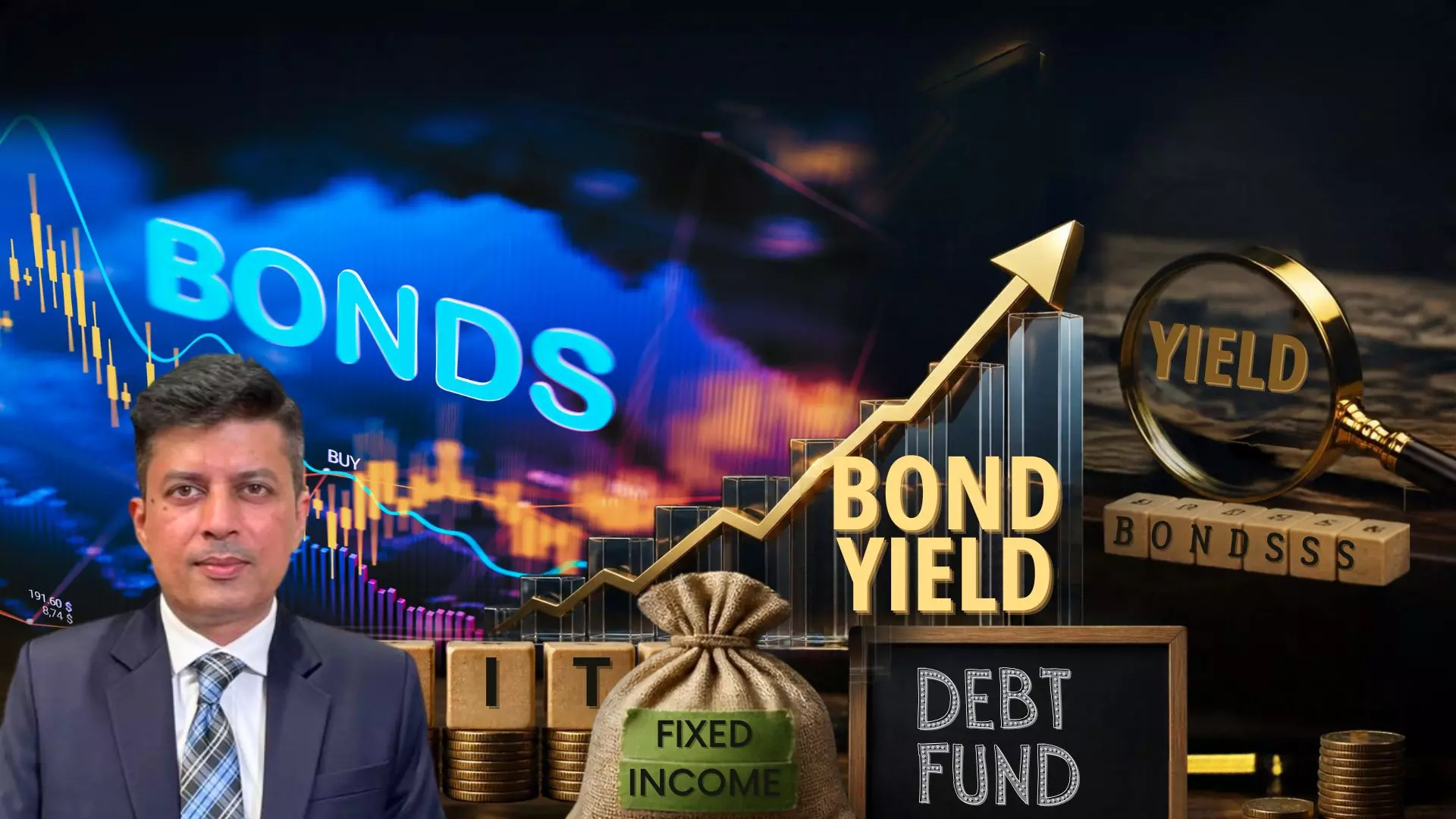
Abhishek Bisen, Head of Fixed Income and Fund Manager, Kotak Mahindra AMC.
Bond yields at 8 pc offer sweet spot for debt investors: Abhishek Bisen
Abhishek Bisen, Head of Fixed Income at Kotak Mahindra AMC, analyses rising G-sec yields, rate cycle timing, dynamic debt funds, and fixed-income risks.

Yields touching 8 per cent on longer-dated government and quasi-government bonds represent a historical "sweet spot" where risk-reward metrics become highly compelling for long-term investors. As central bank rate hikes, geopolitical conflict in West Asia, and rising US Treasury yields push domestic bond yields to multi-year highs, retail investors face crucial choices regarding asset allocation.
The Federal spoke to Abhishek Bisen, Head of Fixed Income and Fund Manager at Kotak Mahindra Asset Management Company, to unpack the drivers behind surging yields, potential risks, and strategies for debt fund investors.
What factors are driving the recent surge in bond yields?
We can divide the drivers into internal issues and external issues, such as interest rates in developed economies and geopolitical risks.
Geopolitical conflicts in West Asia are keeping energy prices fairly high, injecting an element of uncertainty that remains at significantly elevated levels. In such scenarios, risk markets experience anxiety because it is difficult to fathom what is likely to happen. When risk-off sentiment takes hold, investors price off risk, and eventually all asset classes face pressure.
On the other hand, central banks across the developed world are raising interest rates and tightening monetary policy to contain inflationary pressures, which gets reflected in our economy as well.
Domestically, factors remain fairly under control. While inflation is rising and expected to rise further due to factors like monsoon conditions, current market pricing is discounting a fair amount of rate hikes by the central bank. Despite this, the bond market remains under pressure primarily due to global factors driving interest rates higher across our economy.
Should retail investors pause their equity Systematic Investment Plans (SIPs) and shift money into debt funds?
That is a tricky question because it depends entirely on an investor's objective and risk appetite. All markets have experienced significant corrections. Equities, after correcting, offer long-term value. At the same time, fixed income investments have corrected significantly, driving yields to elevated levels.
It would be difficult to advise stopping equity SIPs to move entirely into fixed income. However, equity returns over the last couple of years have been somewhat muted, neutral, or negative in certain segments. Debt has performed relatively better over the last year or two compared to equities and commodities, depending on the time frame analyzed.
From an asset allocation perspective based on overall risk profiles, debt should be a prominent component today. The yield levels we have reached offer attractive value for long-term returns, offering assured-style returns if you remain in safer instruments like government bonds or AAA-rated corporate papers.
Longer-dated bond yields have touched almost 8 per cent or higher, which is a historical sweet spot. Whenever yields have crossed 8 per cent on the longer end of the curve, fixed income returns one or two years down the line have proven very attractive from a risk-reward perspective.
Investors should allocate to fixed income rather than staying overly conservative in overnight, savings account, or liquid options. You can incrementally increase risk within fixed income portfolios. While specific allocation depends on individual risk appetite, given current uncertainty, maintaining a slightly larger debt allocation of around 20 to 30 per cent makes sense from an overall risk perspective while keeping powder dry for potential future equity corrections.
Should investors lock in higher yields immediately or wait for interest rates to peak?
There is a quotation in our conference room: timing any market perfectly is accomplished either by liars or by people who get extremely lucky.
Because of this, we always recommend investors utilize SIPs or staggered allocations in fixed income at every level. Yield levels are currently attractive, and investors can keep accumulating over time.
A runaway move in interest rates is difficult to foresee. Furthermore, duration assets create significant volatility, which we have seen on a scale not witnessed in decades in the developed world. For instance, Japanese bond yields moved from below 1 per cent to around 3 per cent, while US bond yields climbed from around 1 per cent to above 5 per cent.
In India, an 8 per cent yield level represents a fairly decent number to accumulate long-term yields. While yields could move up slightly from current levels due to volatility, Government of India 30-year paper trades near 7.80 per cent, while State Development Loans (SDLs)—which are quasi-government instruments—already offer yields around 8.25 per cent. We have reached attractive numbers to begin allocating across these segments.
Which debt fund categories make the most sense in the current environment, and how do dynamic debt funds operate?
Fund managers continuously adjust duration based on forward-looking expectations and risk-reward dynamics. Dynamic duration funds offer the best solution for investors who are unsure where interest rates are heading.
At this point, funds remain somewhat conservative, but we are looking for opportunities to deploy cash and extend duration toward the higher end as clearer market signals emerge. Because investors dislike fixed income volatility, fund managers stay conservative during periods of extreme market movement.
Allocations toward the longer end look attractive, especially with State Development Loan yields touching 8.25 per cent and 30-year Government Securities trading around 7.80 per cent.
Regarding how dynamic debt funds work, fund managers exercise significant flexibility over duration. During favorable cycles, dynamic bond fund duration can extend to 9 or 10 years, or even higher—for example, gilt fund durations reached 11 to 12 years in past cycles. Currently, dynamic gilt durations sit around 4 to 5 years.
When yield curves flatten, we often employ a barbell strategy—allocating to both the short and long ends of the curve—which performs better than focusing purely on the short end. While shorter-duration funds provide psychological comfort, shorter-end yields can hurt the most when interest rates move up rapidly.
What primary risks should investors evaluate before investing in debt funds?
Duration risk is the primary factor investors must understand. However, duration risk gets mitigated if you remain invested for two, three, four, or five years—similar to how investors approach equity horizons.
Liquidity risk also gets mitigated over a long investment horizon. If volatility arises due to liquidity conditions, investors should remain invested rather than panic.
Credit risk requires extreme caution as we enter an era where credit quality becomes significantly important. Credit risk is often highest when market conditions appear deceptively calm, because the worst investment mistakes occur during good times.
Can investors lose money in debt funds even when bond yields are high?
Theoretically, when interest rates rise, bond prices fall, which can temporarily impact returns. However, over time, the accrual effect comes into play, helping offset initial price declines.
In extreme global scenarios—such as Japan or the US where 10-year yields surged from 1 per cent to 5 per cent, eroding up to 30 per cent of capital value—accrual income cannot easily cover the capital loss. But such extreme structural shifts rarely occur in India.
In India, if you invest in AAA-rated corporate bonds or high-quality sovereign paper with an investment horizon of 18 months or more, capital loss is exceptionally rare. You might experience periods where returns temporarily fall below bank fixed deposit rates, but future returns improve as the interest rate cycle turns over a two-to-three-year period.
What is the right strategy for both existing and first-time debt fund investors?
Because the entire yield curve is high, even investing in short-term debt funds is not a bad starting point for beginners. It helps first-time investors understand interest rate sensitivity, volatility, and how long it takes for accrual income to recover short-term mark-to-market fluctuations.
Investors should gradually progress from liquid and short-term funds toward longer-duration options. Retirement capital or long-term savings that will not be needed for years should be placed in long-term debt buckets. At current valuation levels, accrual income and eventual capital appreciation will cover portfolios over time, making long-term capital loss highly unlikely.
What is your outlook for bond yields and debt funds over the next few months?
The 10-year government bond yield reaching 7.40 per cent represents a key technical and psychological level. If technically breached, yields could head toward 7.60 per cent, though current levels already price in a significant amount of negative news. While yields might temporarily spike toward 8 per cent during periods of extreme global uncertainty, the odds of sustained higher spikes remain low. The broader yield trajectory is likely to move sideways or lower as clarity emerges.
For retail investors, tax changes have made direct inflows into pure debt funds more challenging. However, investors can access debt returns efficiently through hybrid categories, fund-of-funds, income-plus-opportunity schemes, arbitrage funds, or tax-efficient hybrid options like Solution-Oriented or Systematic Allocation funds. These categories combine debt stability with tax efficiency and potential equity upside, yielding better blended returns over a one-to-three-year horizon.
Watch the video here