Instead of addressing youth concerns, Modi’s latest ‘label’ has been reclaimed by a generation angry over jobs, exam leaks and institutional failures
Within 24 hours, Prime Minister Narendra Modi’s ‘Dimagi Naxal’ slur has suffered the exact same fate as Chief Justice Surya Kant’s infamous 'cockroach' remark: far from isolating critics, the insult was instantly inverted and claimed by dissenters as a badge of honour, turning a state-sponsored stigma into a rallying cry, as well as a tool of self-definition.
This unexpected turn of events may not have yet replicated the complete narrative of the Cockroach Janata Party by enlisting millions of social media followers within a day, but by the time of writing, handles of Dimagi Naxal Janata Party had come into being at least on X/Twitter, as well as Instagram. The creators declared – “We are not against the nation. We are against ignorance, injustice and blind obedience. Our weapon is the mind, our evolution is of ideas.” The handles also asked supporters to “think, research and resist”.
Slur that boomeranged
Within a day, there was also a song on YouTube, well sung, slickly produced and with matter-of-fact, but truthful lyrics: If we question, we’re dubbed Naxals, Ask for our rights, and we’re called Naxals, Speak the truth, then too Naxals, And stay silent, still Naxals, It’s the job of police to combat armed rebels in jungles, But why are you giving those who chose pens, The ones who sing songs, Why are you giving them the same name, Dimagi Naxal... It is evident that the Gen Z ‘wave’ has not died down despite the government’s efforts to instil fear once again.
Also read: Modi’s I-Day speech: 'PM failed to address students, youth issues'
One nameless, but not faceless (and therefore fearless) girl mocked the government leadership, including Prime Minister Narendra Modi, stared right into the camera, and declared daringly: “You offend us, and we will own it.”
Countless others on innumerable reels are ready, awaiting their time for the ‘play’ button to be hit.
A new label
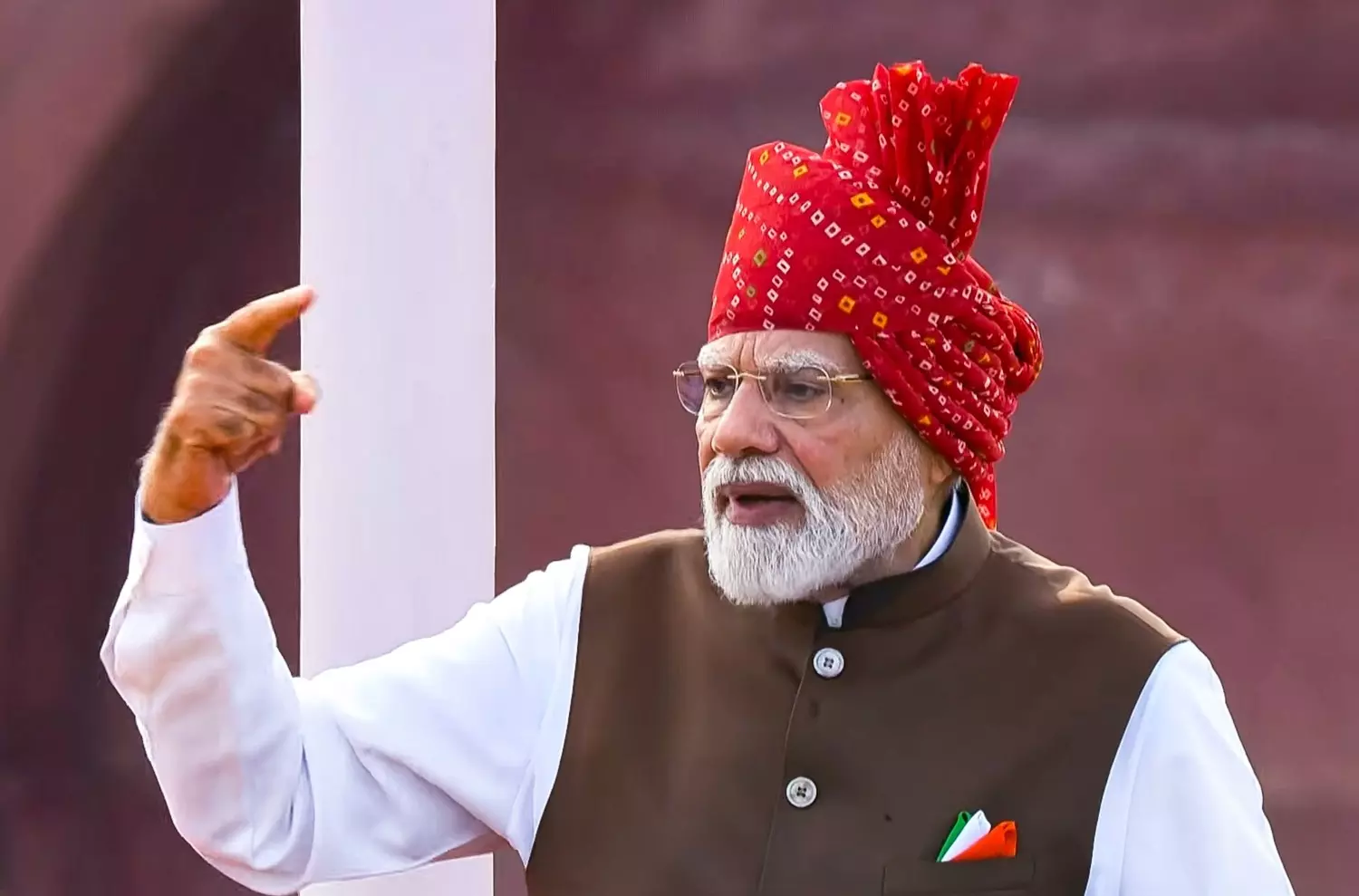
Modi probably did not think this was how the narrative would turn when, on the morning of August 15, as the August heat hung heavy over the red sandstone ramparts of the Red Fort, he stood up, hoisted the National Flag, and walked to the podium to deliver the traditional address.
This speech has historically been earmarked for unifying national visions and big-picture governance with a smattering of political rhetoric, a tradition Modi followed in his initial years.
But on the watershed 80th Independence Day of the nation, Modi, instead, dipped into his increasingly worn political toolbox.
Also read: PM running out of words and ideas? Modi's shortest, least consequential I-Day speech yet
Unambiguously aiming for the top billing in the evening’s televised debates, he introduced a fresh jibe into India’s political lexicon: Modi warned against the shadowy threat of the stealthy "Dimagi Naxals" – the "intellectual", or "mental" Naxalites, alleged to be silently fermenting trouble and instigating lawlessness.
From Urban Naxal to ‘Dimagi Naxal’
Decoding Modi’s latest slur, it becomes evident that what at first hearing appeared to be linguistic evolution from the Urban Naxal or Andolanjeevi disparagements was instead a shift from geographical or organisational categorisation, to the criminalisation of cognitive frameworks and critical thought itself.
Only city dwellers and persons known for sympathies or association with left-of-centre organisations could be dubbed Urban Naxals. But Dimagi Naxals are deemed omnipresent – they can be living anywhere, be engaged in any profession, and articulate any kind of thoughts that’s not in sync with the Sangh Parivar’s, and they would immediately ‘qualify’ for the label.
In his speech, Modi said that his government ensured that the last of armed Naxals were wiped out, but it was now the time to identify and isolate Dimagi Naxals. Importantly, the Dimagi Naxals – this rhetoric frames any form of criticism of the State or individuals who hold its offices -- such as civil rights advocacy, legal challenges, and institutional critique, all of this considered as subversion of national security.
Modi’s definition paints non-violent, structural dissent as an insidious mental condition. But he missed noting that while derogatory tags -- Urban Naxal, Andolan Jivi, Khan Market Gang – worked well during the height of his political hegemony, using them against an aggrieved generation of students and other youth signals a critical misreading of the public mood.
Modi misread the youth anger
Even before he became prime minister, Modi historically relied on semantic delegitimisation to turn public sentiment against critics – shifting from national security threats to ideological adversaries.
These negative tropes against adversaries enabled the creation of an external "enemy within" to divert attention from administrative failures.
Also read: Rijiju defends PM after Chidambaram’s ‘proud to be a dimagi naxal’ jibe
The 'Dimagi Naxal' barb has not stuck because the targets were not Opposition leaders and their parties. Instead, it targeted middle-class aspirants, students, and young voters who felt betrayed by systemic corruption (exam leaks and unemployment).
The derogatory label did not make the targets shrink into a corner, although Modi virtually labelled students’ angst as an "ideological infection", thereby insulting the intelligence of millions of youth.
Modi erred by not realising that his decision to let Dharmendra Pradhan quit the ministry put him on the defensive and dwarfed his familiar commanding heights.
One of the key points that emerged from assertions and declarations at Jantar Mantar, and its replica sites across the country, was that the youth were not getting swayed by paternalistic optics. Instead, they wanted to base their judgement on state delivery and institutional trust.
Instead of taking note of the altered mindset of the young, it was the classic Modi that strode into Red Fort, straight after shooting a video with cows and peacocks at his residence.
When the insult turned into a badge
But after the echo of the Red Fort salvo – duly amplified by his party’s humungous publicity machinery – settled, a different reality set in. The jibe did not trigger the usual disciplined chorus of public approval or force the opposition into a defensive crouch. Instead, it boomeranged.
Opposition parties straightaway got off the blocks and hurled criticism after taking ownership of the insulting tag. Rarely were there so many claimants for the lapel of dishonour.
Also read: Modi's 2047 vision offers little beyond longer wait for Gen Z and others
The altered Opposition tactics prevented success of Modi’s attempt to define his opponents. No one now tried warding off the labels of Urban Naxals, Andolanjeevi or Khan Market Gang. Instead, millions walked around, clad in imaginary Ts, emblazoned with text proclaiming them Dimagi Naxals.
Modi clearly lost the battle because the slur became a commendation.
Gen Z refuses to be silent
The logic of the politics of casting aspersions was taken to its absolute extreme. Modi thought it would be possible to move the disparagement from a physical space or association, to the realm of thought itself – framing dissent not merely as disagreement, but as an ideological pathology.
The fundamental flaw in Modi in this round was his refusal to realise that the Red Fort speech was contextualised by weeks of anger across several parts of India. This resentment may have been catalysed by the NEET-UG examination leaks, but eventually everyone who joined the protest at different venues, carried their own little bag of woes and angst. Importantly, these people were neither far-left nor even slightly to the left.
For this lot, their return home was a victory march. Millions of others shared their victory and jubilated. Twelve years of iron-fisted rule had been humbled, not by political parties or pre-existing activist groups like the farmers were. The victors could not be termed enemies of the people.
Modi erred by not even waiting for the dust from the return journey to settle and mount a fresh verbal onslaught.
He forgot that when you tell a 20-year-old student who spent three years holed up and studying feverishly in Kota, or elsewhere, that their anger over a leaked exam paper is a form of "mental Naxalism," the disparagement does not isolate the student. It isolates the leader.
Changing political vocabulary
For a leader who has carefully cultivated the persona of a paternal, omniscient statesman who has in the past cast himself as a 'non-biological being', the heavy reliance on epithets reveals an underlying vulnerability.
Also read: After Instagram fiasco, why PM Modi wants Gen Z to read books
Modi, the 'strongman', has encountered genuine, decentralised public anger for the first time in 25 years of holding public office.
It is important for him to tone down his instinct to weaponise language. Modi has to realise that there has been a generational shift in how political communication is consumed.
Slogans that once evoked fierce nationalist pride now risk sounding defensive, cynical, and out of sync with the real material concerns of unemployment, paper leaks, and institutional decay.
The nation is not under threat, or so the general perception goes. Instead, the communication-consuming class perceive that they are the ones who face the greatest risk of survival.
People’s fear of the future is why the boomerang returns and begins to hit the very authority that threw it.
(The Federal seeks to present views and opinions from all sides of the spectrum. The information, ideas or opinions in the articles are of the author and do not necessarily reflect the views of The Federal.)