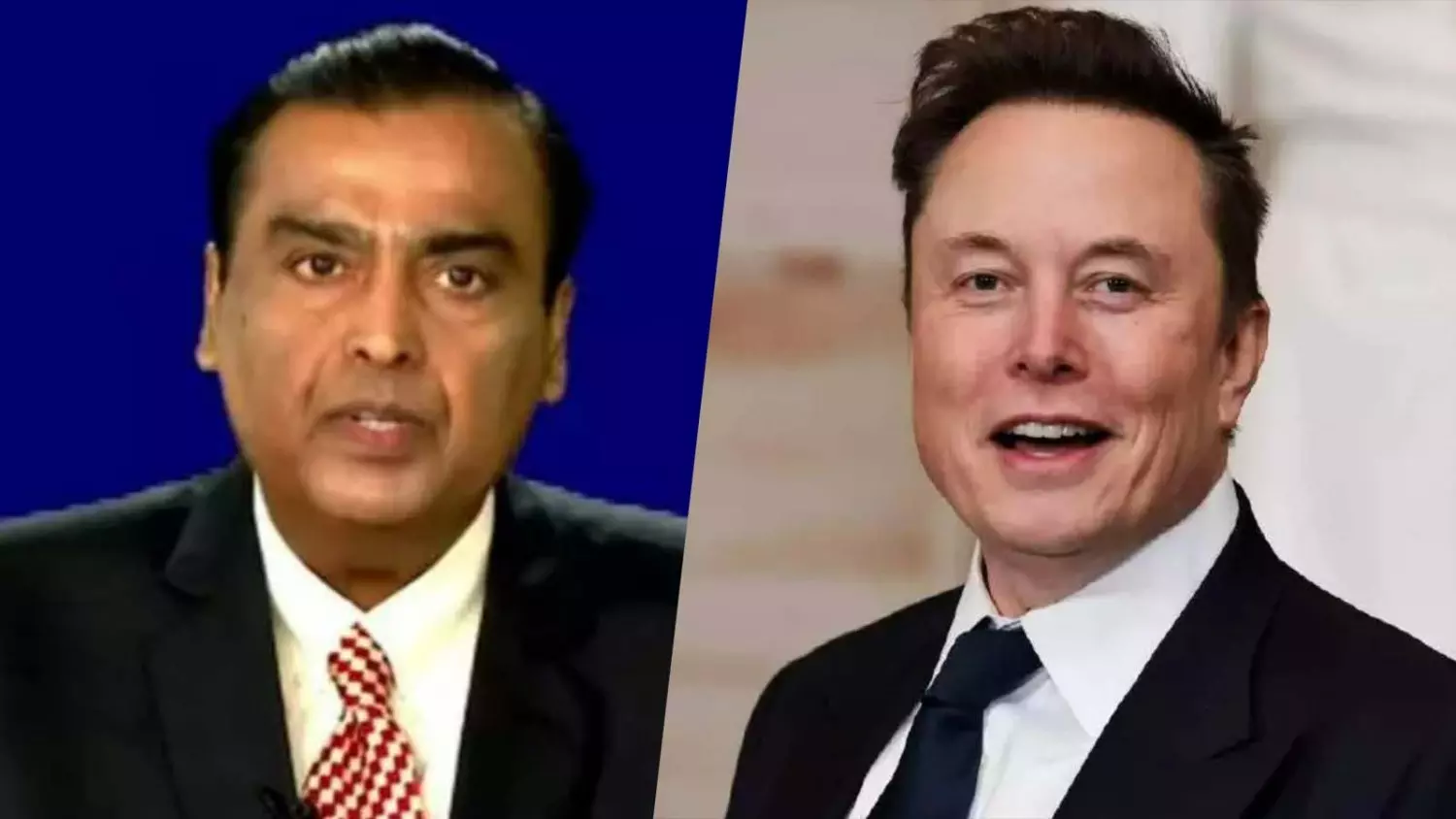
From Trump’s shifting favours to Venezuelan crude and Jio’s blockbuster IPO, this rich-men clash has the whole geopolitical chessboard in play
For most observers, it seems like a global corporate conflict to enter India’s lucrative satellite Internet services (Satcom) market, business expansion, and future profits. But the Twitter tirade, or "X-rated war of words", by Elon Musk, the richest person on the planet, against Mukesh Ambani, the richest in Asia (Forbes real-time list of dollar-billionaires) involves grander and far-reaching elements.
There is geopolitics, American politics, the future of India-US trade ties, and a future IPO, along with dollops of crude oil and data.
Also read: Centre rejects Elon Musk’s Starlink ‘Oligarchs’ allegation, says rules are fair
At a personal level, the implicit animosity is not just between Musk and Mukesh (and other Indian oligarchs). Musk's allegations highlight the fast-changing links between him and American President Donald Trump, Trump and Prime Minister Narendra Modi, and Trump and Mukesh.
At a geographical level, the corporate clash travels from the US to India, via Venezuela, with links to Russia. At a business level, it is about who will capture the global data-based sector, now that data is the new oil.
‘Is Ambani the real boss of India?’
Let us start with the obvious. As Musk tweeted, he “spent five years complying with every single law and requirement” of the Indian government. Yet, he does not have the permission to start Satcom operations.
The man with a net worth of nearly $1 trillion said that he was “blocked by certain oligarchs in order to maintain their monopolistic chokehold on the Indian people”. This was a “crime” against Indians. Musk asked a controversial question, “Is (Mukesh) Ambani the real boss of India?”
Starlink’s ‘star’ owner was worried about the policy gatekeepers within the US. Since Trump’s second tenure, Musk’s personal-political stock soared, and nosedived, and is now poised for a take-off.
Musk’s missives against Mukesh Ambani and other Indian oligarchs seem to be a clear-cut case of corporate conflict. India has pinpointed three entrants in Satcom: Musk’s Starlink, Ambani's Jio, and Sunil Mittal’s Airtel.
India stated that suggestions that its regulatory system was unfair or discriminatory were “baseless and misconceived”. Final licences required “compliance with security conditions”. Security assessment was the reason that none of the three players had got the clearance to start commercial operations. Mittal admitted that he too was waiting for the approvals.
Musk-Trump relationship
Now, let us move to the not-so-obvious factors. In June 2026, Ambani's Jio unveiled plans for low-orbit satellite communications via a global partnership to lease satellite capacity. Musk sniffed danger. This could jeopardise his deals with Jio and Airtel for the same.
The long-distance signals from India’s policymakers carried a security-related stink. Musk’s Starlink devices were found in a major drug seizure. India wanted a level playing field between the foreigner and Indians. It hoped that Ambani and Mittal would develop their Satcom services before the gates were opened for Musk.
Also read: With 'friends' like America, India is learning the cost
Starlink’s ‘star’ owner was worried about the policy gatekeepers within the US. Since Trump’s second tenure, Musk’s personal-political stock soared, nosedived, and is now poised for a take-off. Trump’s recent award of the National Medal of Science to Musk, along with accolades such as “National Treasure”, and “Modern-Day Thomas Edison”, marks, as per an AI summary, “Musk’s full return to Trump’s inner circle after a major public falling out last year”.
Musk had earlier resigned from the all-powerful Department of Government Efficiency (DOGE), and criticised the President’s tax-and-spending Bill.
This yo-yo, and topsy-turvy, trajectory is reflected in the stock prices of Musk’s companies. Tesla hovered at $500 in December 2025, crashed to below $300 in July 2026, and has inched towards $400. The price of SpaceX, which owns Starlink, ruled at a high of over $200 in June 2026, dipped to below $110 in August, and went up to over $160.
Trump’s reason to cosy up with Musk may be related to his lower ratings. The US President fears that he may lose his hold over the Senate and Congress in the upcoming midterm elections.
Eye on Trump’s attention
After having attended Trump’s presidential inauguration in January 2025, Ambani was attacked and reviled by the US President and his loyalists over the purchase of Russian oil. The US wants India to buy the crude from Americans, rather than the Russians.
In the recent past, the Indian oligarch seems to have re-entered the elite circle. There were reports that he would help build a new refinery in the US, the first in 50 years, at an estimated cost of $300 billion, or a “nine-figure investment… at a 10-figure valuation”.
Now that Musk has put Mukesh in his crosshairs, Trump gets another lever to squeeze the Indian trade negotiators.
As a possible quid pro quo, Mukesh emerged as one of the largest non-US buyers of Venezuelan crude. After America ‘captured’ the oil reserves of Venezuela, it decided who would benefit from it.
Today, Reliance accounts for three-fourths of India’s imports, which may double this month. Not to forget that Venezuelan crude comes at a discount of $16 a barrel, which is similar to the $10-12 that Indian importers enjoyed earlier on Russian oil. Now, the Russian spigot is closing, even as the discount dwindled to zero or $1.
Both Musk and Ambani want to grab Trump’s attention. Maybe the US President wishes to woo both again. This is how geopolitics conjoins with American politics. It connects to global trade.
India-US bilateral ties are on tenterhooks because of New Delhi’s past enthusiasm to source crude from Moscow. India has reduced its dependence on Russia and hiked American oil imports. But there are virulent India-US disputes on tariffs and trade in farm products. It is an impasse that may benefit Musk and Ambani, but allow Trump and Modi to use the battling businesspersons as pawns.
Upcoming Jio IPO
Now that Musk has put Ambani in his crosshairs, Trump gets another lever to squeeze the Indian trade negotiators. Reliance's refinery project and purchase of Venezuelan oil help the Indian side to push its agenda. In the new give-and-take scenario that may emerge, Starlink’s Indian satcom licence may be one of the ingredients on the table, along with Ambani's demand for greater access to Venezuelan oil.
One is not sure of the egg or chicken — if the businesses influence trade relations, or vice versa.
In the entire gamut of complex, inter-related, and complicated factors and scenarios, let us not forget the IPO (Initial Public Offering) of Reliance Jio, which will open this month, and hopes to mop up $3.8 billion with a company valuation of more than $100 billion. It may be India’s largest IPO.
Ambani will not accept any harm to it, either potential or actual, real or peripheral. Musk’s timely tweets, thus, aim to trip Mukesh’s telecom travels on a listing course. They may pierce through Jio’s carefully constructed valuation.
(The Federal seeks to present views and opinions from all sides of the spectrum. The information, ideas, or opinions in the articles are of the author and do not necessarily reflect the views of The Federal.)