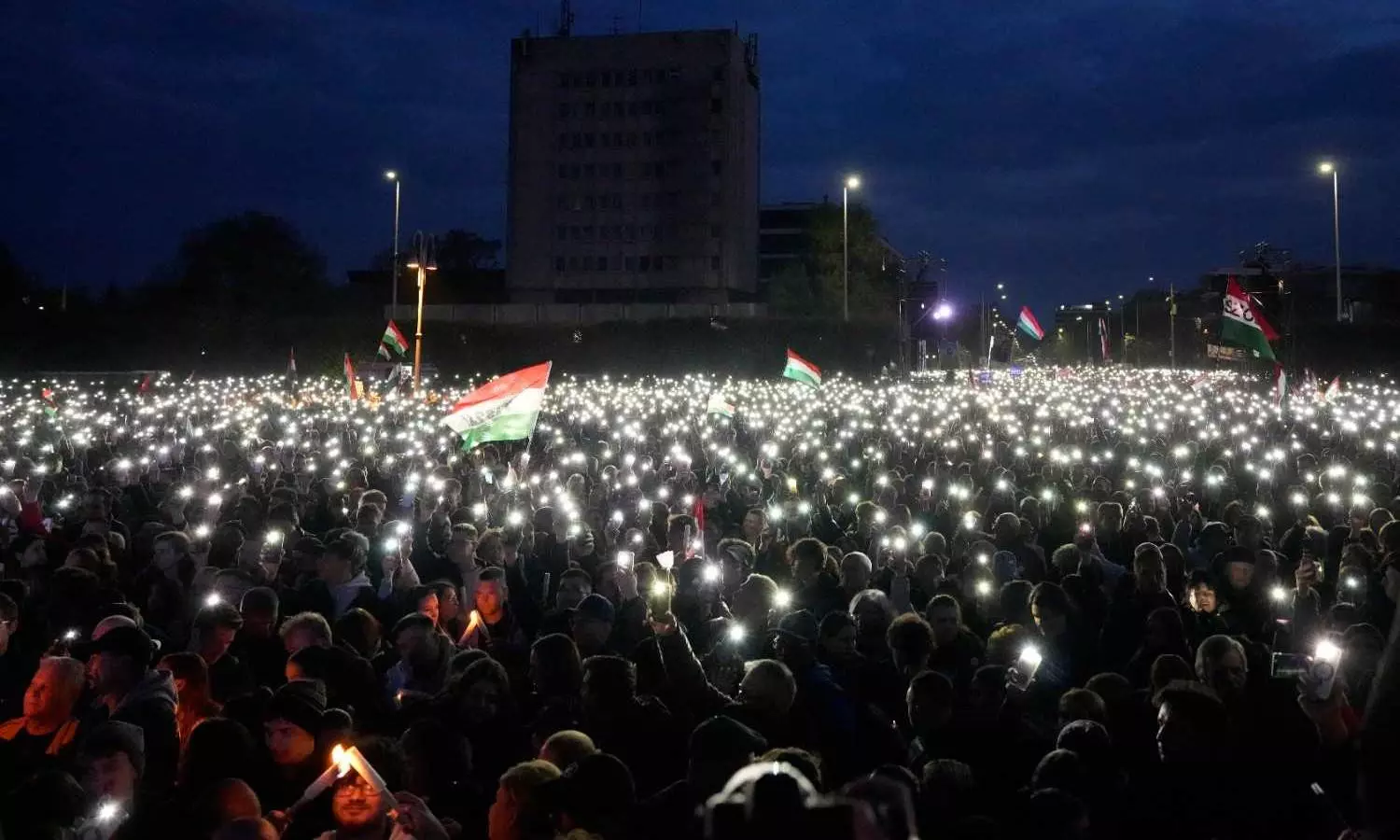
Supporters of Peter Magyar, the leader of the opposition Tisza party, hold up their lit phones during a final election rally in Debrecen, Hungary on Saturday (April 11). Photo: AP/PTI
Illiberal despots can be deposed without an insurrection within the framework of an elected autocracy
In the end, Hungary’s Viktor Orban quietly conceded defeat and congratulated the opponent who has trounced him. He did not rig the electoral rolls, did not howl about stolen elections and lead partisans to storm the country’s legislative buildings to try and foil official acknowledgement of his electoral defeat, did not file umpteen suits in the courts he controlled to try and block the election result.
Was he really the archetypal illiberal democrat he has been portrayed to be? Should we even discuss the change of guard in a small country of less than one crore people, and GDP of some USD 248 billion?
Poster boy of the far right
We should. He did not become the face of the politics of religious-nationalist populism that has been gaining ground in the West for nothing. He has been in power for 16 years. He rejected the European Union’s calls to accommodate the refugees fleeing the Arab Spring’s violent suppression and dissipation. He established legislative control over the judiciary, leaving the European Union fuming over institutional failure, and withholding funds meant for Hungarian development. He encouraged his rich friends to buy out media outlets, so that the mainstream media discourse in the country was uncritically supportive of his government and hostile to the Opposition. The Opposition accuses him of crony capitalism and supporting a system of corruption.
He leveraged the European Union’s requirement of consensus in decision-making to put a halt to major policy initiatives by the Union, such as extending a hefty USD 90 billion loan to Ukraine. He made common cause with the EU’s bete noire, Vladimir Putin of Russia, on Russian hydrocarbons, and against Ukraine, played host to Chinese investment in electric car production at a time when the European automobile industry was trying to keep the low-cost Chinese electric vehicles at bay.
Also Read: Hungarian PM Orbán concedes defeat in European electoral earthquake
He has been the poster boy of radical conservative politics, indeed, of electoral autocracy, acknowledged forerunner of the rise of the far right in Germany, France, and, now, Britain, star speaker at America’s major conservative political event, the Conservative Political Action Conference. Trump’s Make-America-Great-Again base loves him, Vice-President JD Vance travelled to Hungary to speak in support of his ideological comrade during the Hungarian election campaign. That is not interference in some other country’s internal affairs, of course not.
Yet, Orban has bitten the dust. A former colleague and functionary of his Fidesz party, Peter Magyar, and his newly-formed Tisza party, have won a two-thirds majority in the elections to the Hungarian Parliament. The politics of Hungary has not turned any shade of rosy pink. It remains firmly centre-right, for all the parties to be elected to Parliament. Yet, Budapest’s young and old are partying on the banks of the river that runs through the city and Hungary’s history, and dancing to tunes livelier than “the Blue Danube”.
Lessons for the rest of the world
What lessons does Orban’s fall hold for the rest of the world?
For the EU, it means smoother internal functioning, with less blocking of aid to Ukraine and reduced enthusiasm for things Russian. For Hungary, this could pave the way for unblocking funds that the EU had held back, on account of concerns over judicial independence and corruption under Orban.
Also Read: Hungary president resigns over pardon to man convicted in child sexual abuse case
For Europe and America, a political cycle seems to be turning. The electoral gains of the ultra-rightwing AfD in Germany, the rise of the National Rally in France, where its candidate is the favourite to lead in the presidential polls next year, the rising popularity of Nigel Farrage-led Reform UK in Britain, and the Second Coming of Donald Trump in the US have seemed to signal an unstoppable tide of rightwing populism across the West. Orban’s rout in Hungary changes the narrative in a way the National Rally’s relatively anaemic showing in France’s recent municipal elections had not.
Lesson for India
What does Orban’s defeat mean for India? No one’s grip on power is absolute — that is one clear lesson. It took 16 years for the strongman’s charisma to lose its hold on Hungary’s majority, but finally, it did. While the people of Budapest were never in his thrall, more socially-conservative rural Hungary endorsed his Christian values and his loud promise to defend Christendom against Muslim barbarians flooding in as refugees.
Also Read: The EU proposes suspending 7.5 billion euros in funds to Hungary over graft concerns
It took a charismatic leader to rally the dispirited opposition into a coherent force that could dislodge Orban. What really undid Orban was corruption. Initially, Orban held power. Then, he held absolute power, with the power to amend the Constitution and give his party control over the judiciary and the media as well. Power corrupts. Absolute power does an absolute job.
Trampling of rights in India
In India, tribal rights are being trampled upon and stomped into the soft duff of the forest floor. Environmental and forest clearances have been converted into rituals that must be observed to appease dermatic piety, with any significance only in the rare case of judicial intervention. The media is quiescent, as India steadily goes down on all global indices of press freedom and adherence to democracy. It helps that advertising is fragmenting, deserting the mainstream media and rushing to occupy new nooks, crannies, and sermonising mounts of the expanding digital world, making mainstream media susceptible to the allure of state advertising, amidst a culture of personality in which every satrap of every department and government agency, as well as of every state, competes to project the visage of the Great Leader in full-page advertisements and sponsored events.
Also Read: Millions join ‘No Kings’ rallies across US, Europe over Iran war, Trump policies
India’s diversity is a source of rare vigour, when coherent. It is also, like the densely-packed nucleus of an element with an elevated atomic number, readily fissile, when bombarded with external excitation. Sectarian passions are easy to whip up, along multiple identity lines that are also faultlines across national unity.
State power has been used arbitrarily since colonial times. The culture of the administration has never really moved from one of containing and controlling a subject population, with carrot and lathi. Carrots have evolved and turned digital. Coercion permeates the system, instead of being visible as a stick.
Long-entrenched leaders can fall
India, at the moment, lacks a national Opposition that projects an alternative narrative of collective, united advance. The existing Opposition can only find fault and lay blame, not offer solutions to problems that crush the people and provoke what has been called a million mutinies. And there is no Peter Magyar around with an effective social media game.
Yet, it is good to know that long-entrenched leaders can fall, that no one’s grip on power is absolute, that electoral autocracy can depose its despot, even without an insurrection.
(The Federal seeks to present views and opinions from all sides of the spectrum. The information, ideas or opinions in the articles are of the author and do not necessarily reflect the views of The Federal)