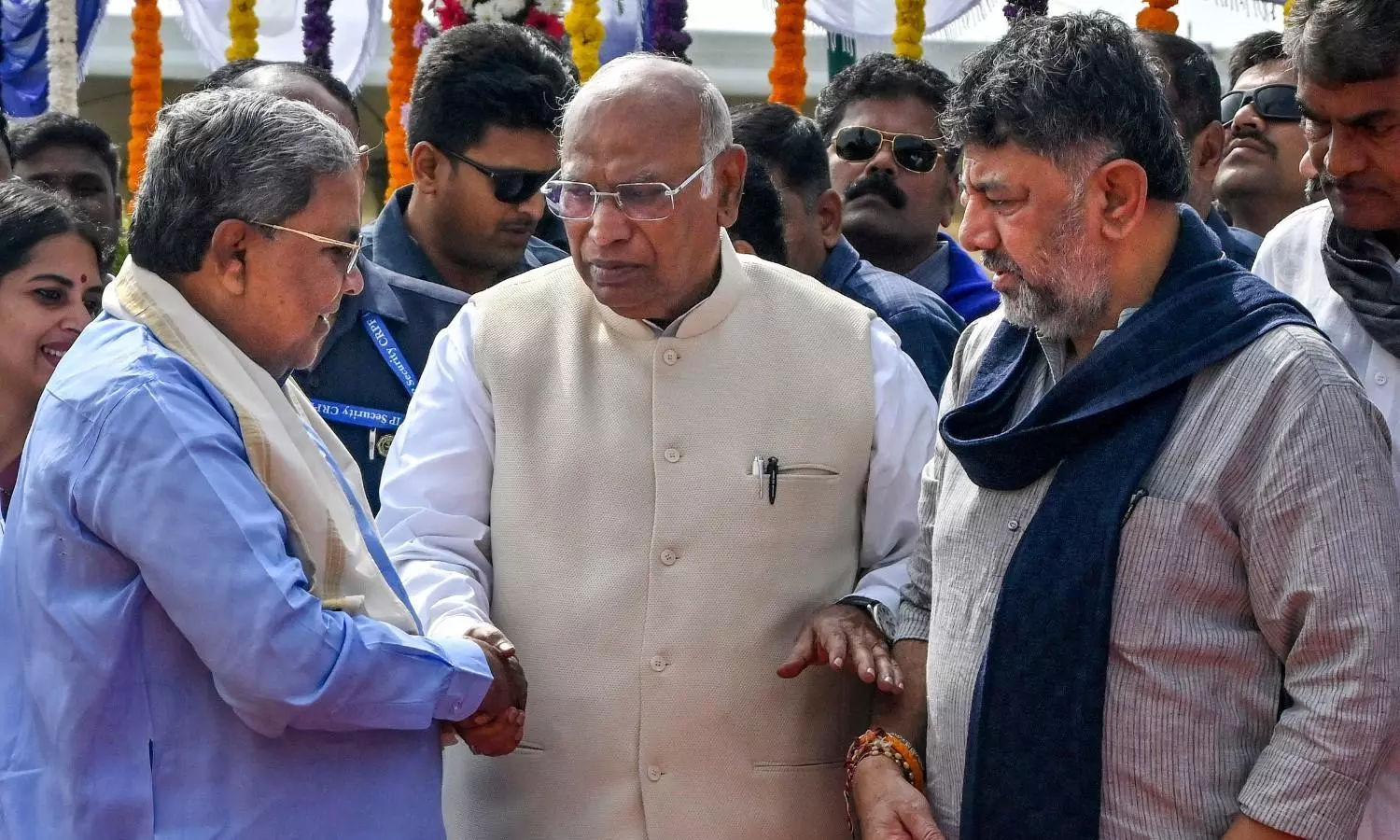
Familiar pattern of infighting and indecision threatens Congress in Karnataka, as it did in Punjab, MP and so on, and opens the door for BJP's Operation Kamal
Déjà vu! Haven’t we seen this all-familiar situation in the Congress?
Kamal Nath vs Jyotiraditya in Madhya Pradesh
TS Singh Deo vs Bhupesh Baghel in Chhattisgarh
Ashok Gehlot vs Sachin Pilot in Rajasthan
Sukhvinder Sukhu Vs Vikramaditya Singh in Himachal Pradesh
Captain Amarinder Vs Navjyot Sidhu in Punjab
These are just some of the famous political dramas that have unfolded before our eyes, almost like a Bigg Boss episode. The famous South Indian addition to this list has been the ongoing DK Shivakumar vs Siddaramaiah in Karnataka. The script almost always has been of unfulfilled ambition and failed promises.
In each of these cases, the Congressmen have fought their own. Repeated attempts to manage many a crisis have failed. And eventually led to the loss of government in the subsequent election.
Delayed actions
How can the same script play over and over again? How can a crisis be so identical each time? What is exactly promised to these leaders that isn’t delivered? Why are these promises made? And, why on earth is all of this sold as ‘inner party democracy’ and ‘we have multiple leaders to choose from’?
In each of these cases, the party is seen to be listening, but moves in too late. By then, the battle is lost. The Madhya Pradesh 2018 mandate was ’stolen’ in 2020 with Jyotiraditya shifting with his loyals to the BJP. The Chhattisgarh fight became so ugly that Baghel lost everything he had on offer to the BJP in 2023.
Also read: Delay could be costly: Cong risks paying heavily for the Siddu–DKS feud
The Punjab rumble of 2021-22 ended in compromise candidate in Charanjit Singh Channi, which was a decision hailed as a masterstroke, but too late in the day to be able to deliver any results.
These episodes underscore a pattern: the Congress high command's reluctance to decisively resolve leadership disputes often amplifies divisions, turning internal democracy into a liability that hands electoral advantages to rivals like the BJP
Rajasthan’s Battle Royale led to Ashok Gehlot holding his own. Full drama on display with barbs for Sachin Pilot like nikamma nakaara (useless and good for nothing). Eventually, the Congress lost to the BJP in 2023.
Weak crisis management
Two Congress-ruled states and a crisis is simmering. Himachal’s Sukhu vs Vikramditya is contained, but a flare up is possible at any moment. And, of course, Karnataka’s DK Shivakumar vs Siddaramaiah is the latest flare up in an ongoing political drama that the party has still not settled.
These episodes underscore a pattern: the Congress high command's reluctance to decisively resolve leadership disputes often amplifies divisions, turning internal democracy into a liability that hands electoral advantages to rivals like the BJP.
Nothing else but the weak crisis management of the AICC explains the constant unease in state leadership. And, if the Congress refuses to address this now, it runs the following risk:
1) Breeding ground for Operation Kamal
2) Tumultuous 2.5 years ahead of the next state elections in Karnataka
While Siddaramaiah is a crucial face internalised in the Congress leadership after he switched from the JDS, DK Shivakumar has been a Congress loyalist throughout. He boasts of galvanising the Congress cadre at a time when a lot has been written about the party’s weak organisational structure. A jilted DKS can be dangerous.
Operation Kamal?
Sample this.
Belagavi. Reports are abuzz of posters and slogans in favour of DK Shivakumar. Some read “Future CM”. Screaming supporters driving that point in for the perusal of the Congress central leadership. Many of these slogans were straight in the face of the Congress’ central leadership the moment they landed at an airport in Karnataka.
Also read: No decision yet on no-confidence motion against Congress govt, says Karnataka LoP
Siddaramaiah was not far behind. His supporters too positioned him as Karnataka Congress’s power centre. This protracted internal rift is not helping Congress one bit. A divided Congress cadre may not necessarily cause trouble in 2028, but it could send the BJP sniffing for an Operation Kamal.
Poaching ground
Is Operation Kamal possible in Karnataka?
Technically, yes. The term refers to the systematic poaching of Opposition MLAs to topple governments, named after the lotus flower symbol of the BJP.
Why luck could still favour Congress
♦ Karnataka BJP is in a mess, may miss the opportunity
♦ A staunch Congress loyalist, DKS may not align with BJP
In Karnataka, it famously succeeded in 2019, when 17 Congress-JD(S) MLAs defected, allowing BS Yediyurappa to form a BJP government briefly before a Supreme Court-mandated floor test. Post the 2023 Congress Assembly poll victory, allegations of Operation Kamal resurfaced in October 2023, when Siddaramaiah accused the BJP of offering Rs 50 crore and ministerial berths to Congress MLAs, a claim echoed by MLA Ravi Kumar Gowda.
By August 2024, another Congress leader alleged BJP inducements of Rs 100 crore amid corruption probes against Siddaramaiah, signalling ongoing vulnerability. As of late 2025, with the government past its halfway mark, whispers of the BJP eyeing disgruntled Congress factions grow louder, risking a repeat of past instabilities.
BJP in a mess
However, the Congress leadership could look at two silver linings to cushion their decision delay.
Firstly, the BJP’s own Karnataka mess. The BJP's tenure from 2018-2023 was marred by incessant leadership flux, starting with Yediyurappa's brief 2018 stint toppled by a Operation Lotus fallout, followed by HD Kumaraswamy's JDS-BJP coalition collapse in 2019.
Yediyurappa's 2019-2021 return ended in resignation amid family corruption probes, thrusting Basavaraj Bommai as a compromise candidate in July 2021.
Bommai, Yediyurappa's protégé, struggled with assertive leadership, facing MLA discontent over development funds and poor coordination in 2021 MLC polls. Rumours of his ouster swirled in December 2021, dismissed by BJP brass as Congress conspiracies, but highlighting fragile unity.
Also read: 'Just a pause, not a settlement': Decoding Siddaramaiah-Shivakumar truce
Controversies like textbook revisions offending communities and hijab bans alienated voters, while infighting eroded the "macho" image. By the 2023 polls, Bommai's inability to inspire karyakartas led to the BJP's drop from 104 to 66 seats, a 38-seat loss blamed on diluted ideology and weak command.
Defections of Lingayat heavyweights like Jagadish Shettar to Congress further dented morale, underscoring southern complexities where caste and regional dynamics defy northern BJP tactics. This mess offers Congress a window, but only if it avoids similar pitfalls.
Staunch loyalist
The second silver lining is the loyalist in DK Shivakumar – his political journey is a testament to grassroots resilience, beginning as KPCC student wing president in 1984, and securing his first assembly win from Sathanur in 1989 at age 27.
The signals in Congress’s Karnataka unit are now clear. And out in the public. It is too much for the Congress Delhi leadership to ignore. What were murmurs so far have now shifted to chants
A Vokkaliga powerhouse, he has represented Kanakapura since 2004. His masterstroke came in 2018, sheltering 44 Karnataka MLAs in a Bengaluru resort to prevent BJP poaching, and in 2017, aiding Ahmed Patel's Rajya Sabha win by protecting Gujarat MLAs. In 2023, Shivakumar's organisational prowess galvanised Vokkaliga votes, shifting them from JD(S) to Congress, clinching 135 seats.
Clock is ticking
The big question then is, can the Congress afford indecision? The signals in its Karnataka unit are now clear. And out in the public. It is too much for the Congress Delhi leadership to ignore. As what were murmurs so far have now shifted to chants. Procrastination will irk supporters on both sides at a constituency level.
The longer the crisis remains, the greater the trouble. And the Punjab formula of a surprise third candidate may not work in Karnataka. Shivakumar is all too powerful. The Punjab Channi formula not only failed there, but in Karnataka it will essentially mean three power centres. A sure-shot losing proposition.
Right now, Karnataka Congress teeters on a knife-edge, with the alleged 2.5-year power-sharing pact – struck post-2023 victory – fuelling open warfare. Siddaramaiah, sworn in on May 20, 2023, was to yield the seat after November 20, 2025, but is asserting perhaps a full five-year term backed by 140 MLAs. Shivakumar’s supporters make it obvious that this is abetrayal.
Two breakfast meetings in late November – first at Siddaramaiah's Cauvery residence, then Shivakumar's house – has yielded no resolution, described as "productive" yet tense. The clock is ticking.
(The Federal seeks to present views and opinions from all sides of the spectrum. The information, ideas or opinions in the articles are of the author and do not necessarily reflect the views of The Federal)