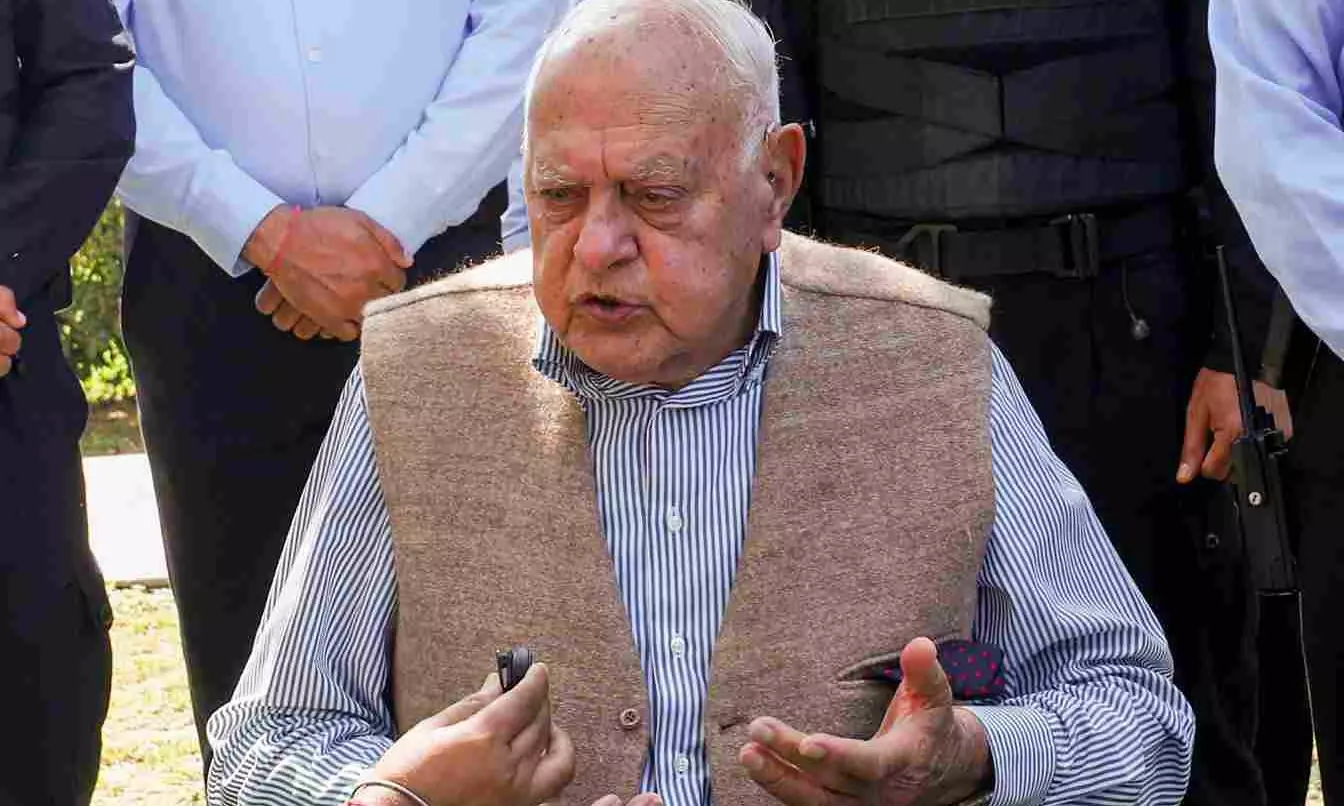
Yet the risk and laxity that led to the incident are palpable issues to be addressed. How did a man armed with a revolver move so close to Abdullah and fire at him, narrowly missing the intended target, cries for an answer. Given the long-troubled history of the border province, both the J&K administration and New Delhi are responsible for the security and safety of the aged National Conference chief, besides other vulnerable targets.
It is a fact that J&K could never be the same place again after way back in 1989, when Rubaiya Sayeed, daughter of the then Union Home Minister Mufti Muhammad Sayeed, was kidnapped at gunpoint in Srinagar. Five prisoners had to be swapped by the VP Singh-led Central government to secure Rubaiya’s release. Farooq Abdullah was Chief Minister at that point in time, and the incident was so bizarre as to etch a deep scar on J&K that may well have healed, or may be forgotten, but not without leaving its ugly mark.
Chain of violence
So, the point is that the brazen political violence, as is the recent case with Abdullah or even the possibility of its perpetuation in a perpetually rife region, is too costly a business to be allowed to be repeated anymore in any form in J&K, even as the rest of the world may go on as usual without being affected. The state and not just the accused or the perpetrator has to be, indeed, answerable in such a case that can have a deep impact on overall peace and stability in J&K and beyond its confines.
Even more than this, the factors, however remotely linked to such incidents, deserve to be figured out and fixed, so as to eliminate every possibility of their recurrence in future, because it may entail carrying the likely scars brought by sheer indifference or complacency for a long time to come. And, since there are umpteen precedents of cold-blooded targeted killings and abductions of politically active persons and public servants since 1989 to last year’s horrific Pulwama massacre.
If in Pulwama, tourists were left undefended, in the case of the highly-protected Farooq Abdullah, gaps or glitches in securing the venue of his visit are too conspicuous to be condoned.
Each incident becomes a precursor to the next, leading to a growing chain of violence which is difficult to break. This is the story of Kashmir and it became too evident during 2020-22, when several political workers and sarpanches were done to death one after the other. If in Pulwama, tourists were left undefended, in the case of the highly protected Farooq Abdullah, gaps or glitches in securing the venue of his visit are too conspicuous to be condoned.
Mercy of God
Yet, no heads have so far rolled in J&K police or administration as a result of the unseemly incident though a probe has been ordered by the Centre. This leaves even the political class, generally thought to be rather privileged, at the mercy of God.
Like the previously deserted meadow thronged by unsuspected tourists from across the country in Pulwama, the bustling place in Jammu where the former CM was visiting was left unsanitised by the local police. This made the entry of a weapon-carrying 63-year-old resident, Kamal Singh Jamwal, to allegedly unleash what could have well been a shorthand to disaster but for Abdullah’s round-the-clock security cover given by the Union home ministry, in view of the huge threat that he faces in a state, which he ran as its CM for years. Jamwal has been arrested.
Unlike in Abdullah’s time as CM, J&K is no longer a full state today and its security right from the country’s frontiers to the province’s deep recess is now Delhi’s responsibility. The local government, led by Farooq’s son Omar Abdullah today, is virtually a bystander in matters related to law and order.
Omar, like his father, is dependent on the Centre for his own security. Yet, New Delhi remained generally unfazed by the March 11 incident.
Hate-stokers
Prime Minister Narendra Modi has so far been silent about the incident though his home minister Amit Shah spoke to Farooq Abdullah over the phone following the incident and assured him of a thorough probe. But the very nature and the player behind this incident are quite different from those that occurred in J&K in the past.
The task before Modi and Shah is to call out the BJP’s love for overt or covert hate, which is taking root in the hearts of the party’s many adherents before it is too late.
The suspect is reportedly associated with an extreme right-wing outfit. So, the incident threatens political rivalries, taking a deeper communal hue than what has been the case in the past. Since this is quite obvious to be missed by anybody, the task before Modi and Shah is to call out the BJP’s love for overt or covert hate, which is taking root in the hearts of the party’s many adherents, before it is too late.
So much so that it may well take things right out of the hands of the higher-ups of the Centre’s ruling party, if it is to be left as such.
(The Federal seeks to present views and opinions from all sides of the spectrum. The information, ideas or opinions in the articles are of the author and do not necessarily reflect the views of The Federal)