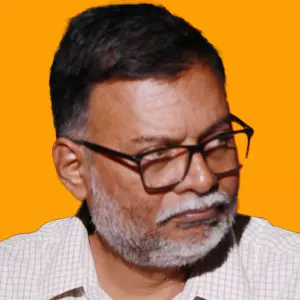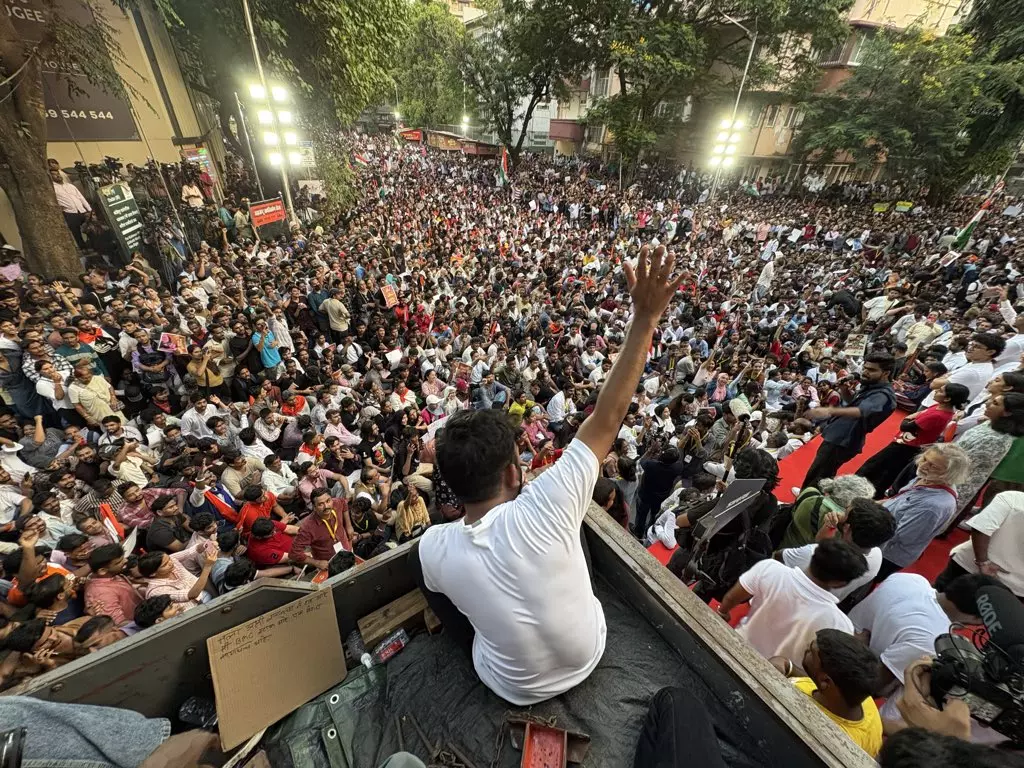
Cockroach Janta Party (CJP) founder Abhijeet Dipke waves at his supporters at a protest against CEC Gyanesh Kumar at Shivaji Park in Mumbai on October 2. Photo: X/@abhijeet_dipke
For the CJP, the inability to see through the government’s wily moves has proved to be a shortcoming
Has the troublesome “cockroach” been stamped out under the heavy boots of the state? It would seem so, at least for the time being.
Using unprecedented police power and legal hocus-pocus, the Modi government has managed to neutralise almost the entire top leadership of the Cockroach Janta Party (CJP).
On a high after the success of the anti-NEET demonstrations, which saw the resignation of Dharmendra Pradhan as education minister, the CJP led by Abhijeet Dipke was all set for another round of agitation at the Jantar Mantar and in Connaught Place when the central government went all out, in a series of questionable and unprecedented moves, that effectively shut out the protests.
CJP leaders sign bond
The young leaders of the CJP, including Dipke, Ashutosh Ranka and Sourav Das, find themselves entangled in a legal web that prevents them from effectively leading or joining any protest. All three have signed a bond before a police officer in the role of a special magistrate that they will not violate the peace.
Watch | Jantar Mantar to Diljit, are crowds making the Modi govt nervous?
This bond has become an albatross around the neck of the CJP leaders, preventing them from doing anything in public. The police, using blanket restrictions including curfew, prohibition orders, etc., have reportedly been stalking and randomly detaining youngsters in Delhi moving around in groups – especially if they are suspected of supporting the CJP.
Seeing how they have been entangled, another top leader of the student movement, Neha Bohra, has refused to sign the bond and has challenged it in court. Though not fully neutralised, she, along with her legal team, is now busy running around the judiciary in a bid to avoid signing the bond.
On paper, the bond’s validity is only until the police complete the enquiry into whether they broke any law when they attempted to gather at the Jantar Mantar on October 13, which had been denotified as a protest spot a day earlier. But, the point is that the enquiry can be stretched using legal means, keeping the peace bond valid and preventing any protest action by the CJP leadership.
How this will impact the future of the CJP is one thing. But, what the government’s actions signify is the spiralling importance of a movement that emerged from a mere meme – in response to the “cockroach” remark made in court by India’s Chief Justice.
Govt pushes CJP on the back foot
When Dipke returned to India from the US a few months ago, and a hunger strike was launched for the removal of Dharmendra Pradhan, the government hardly paid any heed to the bunch of youngsters behind it. To the government’s horror, it snowballed into such an unimaginably major protest that the Modi dispensation was forced to let go of one of its most senior and loyal ministers.
Also read: How the Modi government seeks to delegitimise anti-SIR movement
The pendulum swung the other way this time, when the anti-CEC protests were planned by Dipke and Co. The ruthlessness of the government’s move has pushed the CJP on the back foot, and the cockroach looks lost.
The power of students and youngsters in general is something that the world is witnessing in recent years. In a world where the Internet and social media have made it possible to know what’s happening anywhere in a matter of minutes, if not seconds, it is but natural for an event in one country to influence the other.
Ironically, the Modi government has allowed an anti-CEC rally at the Ramlila grounds on November 1 by the Congress party – indicating that the unaffiliated students are more of a threat than the leading Opposition party.
This shows that the government is confident of handling the formal Opposition but not students. An established political party follows a predictable pattern of protests, or any other action, that the government is used to dealing with. For the current BJP leadership, it has never been difficult to keep in check the Opposition – as most professional politicians have a coloured track record that the state can access at any time to cut them to size.
The list of politicians, earlier with the Congress, and now with the BJP is a long one. And, the party has successfully capitalised on state power to engineer defections and shut out the Opposition either by using coercive state agencies or simply co-opting the more difficult leaders into the BJP. So, an established Opposition party is easy prey.
Why dealing with students is different
The students are, however, a different ball game. They almost always cannot be subjugated by enticements and the state has no hold over idealistic youngsters who hold their cause worthy. Many of them said they had even argued, fought and broken away from their families who supported Prime Minister Narendra Modi.
The power of students and youngsters in general is something that the world is witnessing in recent years. In a world where the Internet and social media have made it possible to know what’s happening anywhere in a matter of minutes, if not seconds, it is but natural for an event in one country to influence the other.
Also read: Executive magistrate and preventive detention: Law behind CJP and AISA cases
Take the CJP’s movement to audit government schools across the country. The action raised an issue that was real, and mattered but few had bothered to expose their pitiable condition. The French movement on similar lines followed the CJP’s action. Of course, the protests took a different trajectory that was in the context of politics in that country.
A caveat here. In the 1960s, student movements spread across several nations – in Europe, US and Asia. But there was no Internet. One influenced the other through newspapers and the limited TV coverage that existed then.
There were also reports of individual student leaders travelling from one nation to another in their personal capacity, inadvertently influencing many more in the countries they travelled to. So, while the Internet now has made influencing or inspiring easier, it is not a necessary condition for protests to spread.
Governments and the larger establishment, have been unnerved by the power and influence of the youth-led movements. So much so, they have been trying to discredit them by alleging formal links with one another and accusing them of conspiring to destabilise governments.
It is not surprising that none of these allegations has been proven, as the issues raised by the young are real and cannot be wished away. And, each nation has its set of pressing issues that have been festering for long.
Nepal suffered endemic corruption, and the youngsters reacted, unwilling to put up with it. Bangladesh too faced a similar situation. On top of it Sheikh Hasina government’s ruthless use of security forces to clamp down on protests outraged the population, especially the young, leading to her overthrow. In India, it was the mismanagement of the education system that led to the widespread protests. And now, the protests are over fear that the Election Commission itself is subverting the electoral process.
If Round One went to the CJP-led movement, Round Two has been wrested by the Modi government. But the issues remain.
Similarly, France, Albania, Spain and Italy are grappling with their own internal troubles each unique to itself. If the French protests were triggered to reform the state of educational infrastructure, in Spain the protests have spread due to a shortage in housing and skyrocketing rents.
Can ‘cockroach’ bounce back in Round Three?
The Indian government and its security advisers have figured out that letting the CJP raise fundamental issues about education and the SIR-related changes to the electoral process will stir a pot too hot to handle.
For the CJP, the inability to see through the government’s wily moves has proved to be a shortcoming. But, the legal challenge to the so-called peace bond posed by Neha Bohra shows that it is waking up to the implications of signing it.
If Round One went to the CJP-led movement, Round Two has been wrested by the Modi government. But the issues remain. Controversial Chief Election Commissioner (CEC) Gyanesh Kumar continues in office, government schools and education need reforms, while the electoral process needs to be de-SIR’ed.
Does the “cockroach” have juice in it, to creep, crawl and fly in a third round of protests? We’ll have to see.