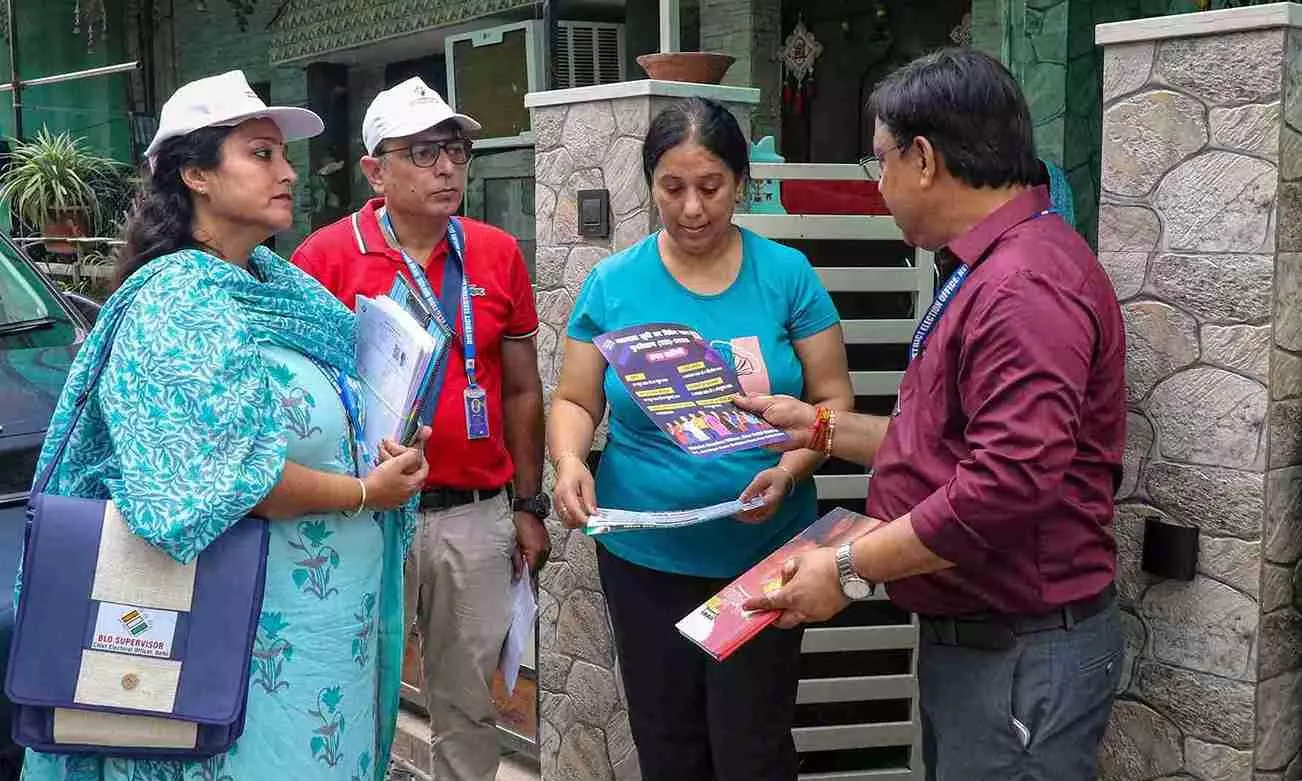
The EC's multi-phase SIR exercise has raised concerns about mass disenfranchisement and a lack of clarity about those excluded
Deleting 12 crore voters by categorising them as “ineligible” is a staggering accomplishment, for which the Election Commission of India (EC) has remained strangely tight-lipped. In world population rankings, 12 crore people exceed the total population of every man, woman and child of mid-size countries like Mexico and Japan. The deletions in India are of only adults, who now find themselves disenfranchised and stripped of their basic right to make a choice about who shall represent them when elections are held.
India’s electoral democracy
The number of voters currently stripped of their voting rights in India – the process that is still incomplete – fits in with the conclusions of the recently released indices on Varieties of Democracy (V-DEM), 2026, which rank India’s electoral democracy at its lowest level in 50 years. Democratic decline in India, that is, its progress towards “severe autocratisation”, is of global concern as “the most populous country in the world”, as its transition is contributing to the worldwide downslide of democracy.
It is absurd to imagine that 12 crore doubtful citizens live in India. It raises the question: then who are these 12 crore persons and why have their names been deleted?
Elections and democracy being inseparable, the V-DEM report holding the Election Commission responsible for failing to be impartial in its management is significant. It noted that the autonomy of the Election Commission as the body responsible for managing elections has sunk below zero, that is, a negative ranking. Contributing to the negative assessment are factors like harassment of political parties, intimidation by elected governments and other voting irregularities.
'Detect, Delete, Deport'
The jargon invented to defend EC’s management of SIR as a process necessary to 'Detect, Delete, Deport' ineligible, non-citizen and the “ghuspaithiya” or illegal immigrant, presumed to be a Muslim and mostly from Bangladesh, has created “havoc”, as a former Election Commissioner, SY Quraishi slammed it. The jargon hides the fact that voters listed as “under adjudication” were in fact cleared by EC as eligible voters, but suspect and therefore singled out for adjudication.
Also read: Karnataka SIR: Padma Shri awardee Harekala Hajabba gets EC notice over name discrepancy
The catch-all to 'Detect, Delete, Deport' purpose of the SIR neatly dovetailed into the ruling Bharatiya Janata Party's (BJP) paranoia about ghuspaithiyas running amok by masquerading as Indian citizens. Hence the multilayered verification of voters, with each layer or gate being invented to exclude voters rather than include them as eligible. This has, in effect, provided the grounds for V-DEM and the UN Committee for Racial Discrimination noting it is “gravely concerned about reports of large-scale violations perpetrated by law enforcement” and, second, that large numbers of voters have been excluded by SIR and Muslims in particular have been targeted for exclusion. It is perfectly possible that UN CRED has a bias, which goes with its job description of tracking racial discrimination; it is equally possible that it is not biased and takes responsibility for reaching a conclusion that is so very specific about targeting Muslims by excluding them from the voters list.
Questions over impartiality
Much reviled by the ruling BJP as a prejudiced assessment of the state of India’s democracy, the V-DEM report merely corroborates the opinion of former Election Commissioner Quraishi and Ashok Lavasa, opposition political parties, media organisations, research institutes and think tanks, civil society activists and the critical public at large, described by Prime Minister Narendra Modi from the ramparts of Red Fort on Independence Day as “Dimagi Naxals”, intellectuals who he figures are ideologically “Naxal”, whatever that may mean. The labyrinthine processes of the EC have raised concerns certainly in India and also across the world.
From Bihar to West Bengal
The Election Commission has adopted studied brevity in terms of explanations is in stark contrast to its loquacious justifications for a Special Intensive Revision (SIR) before it was launched in Bihar in 2024, followed by the West Bengal exercise, in which 90 lakh voters were excluded from the electoral rolls.
Between Bihar, where the first and beta version of SIR was launched in 2024, followed by West Bengal, EC deleted about 1.5 crore voters. The deleted voters and those included in the “draft roll”, but “under adjudication”, then went through a complicated and confusing process of re-verification.
Also read: Mass voter deletions during SIR: ‘Not voters’ responsibility to prove they are voters’
By the third round of SIR of electoral rolls covering 17 states and union territories, the galloping increase in voters deleted suggests that there is something strange about the revision. Thirty-three per cent of voters have been deleted in the National Capital Region (NCR); in Uttar Pradesh, heading to the polls in 2027, a massive 13.21 per cent of voters or about 3 crore adults, have been deleted from the electoral rolls. In Maharashtra, 21.14 per cent of voters have been deleted. Karnataka chief minister DK Shivakumar has called the 19.47 per cent deletions “massive and unjustified”.
Who are deleted voters?
It is absurd to imagine that 12 crore doubtful citizens live in India. It raises the question: then who are these 12 crore persons and why have their names been deleted? The ghuspaithiya argument for savage deletions in certain districts of West Bengal, like Murshidabad, Malda, North Dinajpur, pockets of Nadia, North and South 24 Parganas, Howrah and Kolkata, where Muslims are densely populated, is in line with the BJP’s Hindu majority is under attack from the demographic change agenda.
The fallout of the EC’s complicated manoeuvres in implementing the reinvented SIR as a process of purifying electoral rolls is far-reaching. Who and how will India deal with 12 crore and counting deleted voters, who are citizens, until they are found not to be citizens?
The deletions in Uttarakhand or Maharashtra or Telangana cannot be for the same reason, that is, ghuspaithiyas masquerading as Indian citizens. Does it mean that EC’s branding of SIR as a process of 'Detect and Delete' is the explanation? If so, then 'Deport' as the termination of the SIR process makes the entire process a politically driven exercise, which is why the impartiality of the institution has been called into question by V-DEM and UN CRED.
Citizenship is not EC’s job
Deporting non-citizens is emphatically not EC’s job; it is the Home Ministry’s. The Supreme Court’s Justice Joymalya Bagchi, in July, clarified, “The EC is not a constitutional authority regarding Articles 9, 10, 11 and 12 (dealing with citizenship rights) of the Constitution.” If citizenship is not automatically revoked for ineligible/deleted voters, then who are they?
Also read: On the voter list, yet deported? SIR throws up a new Bengal puzzle
Not permitting 12 crore adults to participate in elections means not just disenfranchisement as an immediate consequence; it means that the compact between voting and representation in the case of 12 crore people is ruptured.
The fallout of SIR
The fallout of the EC’s complicated manoeuvres in implementing the reinvented SIR as a process of purifying electoral rolls is far-reaching. Who and how will India deal with 12 crore and counting deleted voters, who are citizens, until they are found not to be citizens? The tribunals set up in West Bengal under Supreme Court orders are dysfunctional, as the apex court has now found out. The EC, by the same reckoning, is even worse; of the few thousand cases handled by the tribunals over disputed deletions, it restored the voting rights of about 90 per cent of the appellants.
If instead of verification of voters’ eligibility for inclusion the EC’s 'Detect, Delete, Deport' exercise lands India in a quagmire, a gridlock between the executive, judicial and political on the one hand and a potentially paralysed administration, at every level of government, then accountability, transparency and responsibility as values will be drained of all meaning. The SIR under the present EC leadership seems destined to become a significant part of India’s decline as a democracy.
(The Federal seeks to present views and opinions from all sides of the spectrum. The information, ideas or opinions in the articles are of the author and do not necessarily reflect the views of The Federal.)