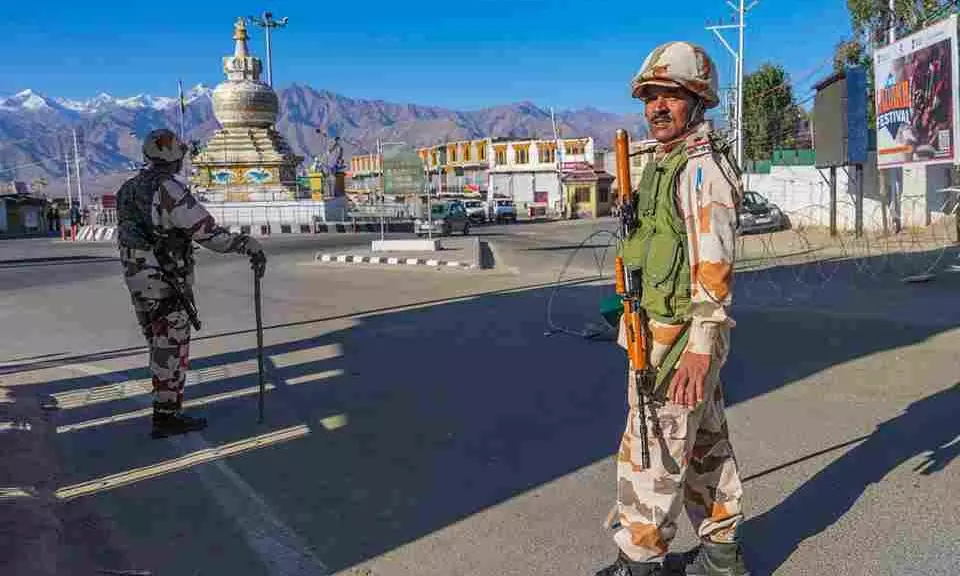
China’s objections to India’s naming of Ladakh’s geographical features have revived tensions, while the Dalai Lama’s succession and Beijing’s Tibet claims further strain bilateral ties
Just when it seemed Sino-Indian relations were heading towards normalcy in the aftermath of the BRICS summit that brought President Xi Jinping to Delhi, a fresh cartographic tussle has erupted between the two Asian giants over a long-disputed Himalayan border.
China has renewed its claims over Ladakh after India standardised the names of 28 locations in the Union Territory. Chinese Foreign Ministry spokesperson Mao Ning said in a recent briefing that Beijing had never recognised Ladakh’s status and rejected India’s move as “illegal and invalid”.
Ladakh and the border dispute
India says the naming exercise simply identifies locations on official Survey of India maps and does not alter sovereignty. New Delhi has reiterated that Ladakh is an “integral and inalienable” part of India, while rejecting China’s territorial claims. The fresh tussle on the disputed border comes at a time when both countries were trying to improve relations after years of serious border tensions.
China says now that it does not recognise the Union Territory of Ladakh and claims the western sector of the border, including Aksai Chin and parts of Ladakh, as Chinese territory.
Also read: Only stable LAC can normalise India’s ties with China, says Jaishankar
In October 2026, the Survey of India standardised the names of 28 geographical features (including peaks, passes, and land areas) in Ladakh. China's reaction was prompt and its Foreign Ministry spokesperson Mao Ning rejected the move as illegal and invalid, stating that Beijing has never recognised the Union Territory of Ladakh and that the western sector belongs to China.
India's Ministry of External Affairs (MEA) strongly rejected China's objections, reiterating that Ladakh is an "integral and inalienable part of India" and that internal cartographic naming does not require foreign recognition.
The cartographic double standard
While Chinese officials and state-owned media describe the Survey of India's naming exercise as provocative, Indian officials say China routinely publishes such lists, having so far released six of them on Arunachal alone, giving Chinese names to locations completely under Indian control since the 1950s. They say the Chinese army did not hold on to many of these locations they captured during the 1962 border war, so the claims have no real basis and are part of a Chinese strategy to pin down the Indian military, forcing it into costly, huge all-weather formation deployments.
The latest bout of cartographic face-off only serves to underscore the contention that an unresolved, festering border dispute will always derail efforts to normalise relations between the two Asian giants. Chinese reformist leader Deng Hsiaoping did tell India's late prime minister Rajiv Gandhi that bilateral relations can develop on all other fronts even if the border dispute remains unresolved. But despite two comprehensive agreements -- the 1993 Treaty of Peace and Tranquillity and the 2013 Border Defence Cooperation Agreement -- peace and normalcy have often been torpedoed by aggressive military commanders determined to assert claims by force of arms. The 2017 Doklam standoff and the bloody 2020 Galwan clashes only emphasise that durable peace between the two countries is not possible without a permanent border settlement.
The Tibetan question resurfaces
It is perhaps no coincidence that fresh trouble on the border has been followed by some tough talk from the exiled Tibetan leadership. The Dalai Lama, now 91, has said recently that the Tibetan cause will endure amid a turbulent global landscape and despite China's growing power and influence worldwide.
"The Tibetan issue will remain alive as the culture and religion is deeply rooted," he told News18.
For much of the world, the Tibetan cause has become inseparable from the Tibetan spiritual leader, and his advancing age has raised questions about the movement's future. In his book Voice for the Voiceless: Over Seven Decades of Struggle With China for My Land and My People, published in March 2025, he wrote that the struggle must not depend on his presence. He described it as being about "the very survival of an ancient people and their culture, language and religion."
Also read: As China salami-slices at LAC, India must not decouple border from bilateral ties
"Tibetans have spent nearly 75 years fighting for freedom. Their struggle should continue beyond my lifetime," he wrote. In 2011, the Dalai Lama passed on his political authority to an elected Tibetan leadership in 2011. The Central Tibetan Administration, based in Dharamshala, has since represented the exile community politically, while he remains its most prominent spiritual figure.
Beijing and the Dalai Lama's succession
In the days leading up to his 90th birthday in 2025, he confirmed that the institution of the Dalai Lama would continue, ending years of uncertainty over a successor. He announced that the sole authority to recognise his future reincarnation rests with his Gaden Phodrang Trust.
The announcement was a direct assertion of religious authority, in complete denial of Beijing's position that the Chinese government must approve the next Dalai Lama.
In some ways, Beijing's needless hardline on Dalai Lama is responsible for lack of meaningful progress on the Tibetan issue. By branding Dalai Lama as "splittist" and " a wolf in sheepskin" even when he had committed himself to a peaceful resolution by accepting Tibet as part of China, Beijing failed to exploit the opening at the end of the tunnel. It may have hoped that the Tibetan struggle would peter out after the Dalai Lama is dead and gone, but the new generation of Tibetan leadership may be more hardline than the spiritual leader. Tibet, like Hong Kong, was a fit case for the "One Country, Two System" paradigm and a final solution based on a recognition of Tibetan rights was possible with the Dalai Lama in the saddle.
(The Federal seeks to present views and opinions from all sides of the spectrum. The information, ideas or opinions in the articles are of the author and do not necessarily reflect the views of The Federal.)