Bharathiraja obit: Legend who shattered studio walls to give Tamil cinema its rural soul
The Padma Shri director's iconic collaborations with Ilaiyaraaja and his revolutionary visual style rewrote the grammar of Kollywood; he changed the Talkies to movies

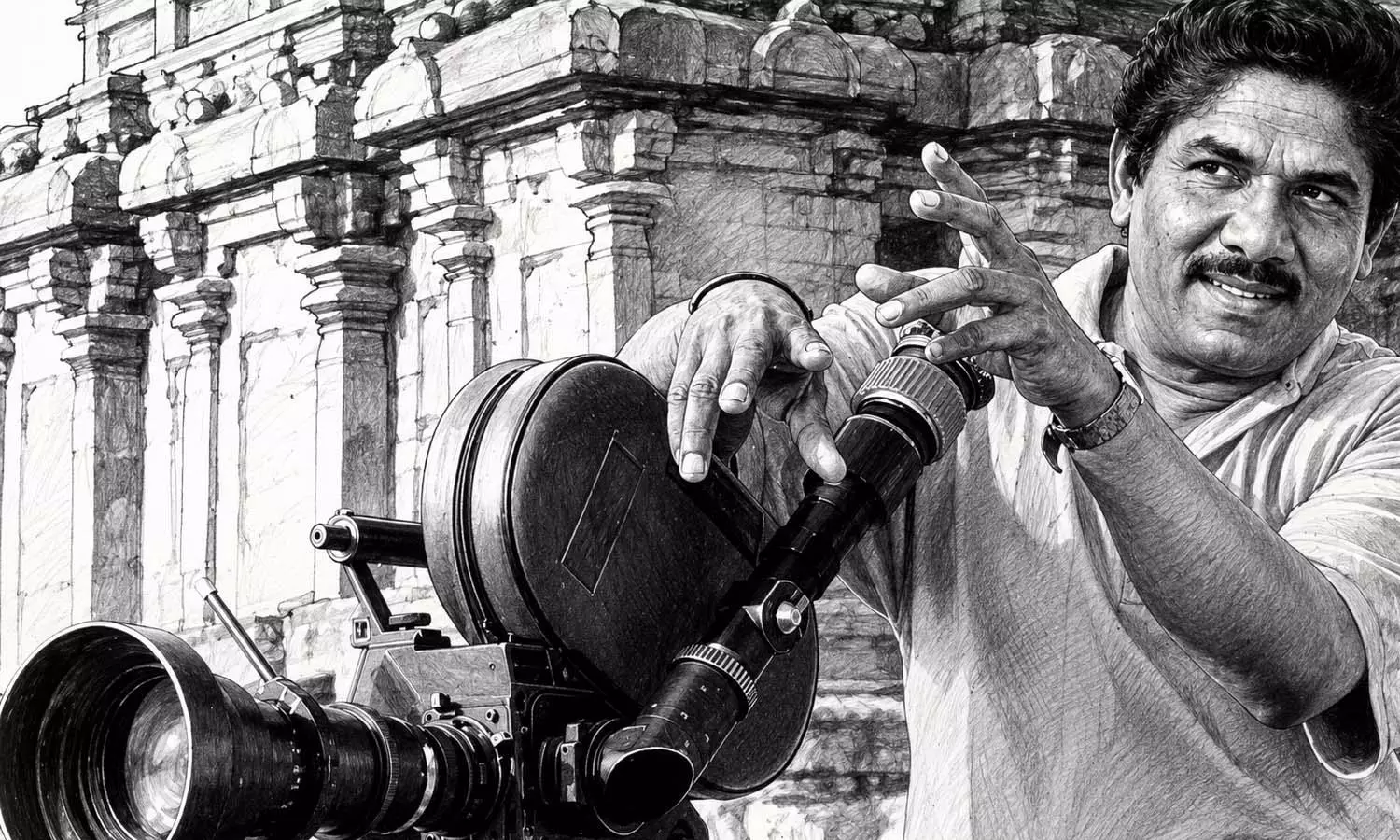
Hailing from a tiny village, Allinagaram, in the erstwhile Theni district of Tamil Nadu, Bharathiraja will always be remembered for transforming the Tamil film industry, spiriting it away from staged film sets created in massive studios in the then Madras to real village locations, in a celluloid journey towards realism.
Palpandi, who was born to parents Periyamaya Thevar and Karuthammal, later named Chinnasami in school records, called himself Viswabharati while enacting plays in Madras, finally became Bharathiraja, the film director. He was responsible for setting a new trend in Tamil cinema with his rural stories, along with his friend Ilaiyaraaja, who came up with folk tunes mixed with Western and Indian classical music to suit the setting and mood of his films.
This major switch that Bharathiraja orchestrated in Tamil cinema even led to the partial and full closure of reputed film studios and shook empires like AVM and Prasad Studios. It also brought in a new wave of directors, who altered the family, dialogue-driven, melodrama-oriented Tamil films and ushered in a new grammar to Tamil films. Bharathiraja was among the first directors to change the Talkies to to movies.
On Monday, June 10, Bharathiraja died of prolonged, age-related illnesses.
Also read: Bharathiraja obit: Why the filmmaker was more than the sum of his films
Until the mid-seventies, leading directors like Krishnan-Panju, AP Nagarajan, P Neelakantan, Sridhar, AC Trilokchander, and others would hire sets in Madras studios for months together to shoot an entire film. Outdoor shots were rare.
Bharathiraja, however, moved to outdoor locales along the Madurai and Ramanathapuram-Tirunelveli belt, using live audio and rustic film songs. The film industry was forced to follow suit and move to the villages to shoot their films.
However, it was the combined talents of story writer Selvaraj, lyricist Panju Arunachalam, Bharathiraja and Ilaiyarajaa, which ushered in a new wave in Tamil cinema.
Early life: Full of challenges
As a child, Palpandi or Chinnasami liked to act like Sivaji Ganesan, and would recite the dialogues from Veeerapandiya Kattabomman with gusto.
He would travel on a rented bicycle for 10 kms to watch films. His first attraction was the stage, and he would act in plays whenever opportunity arose in nearby villages and towns. He first came into contact with Ilaiyarajaa and his brothers, when he took charge as 'Malaria' inspector in the government health department in Pannaipuram, where Ilaiyarajaa was born.
They spent a lot of time together, talking about their dreams of working in the film industry in Madras. It was Chinnaswami who moved to Madras first in search of work, as an actor, which was always his dream. He staged plays in the city, changing his name to Viswabharati, and would often act as the hero.
Also read: Modern Love Chennai delivers but Bharathiraja and Thiagarajan Kumararaja's shorts are the best
When Ilaiyarajaa and his brothers came to Madras in search of film opportunities, it was Bharathiraja who supported them. He stayed in a bachelor's hotel, sharing a room with three others. Now, Ilaiyaraja and his brothers too moved into that small room, earning the wrath of the mansion owner. There they all survived, struggling even to get one meal a day.
Ilaiyarajaa and his brothers, who called themselves the Pavalar Brothers, would take care of the music for Bharathiraja's plays. When Ilayaraja and his brother Bhaskar got an opportunity to work in GK Venkatesh's troupe, they urged the latter make Bharathiraja the assistant to director Puttanna, a legendary name in Kannada cinema.
Bhaskar, much to Bharathiraja's chagrin, 'advised' him to give up acting and take to direction instead.
Bharathiraja makes a mark
It was this move to Bengaluru as become Puttanna's assistant that changed Bharathiraja's life, and turned him into an ace director.
His initial attempt to make a film with singer-friend SP Balasubrahmanyam failed. After the success of Annakili and the launch of Ilaiyarajaa as a music director, things opened up for Bharathiraja and his brand of rural cinema too.
16 Vayadhinile, with Kamal Haasan, Sridevi and Rajnikanth, witnessed the arrival of a new generation of actors, music directors, story-writers, technicians, assistant directors. This also paved the way for directors like Mahendran, cinematographers like Kannan and Balu Mahendra. Bharathiraja saw more success with Kizhakke Pogum Rail and Pudhiya Vaarpugal.
To prove his critics wrong that he could handle only rural-based subjects, he made a psycho-thriller Sigappu Rojakkal and a modern film in Tik Tik Tik, which proved to be ahead of their time in terms of treatment.
The Bharathiraja-Ilaiyaraaja brand continued to dominate in films like Aalaigal Oivathillai, Mann Vasanai, and a different version of Sivaji Ganesan in Mudhal Mariyadhai. There were some films which didn't do well like Nizhalgal and Kadhal Oviyam, which broke the director's heart.
Friends part ways
A misunderstanding led to parting of ways with Ilaiyaraaja. The filmmaker famously said: "An Ilaiyaraaja can exist without Bharathiraja, and a Bharathiraja can exist without Ilaiyaraaja."
In the next few years, Bharathiraja struggled to make a mark, and had a hit only with Vedham Pudhidhu. This was the situation until the arrival of AR Rahman in Roja.
K Balachander, Bharathiraja and lyricist Vairamuthu, all of whom had a tiff with Ilaiyarajaa, now began working with Rahman.
Bharathiraja had success with Kizhakku Seemaiyile and Karuthamma, but his efforts to make his son Manoj hero came a cropper. Despite Rahman's music, these films flopped, creating a new crisis for Bharathiraja.
A desperate attempt to renew ties with Ilaiyaraaja, with whom he made three more films, helped him in Nadodi Thenral, though the old magic could not be re-created. He made remakes of some of his Tamil films in Telugu and Hindi. His Hindi films, in particular, failed at the box-office..
Honouring Bharathiraja
Bharathiraja won six National Film Awards, four Filmfare Awards (South), six Tamil Nadu State Film Awards, and was honoured with the Padma Shri award as well, but towards the end, he halted his directorial ventures mid-way and turned to acting. He largely did aged, character roles, which brought him money and some fame, and kept his hopes alive in the film industry.
His dreams as an actor were partially realised but his son Manoj's death in 2025 shook him.
Bharathiraja's legacy is that he inspired several directors and assistant directors, introduced lyricists like Vairamuthu, promoted many of his assistants like Bhagyaraj, Manivannan, Manobala, Ponvannan, provided the launch pad for actors like Karthik, Radha, Revathi, Pandian, Chandrasekhar, Napoleon and so on.
He became an industry by himself. In the last few years, he had health problems, and struggled to carry on. His funeral will be carried out with state-honours. The film industry has announced that there would be no shooting for 12 hours on Thursday (June 11) from 6 am, as a mark of respect to Bharathiraja.
Truly, Tamil cinema must be classified as 'Before Bharathiraja' and 'After Bharathiraja', as he was the one who changed cinema to a more visual medium, as it should have always been.