



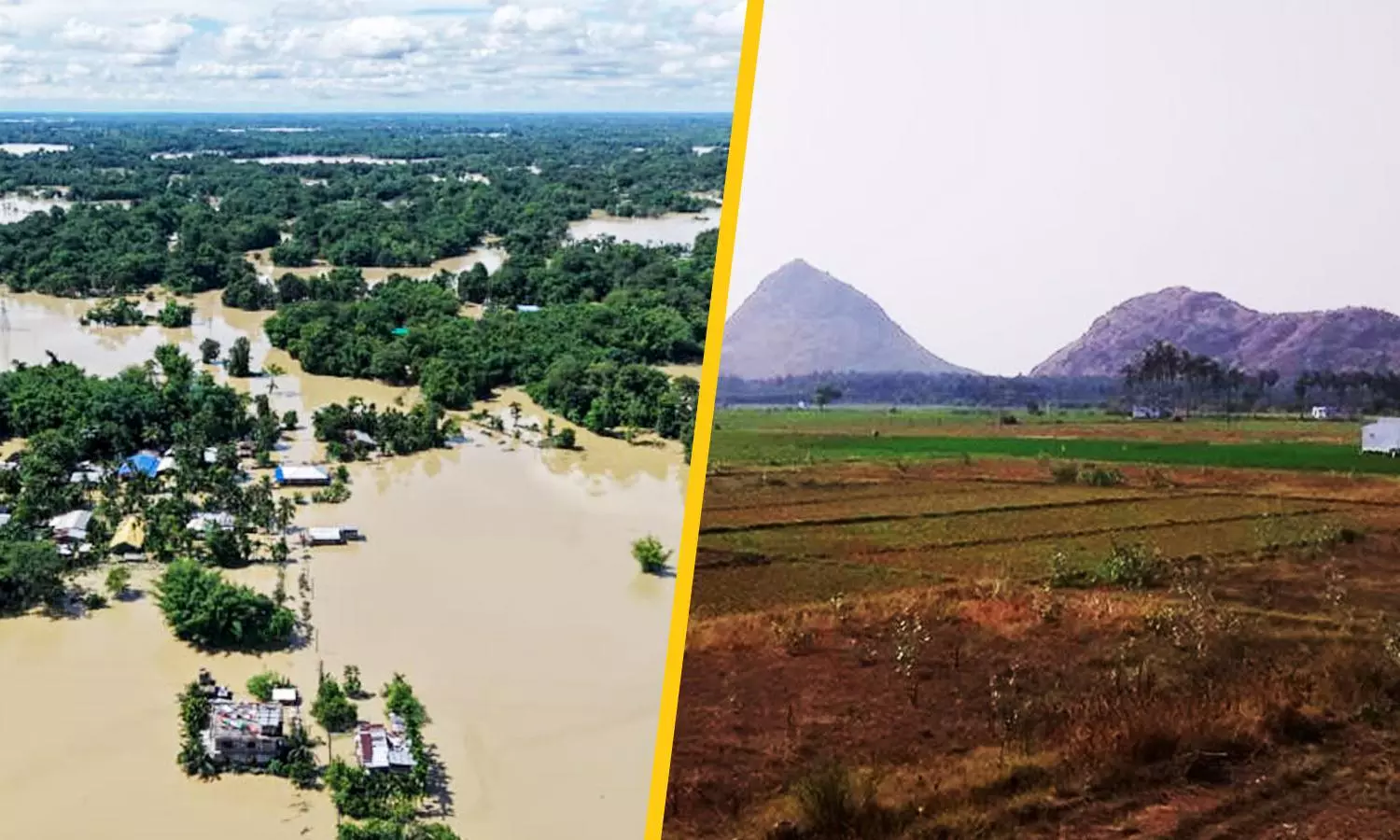
Flood here, drought there: A tale of two Indias in monsoon
2026 monsoon exposes a climate divide yet again, with floods striking some states while prolonged dry spells threaten agriculture, water security, livelihoods in others

India's monsoon is unfolding as a tale of two extremes. While floodwaters have inundated large parts of western and north-eastern India, several states in the south, east and central regions continue to battle rainfall deficits and drought-like conditions.
The contrasting weather pattern, now becoming a recurring feature of the Indian monsoon, is being linked by climate experts to a warming climate, erratic rainfall cycles and the influence of El Nino.
Also read: Karnataka Deputy CM calls state drought crisis 'extremely serious', seeks Centre's urgent help
The contrast is stark. Gujarat is grappling with widespread flooding after days of incessant rain, while Karnataka nearby is facing intense drought-like conditions due to a prolonged dry spell. In the Northeast, Assam and Nagaland are reeling under floods even as parts of Arunachal Pradesh and Manipur continue to struggle with inadequate rainfall.
IMD’s fresh warnings
West Bengal, Jammu and Kashmir, Mizoram and parts of Arunachal have also witnessed flood-like situations, while Jharkhand, Goa, Delhi, Telangana and Maharashtra remain among the states facing significant rainfall shortages.
The India Meteorological Department (IMD) has now sounded fresh warnings, issuing a Red Alert for Odisha as a deep monsoon depression crossed the West Bengal-North Odisha coast. Heavy to extremely heavy rainfall has been forecast for more than 18 states over the coming days, raising the threat of flash floods, landslides and river overflows across several regions.
Changing pattern
The unusual split between floods and drought is no longer an isolated event. Climate scientists say the Indian monsoon has increasingly shifted from delivering widespread, steady rainfall to producing highly localised, short-duration bursts of intense precipitation. Instead of rain being evenly distributed across the season, much of it now falls over a few days in select regions, leaving neighbouring states unusually dry.
Also read: Why in India, the monsoon is as much music as season
One of the biggest drivers behind this changing pattern is El Nino, the periodic warming of the central and eastern Pacific Ocean that disrupts global weather systems. El Nino traditionally weakens the southwest monsoon by reducing moisture transport towards the Indian subcontinent.
However, researchers say climate change is amplifying its impact. Rather than uniformly suppressing rainfall, El Nino now appears to concentrate available moisture into fewer but much more intense weather events.
2026’s southwest monsoon
This year's monsoon offers a clear example. The season began with an unusually weak spell, leaving large parts of the country facing severe rainfall deficits through June and early July. By the middle of July, India's cumulative rainfall was still 23 per cent below normal, with Central India recording a staggering 76 per cent weekly deficit and the Southern Peninsula 77 per cent below average during the early part of the month.
The rainfall shortage had immediate consequences. Around 54 of India's major reservoirs fell below 80 per cent of their historical storage levels, while southern states saw live storage decline by nearly 36 per cent compared with the same period last year. The situation raised concerns over drinking water supplies and delayed sowing of kharif crops in rain-fed agricultural regions.
Dramatic shift
Within weeks, however, the weather pattern reversed dramatically. A series of low-pressure systems and a deep depression over the Bay of Bengal injected enormous amounts of moisture into central and northern India, triggering widespread heavy rainfall. While the downpours brought relief to some rain-deficit areas, they also unleashed flash floods, landslides and overflowing rivers in several states.
Also read: From Himalayas to plains, relentless rains trigger floods, landslides: More than 50 dead
Meteorologists point out that these powerful weather systems often dump enormous volumes of rain over one region while leaving nearby areas largely untouched. As a result, one state may experience devastating floods while another, continues to struggle with drought.
Experts also caution that the impact of extreme rainfall is not determined by weather alone. Cities such as those in Gujarat and Assam are increasingly vulnerable to urban flooding because rapid concretisation has reduced the ground's ability to absorb rainwater, while inadequate drainage systems worsen waterlogging. Conversely, prolonged dry spells prevent reservoirs and groundwater aquifers in deficit regions from being adequately replenished, increasing water stress and affecting agricultural output.
Climate change
The broader backdrop is climate change. Twelve of India's 15 warmest years on record have occurred since 2006, with rising temperatures intensifying both extreme rainfall events and flash droughts.
Also read: Subdued monsoon leaves much of India dry; heavy rains batter Uttarakhand, Himachal, Bengal
Studies have also shown that nearly 39 per cent of India's flash droughts now occur during El Nino years, highlighting how global climate variability is interacting with long-term warming.