



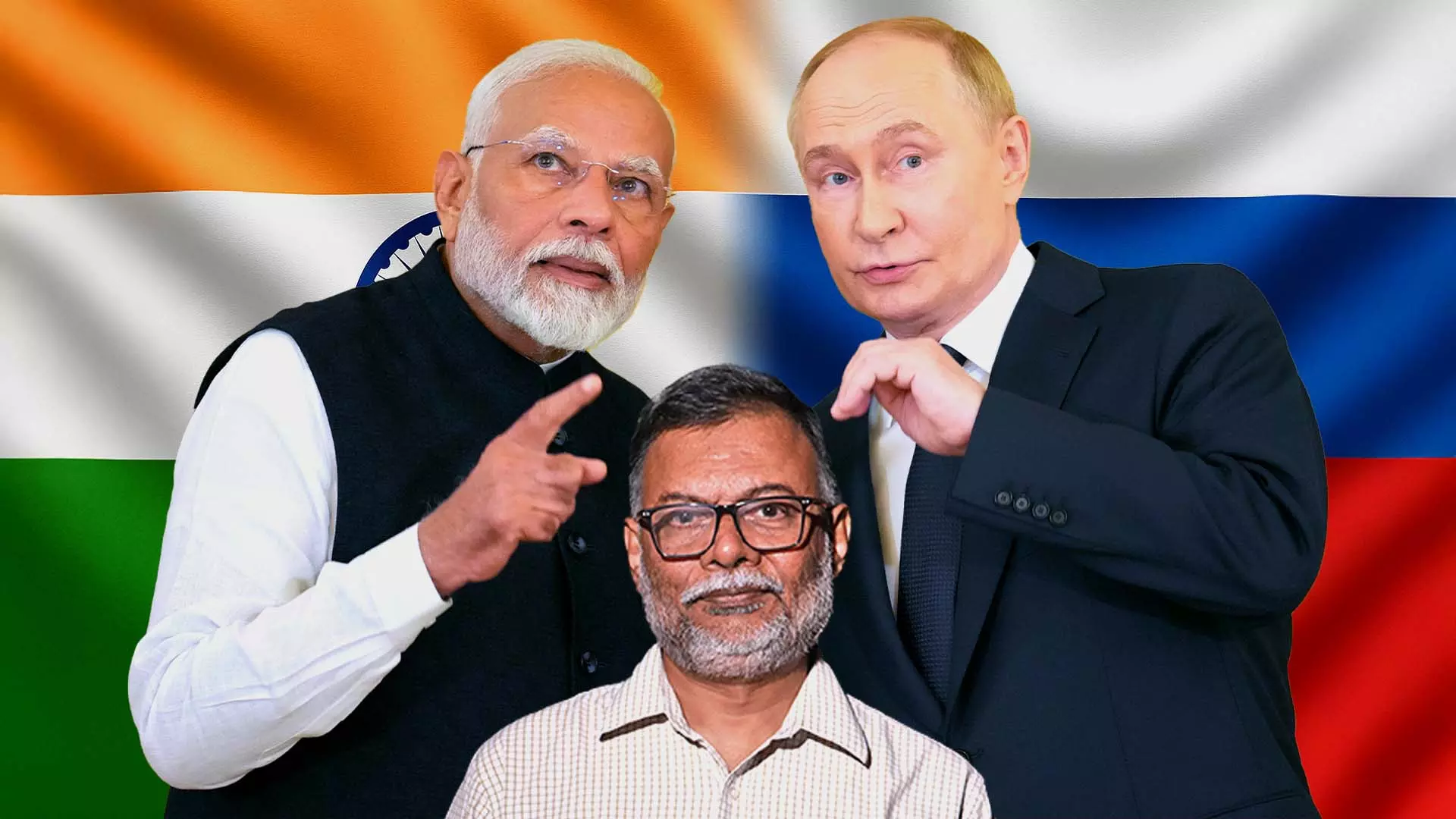
Putin's India visit: 'It's a message to West and US'
Putin arrives in Delhi as India navigates US pressure, sanctions, defence deals, and strategic autonomy. What will this high-stakes visit deliver?

The Federal spoke to KS Dakshina Murthy, consulting editor and senior observer of international affairs, on Russian President Vladimir Putin’s visit to India. He explains why the visit matters, how it fits into India–US tensions, and what it means for regional geopolitics.
How significant is Putin’s visit at this moment of global shifts?
This visit to India is one of Vladimir Putin’s rare trips outside Russia since the war began. With issues around the International Criminal Court, he is cautious about leaving Russia, and New Delhi is one of his comfort destinations.
The visit reflects the trust and deep friendship between Russia and India. Recent strains, especially Donald Trump asking India to stop importing Russian oil, could have created resentment, but there is no visible sign of that. Putin seems to have taken it in stride.
The summit is expected to deepen the existing relationship. Putin also wants to show that Russia is not isolated and still has friends, including India. The visit carries larger geopolitical meaning because of the Russia–Ukraine war and the global polarisation between US-led nations and countries aligned with China. India remains friendly with both sides, trying to balance them.
Putin’s visit is also a signal that Russia values the relationship and wants India to reciprocate.
Do Trump’s tariffs push India closer to Russia, and what message does hosting Putin send Washington?
This summit had to go ahead, especially after Trump’s punitive tariff of 25%, combined with India’s 25%, raised the total to 50%. This became a reality check for India. It showed that the United States does not hesitate to take negative steps despite a strategic partnership.
Trump did not impose similar tariffs on China, Turkey or EU nations, which also deal with Russia. So the move appears to single out India, hurting the foreign policy establishment.
India needed to assert itself. Hosting Putin and moving ahead with major decisions sends that message. India is furthering arms trade, including purchases such as the Su-57 stealth fighter, and deepening nuclear energy cooperation from Kudankulam to small modular reactors.
These wide-ranging initiatives signal that India is conducting foreign policy on its own terms, regardless of pressure from Washington.
Is India preparing for a deeper multi-sector reset with Moscow?
Yes. Russia’s lower house, the Duma, recently ratified the logistics deal signed in February. This is a crucial pact. It allows Russian military personnel to be based in India and Russian naval ships to berth in Indian ports. India can do the same in Russia.
This level of access and cooperation does not exist even with the United States. It marks a significant opening that brings India–Russia ties close to the depth once seen during the Soviet era.
After the Soviet Union disintegrated, this is perhaps the most consequential pact India has signed with Russia. It will have far-reaching implications for military, strategic and logistical cooperation.
Is the summit also meant as a geopolitical message?
Yes. It sends a message to the West and the United States, and a message to Russia that India still values the partnership.
The Modi government must show that nothing has fundamentally changed despite pressure from Trump. Russia remains crucial for India’s strategic interests in Asia. Russia’s close relationship with China helps India maintain regional stability because it prevents China from acting unpredictably.
With China and Pakistan closely aligned, that balance matters. A strong relationship with Russia also helps India indirectly on Afghanistan because Russia was the first country to recognise the Taliban, giving India diplomatic openings.
Everything is interconnected. The summit is not only a signal to Washington, it is also essential for India’s long-term strategic position in the region.
The content above has been transcribed from video using a fine-tuned AI model. To ensure accuracy, quality, and editorial integrity, we employ a Human-In-The-Loop (HITL) process. While AI assists in creating the initial draft, our experienced editorial team carefully reviews, edits, and refines the content before publication. At The Federal, we combine the efficiency of AI with the expertise of human editors to deliver reliable and insightful journalism.


