'India moving towards single-party rule on China model': Vinod Sharma | Interview
The veteran journalist told The Federal that TMC rebels merged into a ‘shell party’ and warned of falling political morality; he also felt the Congress must run a ‘mother’s kitchen'

The Trinamool Congress's (TMC) rebel MPs merging with an obscure party is just the latest symptom of a deeper rot, says veteran journalist Vinod Sharma, who argues India is drifting towards single-party rule on the Chinese model.
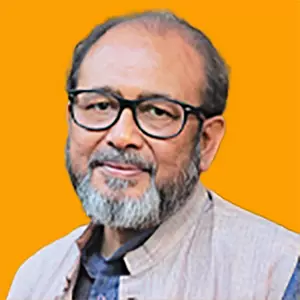
As 20 of the party's members of the Lok Sabha merge with the little-known Nationalist Citizens Party of India (NCPI) to avoid the anti-defection law, the question being asked across the political spectrum is: how far has Indian democracy fallen? To find an answer, The Federal spoke with Sharma, Political Editor of Hindustan Times and one of India's most experienced political journalists.
Here are some excerpts from the interview
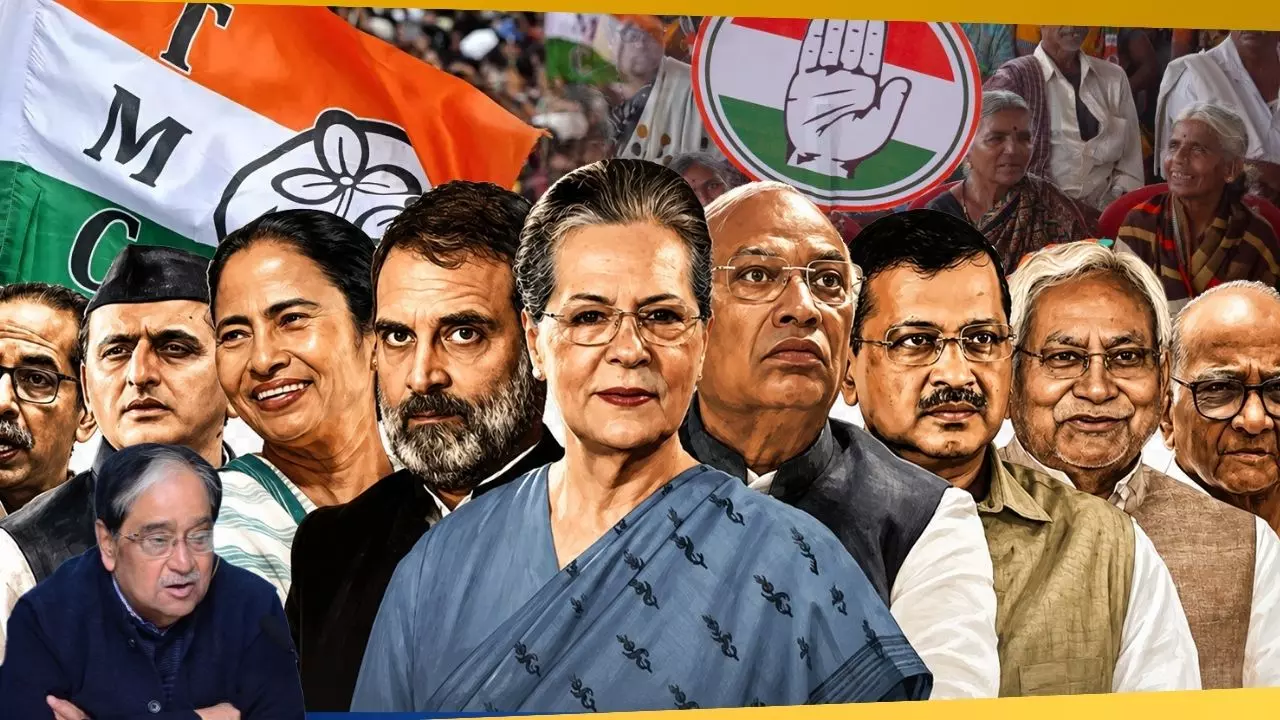
There is a lot of buzz about a grand reunion — TMC, NCP (Sharad Pawar faction), and other regional parties returning to the Congress fold. Is this imminent?
I don't see it as an imminent reality, though it's a good idea. There's an old saying: let all good men — and not-so-good men — come to the aid of the party. But I wonder whether this so-called grand reunion will have all the alphabet, as it were, across the political spectrum.
Also read: Rahul Gandhi as Parashuram? Panel calls Varanasi act misguided | Capital Beat
Over the years, these smaller parties have started treating their support base as their own fiefdom. They thought that in a divided polity, their purpose was better served by staying alone or independent, rather than being part of a bigger political party. The NDA (National Democratic Alliance) itself is one example — smaller parties but a bigger presence at the Centre.
So it's a good idea, but I wonder whether somebody can actually do it. It's not easily doable.
You mentioned 2004, when the UPA was formed. Could something similar happen now?
In 2004, the UPA (United Progressive Alliance) was not done by the Congress alone. There were other seasoned politicians — people like Harkishan Singh Surjeet and others who were active and brought Mulayam Singh Yadav on board. Mulayam was always very strong about keeping his identity, and he did keep it, and yet he was part of the government.
The question now is: does the Congress party have the political wherewithal to bring these parties together under one umbrella? Does it have the gravitas, or rather the political promise, to do it?
There is talk that with Mamata Banerjee weakened, Rahul Gandhi is now more naturally accepted as the leader of the entire opposition. Do you agree?
I hear a lot of people saying the ground is now clear for Rahul to be accepted as the leader of the entire opposition — that those who did not accept him earlier will now accept him.
I think this is a premature assessment. The Congress Party has to put its own house in order first. It has done some smart moves recently — appointing the chief minister in Kerala, who was a legitimate claimant to the office, rather than appointing someone close to Rahul, which would have been a non-starter. Likewise in Karnataka, they have brought in D K Shivakumar — who was waiting in the wings. Siddaramaiah stayed for three years, which I think brought him enough respect for his seniority and his popular appeal as a legitimate inheritor of the Devaraj Urs ideology.
Karnataka was resolved amicably, and so was Kerala. But let's see whether the Congress can electorally retain the states it has, including Himachal Pradesh.
What is your assessment of Rahul Gandhi as Congress president?
He is the de-facto president of the Congress. What works in politics is not de jure — what works is de facto. But is he willing to take credit and also the blame for difficult decisions? Because he is not upfront on many issues. He leaves it to (Mallikarjun) Kharge or others in the party to take the credit or take the blame.
Also read: Why Rahul Gandhi, flaws and all, remains the Opposition’s best bet
Sonia Gandhi's strength was that she was broadly perceived as a consensus builder. Before a big decision, she would speak to all senior leaders and then take a call. But when she did take a unilateral decision, it carried the day — precisely because she was otherwise seen as a consensus builder. Rahul has yet to evolve as a leader in that sense.
There is also the media problem. Yesterday's Kota rally was impressive, but it was not adequately publicised. It suddenly happened, and unfortunately, the mainstream media is not very responsive to what the Congress does. Even during the Bharat Jodo Yatra, the initial media response was very tepid — it was only after they crossed the Vindhyas that the media said, "Oh, this is for real." Congress has many loose ends to tie.
You have called the NCPI — the party the TMC rebels merged with — a shell party. Can you explain?
Till now, we had heard of shell companies, where you park your ill-gotten wealth. Now we are seeing shell parties, where you park your ill-gotten MLAs or MPs. That is exactly what has happened in the case of the Trinamool splinter group.
It is a registered but not recognised party. Registered with the Election Commission, but not recognised. It was a way to avoid legal complications under the anti-defection law while maintaining political proximity to the BJP-led NDA.
In over four decades of watching Indian politics, have you ever seen political morality this low?
No, I have not seen it. I came into the profession during the Emergency (1975-77), and I was a research associate with All India Radio. I know what was going on in the name of the 20-point programme and Sanjay Gandhi's 7-point programme.
But there was something called "aankh ki sharam" (fear of public shame) in politics. That has gone. That has completely vanished. You would talk about the prime minister saying "Congress Mukt Bharat" — later, the RSS revised that statement and they don't repeat it often. But he also said other things when he entered Parliament for the first time — he spoke about Team India, about cooperative federalism. Where are those slogans today? Where is cooperative federalism, when states ruled by the opposition keep protesting that they are not getting their legitimate share of central taxes?
Where exactly is India headed? Is this Congress-Mukt Bharat, or something more?
It is not Congress-Mukt Bharat. It is not Opposition-Mukt Bharat. What the entire system is moving towards is single-party rule — the Chinese model. The BJP, ever since it came to power, used to say their party would become bigger than the Communist Party of China. On paper today they claim to be the largest political party in the world. And most things in politics are on paper.
What about the four pillars of democracy — how are they holding?
About the media, the less said the better. There is a famous saying: in a country where there is no free media, there cannot be democracy. Democracy is sustained by criticism — it is not weakened by criticism. But now that theory is being turned on its head. If you criticise, you are weakening the country; you are being anti-India.
Also read: Sushmita Dev exclusive: ‘TMC rebels have taken a huge risk’
The political parties are masquerading as the nation itself. D K Barooah once said, "Indira is India, India is Indira." Now that is everyday conduct — proved by the everyday behaviour of the ruling party and the executive. All principles have been abandoned. There is no limit to the pursuit of power. There is no limit to retributive politics. There is no limit to moves aimed at destroying your rival rather than measuring up to him.
What about the Congress being labelled a "Muslim party" — how do you see that charge?
I find it very odd and ironical. My respect for Atal Bihari Vajpayee was always there, despite him being a leader of the BJP, with whose ideology I did not agree one bit. In 1984, he kept the secular character of the Indian vote intact by openly campaigning for the Sikh vote. His party got reduced to two seats. But he kept the flag of electoral democracy flying high. That was the value of the man.
When I was posted in Pakistan at the time of the Babri Masjid demolition, I went to collect newspapers at the High Commission the next morning. Liaqat Baloch — the parliamentary party leader of Jamaat-e-Islami — was standing at the gates of the commission. He looked at me and said, "Kya karwa diya hai, Sharma? (what have you done, Mr Sharma?)"
I told him: This is not a Hindu-Muslim question. This is a battle between secular and non-secular India — between secular forces and non-secular ones. Muslim voters in India repose their trust in non-Muslim secular leadership. I took the names of Mulayam Singh Yadav, K P Unnikrishnan, Chandra Shekhar. Liaqat Baloch had no answer.
I feel the Congress Party is somewhere forgetting its own foundational principles by becoming very defensive on the Muslim question. It should not. The Congress was the party that came out of the freedom struggle. That was a badge it should wear with honour, not apologise for. Being true to that is being true to the dream India dreamt for itself at Partition.
On the UP Assembly elections — can the Congress-SP alliance repeat 2024?
In 2024, they got the right slogan at the right time. The BJP, in its complacency, walked into their trap by saying "Abki baar 400 paar (this time, we will cross 400)". The opposition said: this is a conspiracy to abandon the Constitution and snatch away your rights. Rahul went around holding a copy of the Constitution, and that Red Book became the symbol of their campaign. People understood that what they have, they have because of the Constitution.
Also read: At 60, Shiv Sena battles its biggest survival crisis; will the tiger roar again?
The problem today is whether they can carry forward that narrative — that the BJP wants to destroy the multi-party structure of this country. That multi-party structure is the reason for any democracy, because it gives people choices. And the BJP has been, right from its (Bharatiya) Jana Sangh days, a Vikram-Betal kind of party — always looking for a Vikram whose shoulders it could ride on, and then destroying those very people. Look at the Janata Dal, the JD(U), the JD(S) — where are those parties now? These were the bulwarks of social justice against the BJP's temple movement.
And the Election Commission — what is your verdict on how it has conducted itself?
History will judge this Election Commission as one that presided over an election whose sole aim was to make a political party win, and not help the people elect the party of their choice. That is largely believed by most people — and I think even BJP people, deep down in their hearts, would know this.
Five or six former chief election commissioners and election commissioners publicly questioned this mode of operation. And the Supreme Court of India has not done anything to correct those aberrations. The Supreme Court said SIR — the Special Intensive Revision — was valid. But who was questioning that? We were questioning the integrity of the process. Was the process honest? That was the question the people were asking.
Also read: Rahul reaffirms ties with Stalin despite Congress-DMK rift in Tamil Nadu
These very institutions — the judiciary — it was the judiciary that disqualified Indira Gandhi. It was the judiciary that gave the Kesavananda Bharati judgment, which stated the basic structure of the Constitution shall not be tinkered with. The headcount of MLAs has to be done on the floor of the House, not at the governor's residence. They have delivered milestone judgments. They have a history. But they are giving that history short shrift. And the new history that is being created is not something you would want taught in school textbooks.
What is the one thing the opposition — and the Congress in particular — must do now?
If the situation requires that you subsume your entity into that of another party in order to strengthen democracy, strengthen people's rights, and affect the change of government you want — then you have to do it. The BJP wants a permanent majority in this country. They have progressed a long way toward that goal. They have to be stopped in their tracks.
And for those within the Congress — the leaders will also have to be large-hearted. They have to give space to everybody. The Congress has to run a mother's kitchen. If a partner is a trifle weak and another a trifle stronger, you assign them different tasks — but at the dinner table, you serve everyone the equal meal. That is the principle of a mother's kitchen.
The content above has been transcribed from video using a fine-tuned AI model. To ensure accuracy, quality, and editorial integrity, we employ a Human-In-The-Loop (HITL) process. While AI assists in creating the initial draft, our experienced editorial team carefully reviews, edits, and refines the content before publication. At The Federal, we combine the efficiency of AI with the expertise of human editors to deliver reliable and insightful journalism.