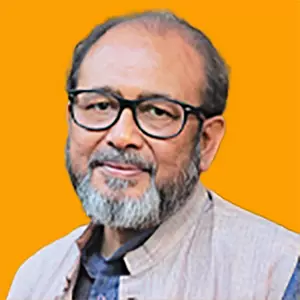
Education and social inclusion key to ‘Viksit Bharat’: Economist Sanjaya Baru
Sanjaya Baru says India’s 2047 goals risk stalling without an independent global strategy; India needs to articulate their position clearly on West Asia crisis

Economist Sanjaya Baru believes that India cannot succeed in building a Viksit Bharat and achieving Atmanirbhar Bharat without stronger investment in education, social cohesion, and an independent global strategy.
Arguing that these ideas are not new, the former media advisor to Prime Minister Manmohan Singh, said inclusive growth, ensuring that every Indian is part of this journey, and clear national priorities, are crucial for Viksit Bharat to succeed. In this episode of Off the Beaten Track, The Federal spoke to Sanjaya Baru — senior journalist, and author of The Accidental Prime Minister — on whether India is on the right path to becoming a developed nation by 2047.
Edited excerpts:
How do you interpret the idea of Viksit Bharat? What should India look like by 2047?
First of all, the idea of becoming a developed economy and being self-reliant goes back to our national movement and the Constitution itself. From the very beginning, we aspired to regain our position as a major global economy.
We are a post-colonial country that suffered nearly 200 years of colonial rule. Our goal was to rebuild—economically, industrially, agriculturally, and intellectually. Self-reliance meant having the capability to produce what we need across sectors.
Also read: Modi calls for 'Reform Partnership Charter' to drive Viksit Bharat
Historically, India accounted for nearly 25 per cent of world income in 1700, which dropped to less than 5 per cent by 1950. Since independence, the aim has been to reclaim that space. So, Viksit Bharat is not a new idea. It is part of a long-standing national strategy. What has changed is the urgency—the sense that now is the time to accelerate.
Is the current government following the right strategy to achieve Viksit Bharat and Atmanirbhar Bharat?
Domestically, successive governments—from Narasimha Rao to Vajpayee, Manmohan Singh, and now Modi—have all aimed to strengthen India’s economic capacity.
If you look at growth trends, India moved from about 0 per cent growth between 1900 and 1950 to 3.5 per cent between 1950 and 1980. Then it rose to 5.5 per cent until 2000, and about 7.5 per cent between 2000 and 2015. However, in the last decade, growth has slowed to around 6.5 per cent.
The key question is: why has this acceleration slowed? That needs serious examination.
On foreign policy, India historically stayed non-aligned, focussing on development rather than power rivalries. More recently, we’ve moved to “multi-alignment.” But, I believe, we may have gone too far in aligning with the United States, especially at a time when global tensions are disrupting growth.
Are we investing enough to achieve a knowledge-driven, self-reliant India?
This is perhaps our biggest challenge. If you compare India with China, the difference lies in investment in education and the knowledge economy.
China invested heavily in education at all levels, in research and development, and in building human capability. That has paid off enormously.
In India, our performance in education and R&D has been weak. Unless we invest in skills, knowledge, and human development, we cannot achieve either self-reliance or developed status.
Also read: Is NITI Ayog overly optimistic about Viksit Bharat and Net Zero goals?
We also face two worrying trends: brain drain and what I call “wealth drain.” Many educated Indians leave the country, and increasingly, financial capital is also moving abroad. This weakens our development process.
How important is unity and inclusion for Viksit Bharat?
It is absolutely critical. India has always faced twin challenges: economic development and managing internal diversity.
We are a country of multiple religions, languages, castes, and identities. The Constitution recognised this and created a federal structure to accommodate diversity. Development cannot happen if sections of society feel excluded—whether in the Northeast, Kashmir, or the South. Everyone must feel they are part of the national project.
An inclusive society is essential for a developed economy.
Can India achieve Viksit Bharat without strong social cohesion?
In the short term, perhaps. But in the long run, internal divisions increase the cost of governance. They impose a burden on the system, divert attention, and slow down decision-making. Development becomes more expensive and less efficient.
You need every section of society to feel invested in the system—through representation, language rights, and economic opportunities. Divisive politics ultimately harms growth.
How do you view the political narrative around past leaders and current policy?
In a democracy, political parties will differentiate themselves—that’s natural.
Also read: British giant Rolls-Royce unveils mega India plan; to be part of Viksit Bharat
But it’s important to recognise that every government over the past 80 years has contributed to building India. Yes, mistakes were made, but they were part of the learning process. Leaders like Nehru and Indira Gandhi faced enormous challenges and showed courage, especially in dealing with global powers.
My concern today is that we are not showing the same level of assertiveness, particularly with the United States.
Is India’s global strategy aligned with its development goals?
That is my concern. The United States today is pursuing a strategy of dominance, and it has said so explicitly. We should be clear that this is not our project. India must assert its independence and not be seen as aligning with any major power bloc.
Global conflicts—like those in West Asia—are hurting developing countries through rising oil prices and disrupted trade. India should speak out more clearly.
If we want to be the voice of the Global South, we must articulate our position firmly.
What is the key to achieving Viksit Bharat and Atmanirbhar Bharat?
We are all aligned on the goal of making India a developed and self-reliant country. But to achieve that, we must focus on inclusive development, invest in education and knowledge, and assert our national interests globally.
We cannot afford internal divisions or external dependency. Development must be broad-based, and every Indian must feel they are part of this journey.
The content above has been transcribed from video using a fine-tuned AI model. To ensure accuracy, quality, and editorial integrity, we employ a Human-In-The-Loop (HITL) process. While AI assists in creating the initial draft, our experienced editorial team carefully reviews, edits, and refines the content before publication. At The Federal, we combine the efficiency of AI with the expertise of human editors to deliver reliable and insightful journalism.