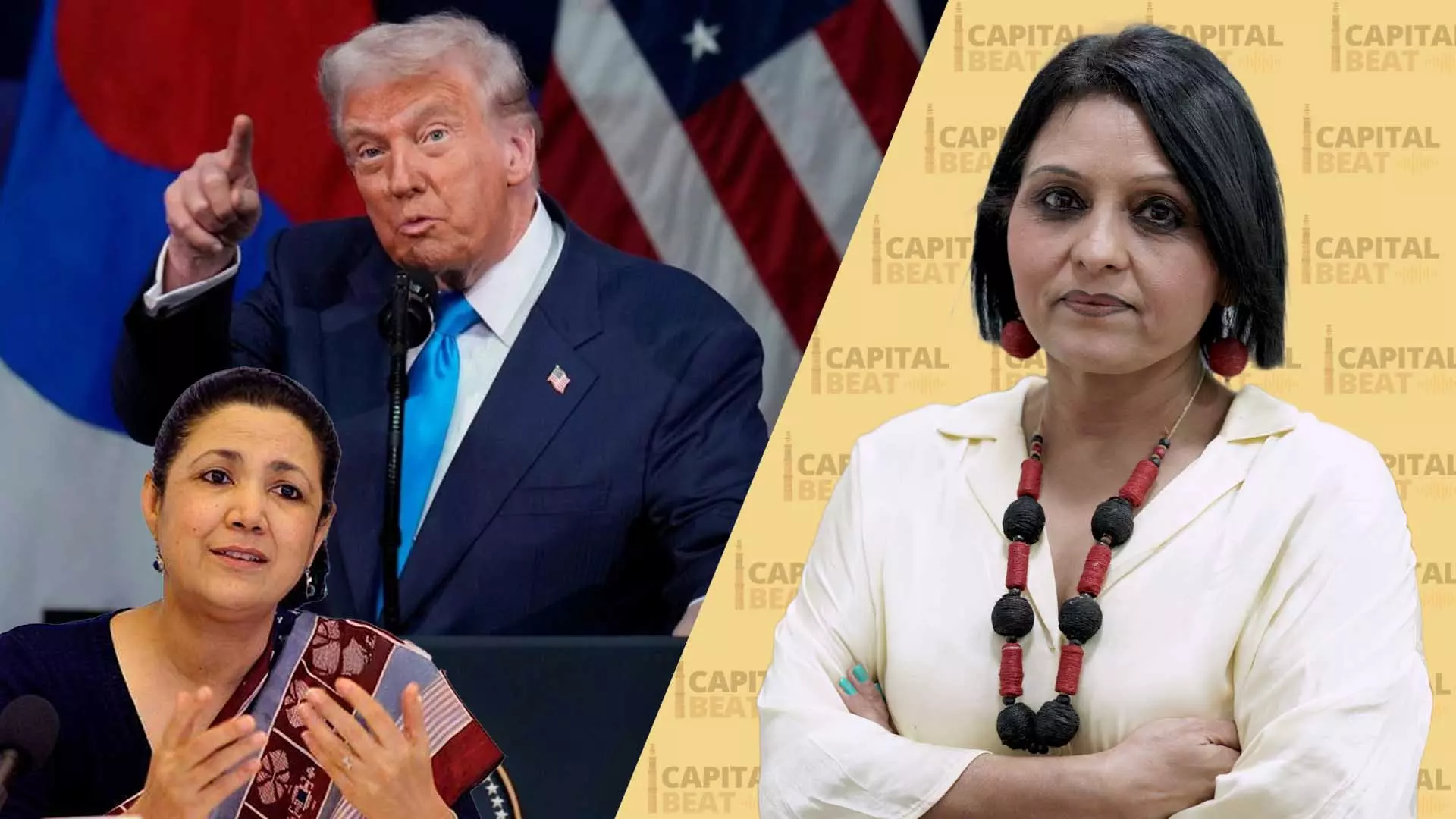
What does US Supreme Court ruling on Trump’s tariffs mean for India? | Capital Beat
With the Supreme Court striking down Trump’s reciprocal tariffs, India now faces new decisions on trade negotiations and its next steps with the US

In this Capital Beat episode, The Federal spoke with former ambassador Meera Shankar to unpack the implications of the US Supreme Court striking down US President Donald Trump’s sweeping reciprocal tariffs.
With Trump announcing a fresh 10 per cent universal tariff and insisting that “nothing changes” for India under a proposed trade framework, the ruling has sparked political reactions in New Delhi and raised fresh questions about India’s negotiating space.
With the US Supreme Court striking down the reciprocal tariffs, what does this mean for India, and what choices lie ahead for New Delhi?
According to me, the Supreme Court judgement means that, as of now, we go back to the MFN tariffs under the WTO, which were an average of about 3 per cent US tariffs. President Trump has imposed a 10 per cent tariff under Section 122 of the US Trade Act, which will be in addition to the MFN tariffs.
I don’t think that the tariffs that were being negotiated are automatically valid. As far as India is concerned, we have not yet signed even the interim deal. What we had was a framework, an understanding on a framework, which still has to be fleshed out into an actual agreement.
So, for India, it would be important to wait and watch. We need not be in a hurry to conclude the deal. Our trade team is in Washington right now. It would be important for them to come back and consult with legal experts here and in the US, and of course with the political leadership, on how this is going to impact the way forward.
Right now, waiting and watching is probably the best policy because we don’t know what the US will do next. The Supreme Court has said Trump exceeded his authority under the International Economic Emergency Powers Act, the law under which he imposed the reciprocal tariffs.
Now, Trump and his team are looking at other provisions of US trade law — including Sections 122, 301 and 232 — under which tariffs can be imposed. Under Section 122, there is a limit: he cannot impose more than 15 per cent, and it applies only for 150 days. Under Section 301, there has to be an investigation that concludes unfair trade practices are taking place. So, there are procedures and processes. It is not something that can be done instantly through executive authority.
Trump has said India will pay the tariffs and that “nothing changes.” Is that just political rhetoric?
He is going by the framework that was negotiated — or at least the broad understanding within which the interim arrangement was being finalised. That understanding specified that there would be an 18 per cent tariff on Indian exports, and India would reduce its duties on US industrial products substantially, preferably to zero.
So, he is reflecting what that understanding was. Now that the Supreme Court has held these tariffs to be invalid because they exceeded legal authority, Trump seems to assume the deal will automatically continue.
But for India, it is important to consider the implications and wait to see what course the US takes.
The Opposition has argued that India acted in haste and should have waited for the court verdict. Did India rush into the framework?
India held out longer than most countries, except perhaps China. Many countries negotiated asymmetrical deals quickly with the United States — for example, Vietnam agreed to zero-duty access for US goods while paying 19–20 per cent duties.
It is true that most assessments suggested the US Supreme Court was likely to overturn the tariffs imposed under the International Economic Emergency Powers Act. The Constitution gives Congress the authority to impose taxes and tariffs. Financial appropriations are done through Congress. The president has more leeway in foreign policy than in domestic economic policy.
At several points, there was speculation that the judgement was imminent. The questions and remarks from the justices during hearings indicated they were inclined to see this as a breach of constitutional authority. But the timing was uncertain. On more than one occasion, it appeared the judgement would come, and it did not.
So, while there was an expectation that the court might overturn the tariffs, there was no certainty about when that would happen.
Does the verdict give India more leverage to renegotiate? Can India insist on reverting to older tariffs?
It certainly provides space. Since the deal has not been finalised and there is no agreed text of an interim trade deal, India can say it is taking stock of the new situation and needs consultations.
We need to see how other countries respond — those that worked out trade deals with the US. This is a moment to pause.
Does India have the option of approaching the WTO if Trump persists?
The WTO dispute settlement mechanism has been virtually non-functional because the US has blocked appointments to the appellate body. So, even if India challenges the US, it is unclear what effective relief would come from that.
If a large number of countries collectively challenge the US, that is a different matter. India has previously moved at the WTO, but given the current situation, it is uncertain what outcome one can expect.
Realistically, how much room does India have to renegotiate?
We need to wait and see what the US does. Trump has already imposed a 10 per cent universal tariff under Section 122. They may explore other sections, but each has limitations. Under Section 122, there is a 15 per cent ceiling and a time limit.
Under Section 301, they must conduct an investigation and specify unfair trade practices before imposing penalties. In the past, for example, the US withdrew GSP benefits for certain Indian pharmaceutical exports on intellectual property grounds. But that was sector-specific, not across the board.
Other provisions also have limitations in imposing broad-based, high tariffs.
Does the legal basis of the earlier 25 per cent reciprocal tariffs now disappear entirely?
Yes. The legal basis under which the 25 per cent reciprocal tariffs were imposed is no longer valid. Those tariffs revert to the status quo — meaning the MFN tariff, plus the 10 per cent universal tariff Trump has now announced.
Unless a bilateral agreement is formally concluded — which, as of now, has not happened — the earlier reciprocal tariffs cannot stand.
Is this verdict a win-win for India?
The US Supreme Court verdict certainly improves the situation for India because it gives more space in terms of legality.
However, it does not rule out the possibility that Trump may try to impose similar tariffs through other legal mechanisms or even seek Congressional approval. If Congress approves them, they cannot be challenged on the same grounds.
But that would involve debate and dissent, even within the Republican Party. It is not something he can do instantly.
So, the best course for India right now is to pause and see how the US responds beyond the 10 per cent tariff and how other countries interpret the judgement.
Can Trump use other tools such as embargoes? What mechanisms are available?
Section 301 allows tariffs if there is a finding of discriminatory trade practices. Section 232 deals with injury to domestic industry. Section 122, on national security grounds, offers the biggest leeway but still caps tariffs at 15 per cent.
Even these provisions have limitations in scope and duration. The US team is clearly exploring possibilities because a major plank of Trump’s platform has been undone by a 6–3 verdict from a conservative-majority court.
Can India now take a tougher negotiating stance?
There are power asymmetries in the economic field between India and the United States, and those asymmetries will continue. When negotiating, one must keep relative strengths in mind.
But certainly, the verdict gives more space. There is no need for India to rush into deal-making. The prudent course is to wait and watch.
The content above has been transcribed using a fine-tuned AI model. To ensure accuracy, quality, and editorial integrity, we employ a Human-In-The-Loop (HITL) process. While AI assists in creating the initial draft, our experienced editorial team carefully reviews, edits, and refines the content before publication. At The Federal, we combine the efficiency of AI with the expertise of human editors to deliver reliable and insightful journalism.