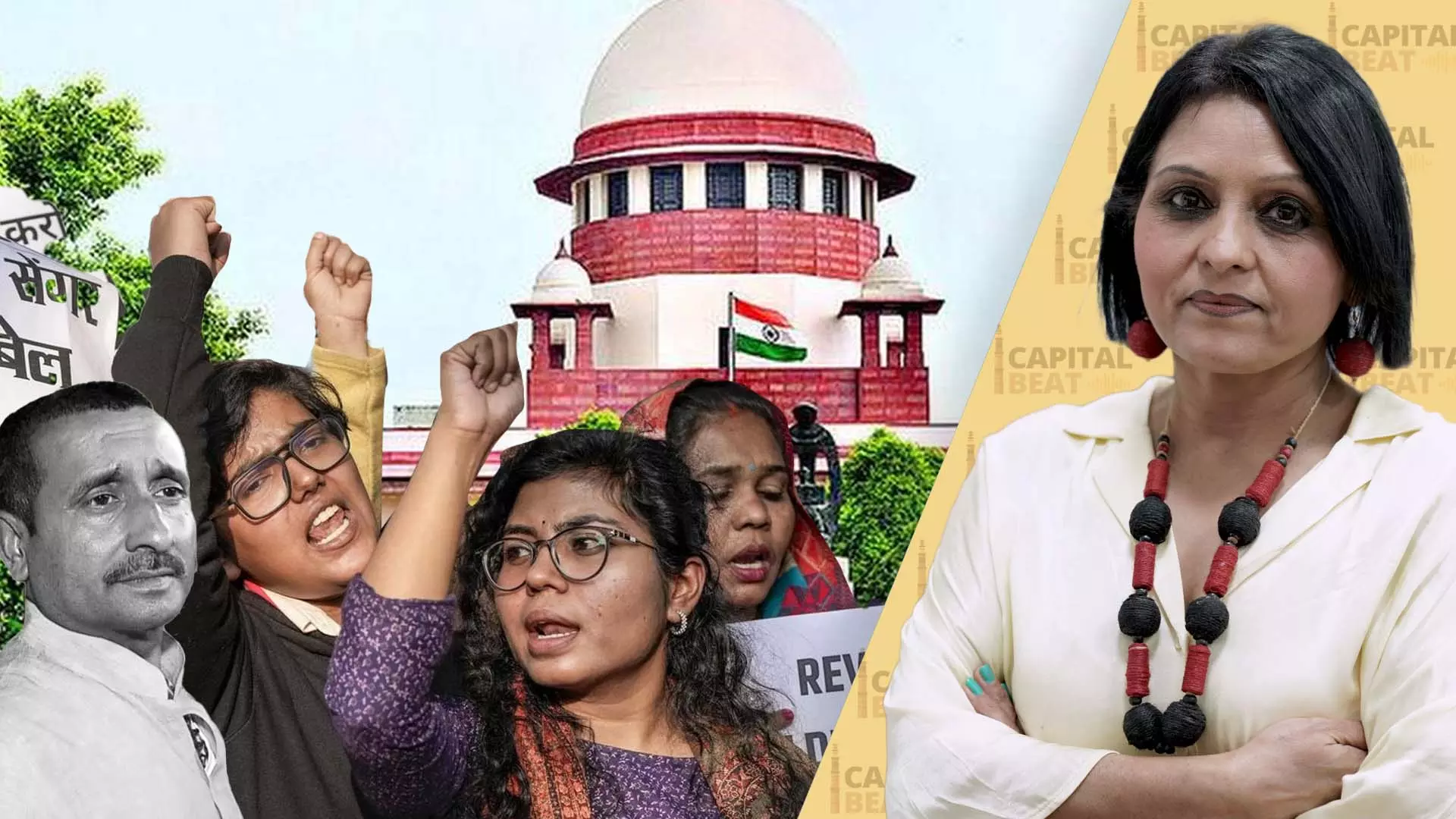
Unnao rape case: Did public outrage influence SC's decision to stay Sengar's bail?
The Capital Beat panel discussed the legal questions before the court, the survivor’s prolonged struggle, and the implications of public pressure and judicial scrutiny as the case awaits further hearing

In the latest episode of Capital Beat, Sunita Aron, consulting editor of Hindustan Times, and Tara Rao, social activist, discussed the Supreme Court’s stay on the Delhi High Court order granting bail to former BJP MLA Kuldeep Singh Sengar in the Unnao rape case. The discussion focused on the court’s concern over the interpretation of “public servant” under the POCSO Act, the implications for the survivor, and the continuing legal process.
The Supreme Court was hearing a CBI plea challenging the Delhi High Court’s decision to suspend Sengar’s life sentence and grant him bail during the pendency of his appeal against conviction. The apex court expressed concern over an interpretation that could treat a constable or patwari as a public servant under POCSO but exclude an elected MLA.
Also read: ‘We were not heard’: Sengar’s daughter on SC stay in Unnao case
The Bench, comprising Justice Surya Kant, Justice JK Maheshwari and Justice Aravind Kumar, issued notice to Sengar and stayed the bail order, noting that substantial questions of law required consideration. The court observed that a bail order in favour of a convict should not ordinarily be stayed without hearing the accused, but made an exception as Sengar had not been released and remained in custody in another case.
SC flags legal questions under POCSO
The case centres on whether an elected MLA qualifies as a “public servant” for the purpose of aggravated offences under the Protection of Children from Sexual Offences (POCSO) Act. Sengar has contested the charge of aggravated penetrative sexual assault, arguing that under Section 22 of POCSO, the definition of “public servant” is drawn from Section 21 of the IPC, which does not explicitly include MLAs.
During the hearing, Solicitor General Tushar Mehta submitted that the POCSO Act does not define “public servant” and must be interpreted contextually. He referred to Section 42A of the Act, which gives it an overriding effect, and argued that for POCSO, a public servant should mean a person in a dominant position over a child, where misuse of that position attracts aggravated offence provisions.
Also read: 'Won't rest until he is hanged': Unnao rape survivor after SC judgement
It was contended that Sengar, as a powerful MLA at the time of the incident, exercised dominance over the survivor. When asked whether the status of public servant becomes irrelevant once the victim is a minor, the Solicitor General responded affirmatively, stating that penetrative sexual assault was an offence on the date of the incident and aggravation depended on circumstances such as abuse of dominance.
HC order stayed, survivor awaits next hearing
The Supreme Court stayed the Delhi High Court order dated December 23 that had suspended Sengar’s life sentence and granted bail. The apex court noted that the matter would be heard again after four weeks.
Aron described the stay as relief for the survivor but emphasised the prolonged nature of the legal struggle. “Anybody who is elected by the public has more responsibility towards the people than anybody else,” she said, referring to the debate on whether elected representatives should be treated as public servants.
She described the argument accepted by the High Court as “a very technical point” and said it had led to widespread dissatisfaction. Aron pointed to public reactions and international perceptions, recounting a personal interaction during travel where questions were raised about crimes by public representatives and continued electoral support.
Trauma and prolonged legal struggle
Aron highlighted the continuing impact on the survivor, stating, “The poor thing has to continue fighting the battle in the court again, again go through that trauma of repeating what has happened.”
She referred to multiple crimes connected to the case and said the survivor’s battle had been ongoing for several years. “Even now, even after the Supreme Court, because it’s just a stay, you don’t know what the final judgment would be,” she said.
She also spoke about public reaction and political responses, stating that silence from those in power had drawn criticism. Aron said the survivor’s struggle raised broader questions about women’s security and institutional support.
People’s outrage and media scrutiny
On whether public outrage influenced the court’s intervention, Aron said, “Definitely. It’s not only people's power. I think the media has also played a very important role.”
She said public criticism on social media and sustained media attention kept the issue alive. Referring to the “Beti Bachao” slogan, Aron said repeated scrutiny had focused attention on the gap between rhetoric and action.
“The system did not support her anywhere at any point of time,” Aron said, adding that the survivor’s fight was carried forward by people, lawyers and media scrutiny.
Tara Rao on law, justice and power
Rao questioned how a person serving a long sentence could seek release during the pendency of an appeal. “This is not a problem of one person. This is a problem that every person is concerned and should be,” she said.
Rao framed the issue as part of a broader relationship between women, violence and power. “This relationship is the most unhealthy one that we persist with,” she said, adding that the struggle extended beyond a single case.
She described a disconnect between law and justice, stating, “We are now battling with this relationship of law and justice, as if they are two distant cousins.”
Public vigilance and continuing battles
Rao said the case reflected a larger test of public resolve. “This is one such battle testing whether people will come out,” she said, adding that fatigue could not be allowed to set in.
She stressed that each legal and social struggle should strengthen public resolve. “This one hits everyone. We all have women in our lives,” Rao said.
On whether public pressure influenced judicial action, Rao said the conviction already existed and questioned the grounds on which relief was sought. “There is law and there is justice and they are both on the side of the survivor,” she said.
Debate over definition of ‘public servant’
The discussion returned to the Supreme Court’s concern about excluding elected representatives from the definition of public servant under POCSO. Aron described the court’s observation as significant, noting that it raised questions with potential implications beyond the case.
She said such observations could offer “a new lease of life” if they led to legal reform, but questioned the political will to act. “Which state Assembly would pass the resolution? Will the MLAs agree to it? I don’t think so,” Aron said.
She recalled debates following the Nirbhaya case, where punishment and deterrence were widely discussed, and said arguments about technical definitions risked diluting accountability.
Open letter by Sengar’s daughter
The panel also discussed an open letter written by Sengar’s daughter to the authorities. The letter described fear, social targeting, and loss of faith in institutions, while appealing for fairness and due process.
Rao said she found the letter confusing in its framing. “He has been convicted in the court of law,” she said, emphasising that the verdict must stand. While acknowledging that children of convicted persons should not face harassment, she said, “Your father must remain in prison given what the verdict was.”
She called for proportionality, stating, “Let’s also provide that same kind of respect, dignity and empathy for the girl who was only 15 years old who was brutally raped.”
Empathy and rule of law
Aron said she could empathise with the daughter’s personal situation but questioned the timing of the letter. “Why was she silent all these years?” she asked, noting that the letter emerged after the Supreme Court stayed the bail order.
She reiterated that the rule of law must prevail. “He wouldn’t have been convicted if he had not done it,” Aron said, adding that public support or opposition should not influence judicial outcomes.
Aron also said the case could see further public mobilisation, but maintained that the survivor’s relief lay in the Supreme Court’s intervention and the forthcoming hearing.
(The content above has been transcribed from video using a fine-tuned AI model. To ensure accuracy, quality, and editorial integrity, we employ a Human-In-The-Loop (HITL) process. While AI assists in creating the initial draft, our experienced editorial team carefully reviews, edits, and refines the content before publication. At The Federal, we combine the efficiency of AI with the expertise of human editors to deliver reliable and insightful journalism.)