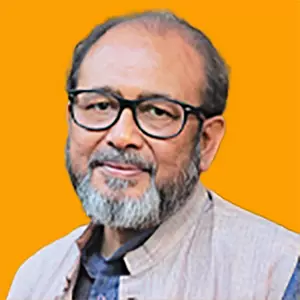
Professor Sukhadeo Thorat interview
Higher education at a crossroads: NEP, equity and UGC rules under scrutiny | Interview
From UGC anti-discrimination rules and NEP rollout to privatisation and the ‘Indian Knowledge System’, Prof Sukhadeo Thorat explains what lies ahead

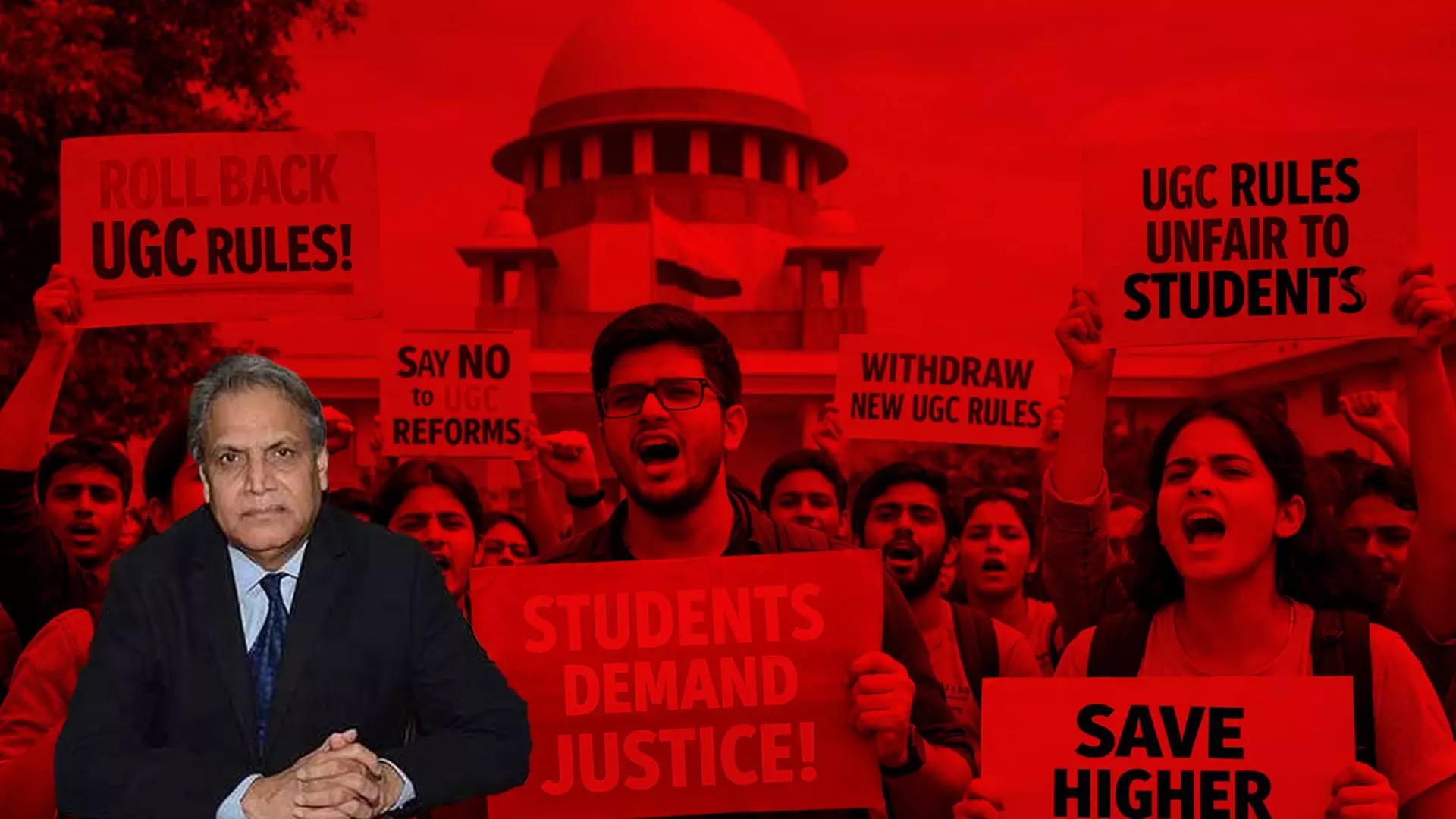
A sweeping set of higher education reforms — framed as anti-discrimination safeguards and quality upgrades — has instead exposed deep fault lines around caste, access, and the future of Indian universities. From protests against new UGC regulations to the Supreme Court’s decision to pause their implementation, the debate has widened into a broader reckoning over whether India’s education system is becoming less equitable under the New Education Policy. The Federal spoke to Prof Sukhadeo Thorat, economist and educationist, on why fears of “reverse discrimination” lack evidence, how policy changes are reshaping access to higher education, and why the current reforms risk entrenching inequality rather than addressing it.
Is there evidence of “reverse discrimination” under the new UGC rules?
I believe this argument is completely unfounded. The UGC’s 2026 regulations improve on the 2012 regulations framed under the UPA government. Those 2012 rules were taken to the Supreme Court by the mother of Rohith Vemula, arguing that despite the safeguards, her son faced discrimination that ultimately led to his death. The petition sought stronger implementation.
The revised regulations aim to strengthen protections. The current objection is that caste is already part of the general definition of discrimination, so separately naming SC, ST and OBC could lead to reverse discrimination. This does not hold up. Complaints are examined by an equity committee. There is no automatic presumption. In 11 years of the 2012 rules, there has not been a single documented case of reverse discrimination or mala fide misuse by SC, ST or OBC students.
Why is this claim being pushed now?
This is political and ideological, not legal. We have laws against untouchability, atrocities, religious discrimination, and sexual harassment. No one says remove them because they may be misused. But when caste is named directly, there is discomfort.
Over the last decade, resistance has grown to acknowledging caste as a social reality. It is part of an attempt to avoid bringing caste and untouchability into public discussion — including through curriculum changes where Ambedkarite and Dalit-related content has been reduced or removed.
What happens next after the Supreme Court paused the 2026 rules?
The 2012 regulations will continue for now. The court has suggested an expert committee may refine the 2026 regulations to remove legal ambiguities. I expect the framework to return with improvements. The next hearing on March 19 will be important.
What is your core objection to the 2020 New Education Policy?
The biggest issue is that it was introduced without a serious study of the higher education system. The last national policy was in 1986, followed by a Programme of Action in 1992. For nearly 37 years, reforms stayed within that framework.
Earlier commissions like Radhakrishnan and Kothari studied universities and colleges, collected data, and consulted widely before recommending changes. The 2020 policy relies on “best practices,” often borrowed from the US, without analysing how India’s system has transformed — especially through privatisation.
How has privatisation changed higher education?
Privatisation is now the dominant feature. More than half of universities are private. Around 65% of colleges and about 67% of standalone diploma and certificate institutions are private.
This still understates the reality because public institutions have also been privatised through self-financing courses. They charge high fees because grants are inadequate. In Karnataka, for example, once you include self-financing courses in public institutions, nearly 73% of students are effectively paying private-level fees.
How do “quality reforms” end up hurting equity?
Many reforms claim to improve quality but indirectly reduce access for poorer students.
One major example is replacing affiliating universities with unitary universities. The affiliating model spreads colleges across small towns and rural areas, making access cheap and practical. Converting to large, multidisciplinary unitary universities concentrated in cities forces students to migrate, pay rent, and bear higher living costs. That reduces access.
Similarly, shifting from a three-year to a four-year bachelor’s degree adds cost. Over time, the labour market will prefer four-year degrees, but poorer students may not be able to afford the extra year.
Why does removing MPhil matter?
It cuts off an important pathway for disadvantaged students to enter research. In institutions like JNU, many students used MPhil to build capacity for PhD or to secure jobs. Removing it narrows access to research degrees and delays economic mobility.
What is the problem with multiple entry-exit?
It normalises dropout. Students who leave after one or two years get certificates and diplomas, but this reduces the chance they return and complete full degrees. Over time, it restricts advanced education to those who can afford to stay on, while poorer students settle for early exits.
Do common entrance tests reduce access?
Yes. They tend to favour students who can afford coaching and mechanical test preparation. After common tests were introduced in central universities, SC/ST representation fell in institutions like JNU. When India’s overall enrolment rate is still low, adding high-stakes filters makes access worse.
What is your critique of “Indian Knowledge System”?
Teaching knowledge produced in India is not the issue — it already exists in the curriculum. The problem is how “Indian Knowledge System” is being defined and implemented.
In practice, it privileges Brahminical texts and ideology while excluding non-Brahminical traditions such as Buddhism and Charvaka. It is also shaping political science and moral education. This is not a neutral inclusion of Indian knowledge; it risks turning curriculum into an ideological project that weakens critical inquiry and constitutional values.
The content above has been transcribed from video using a fine-tuned AI model. To ensure accuracy, quality, and editorial integrity, we employ a Human-In-The-Loop (HITL) process. While AI assists in creating the initial draft, our experienced editorial team carefully reviews, edits, and refines the content before publication. At The Federal, we combine the efficiency of AI with the expertise of human editors to deliver reliable and insightful journalism.