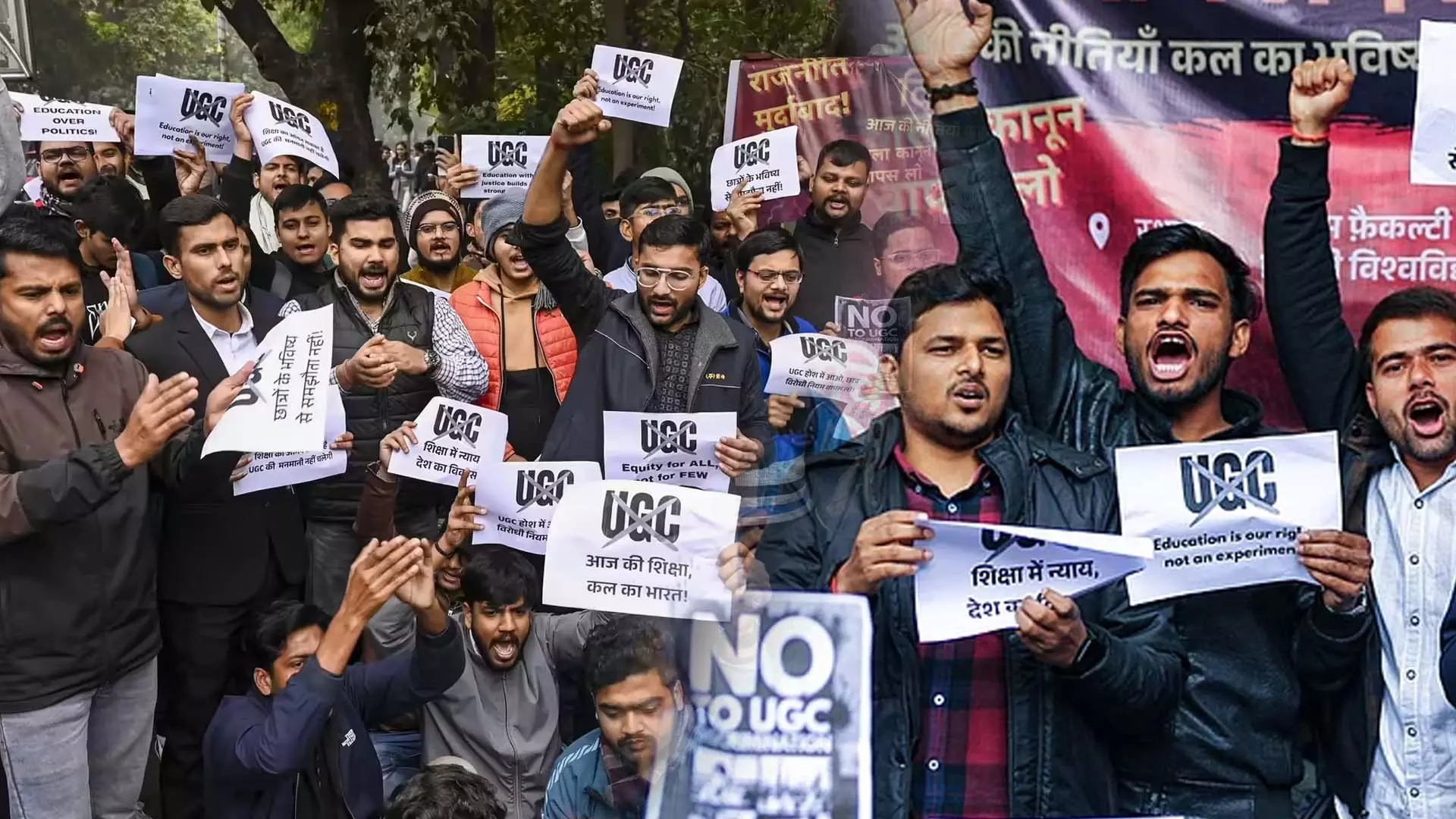
Students protest UGC equity regulations
Students mobilise nationwide after SC stays UGC equity rules
After the Supreme Court stayed UGC equity rules, students plan a Delhi convention seeking restoration and stronger anti-caste safeguards

The movement in support of the University Grants Commission’s Equity Regulations, 2026, is set to intensify, with students from across the country converging in Delhi on February 9 to escalate their campaign. The mobilisation follows the Supreme Court’s recent stay on the regulations aimed at curbing caste discrimination in higher education institutions.
The regulations, designed to address caste discrimination in higher education institutions, triggered a strong upper-caste backlash online and were subsequently challenged in the Supreme Court. The court stayed the regulations, describing them as “vague” and “capable of misuse”.
In response, students and activists from multiple states have formed a joint platform called the Samata Sangharsh Samiti. Their demand goes beyond restoring the regulations; they are calling for them to be strengthened and backed by more substantive measures to tackle caste-based discrimination.
Student mobilisation
Elaiya Kumar of the Students’ Federation of Dravidians said the movement would continue to build pressure until meaningful safeguards are implemented.
Aman Yadav, former Students’ Union President of Gorakhpur University, spoke about what he described as systemic discrimination in universities. “I have been a students’ union president, and I have seen this closely. OBC, SC and ST students clear the JRF but are still denied PhD registration. Upper-caste teachers often favour students from their own caste. We had to fight to ensure these students received their registration and fellowship,” he said.
Students participating in the mobilisation argue that the regulations were a necessary step toward accountability and institutional reform.
Court's rationale questioned
Some students also questioned the Supreme Court’s rationale for staying the regulations. Mukul Chauhan of Panjab University raised concerns about the court’s handling of the petition and broader issues of discrimination.
“First of all, I would like to say that when this petition was filed under Justice Surya Kant, whether you read the hearing of February 28, 2025, or the fourth hearing, you will understand the issue only when you recognise caste discrimination or discrimination of any kind. When Solicitor General Tushar Mehta said there are already regulations in place, senior advocate Indira Jaising said they should then be implemented. I would like to ask, where was the Supreme Court during the two-and-a-half-year farm protests, when many elders lost their lives?” he said.
The remarks reflect a broader frustration among sections of students who see the stay order as a setback in the fight against caste discrimination in higher education.
Next steps
The Samata Sangharsh Samiti has articulated three core demands that will guide the next phase of its campaign.
The immediate focus is a national convention in Delhi on February 17, expected to draw participation from students and organisations across the country. Mayank Kumar of the Samata Sangharsh Samiti said the convention would outline the roadmap for future action.
Until then, students say the pause on the UGC Equity Regulations has only strengthened their resolve to push the issue of caste discrimination back into the national spotlight.
The content above has been transcribed from video using a fine-tuned AI model. To ensure accuracy, quality, and editorial integrity, we employ a Human-In-The-Loop (HITL) process. While AI assists in creating the initial draft, our experienced editorial team carefully reviews, edits, and refines the content before publication. At The Federal, we combine the efficiency of AI with the expertise of human editors to deliver reliable and insightful journalism.