



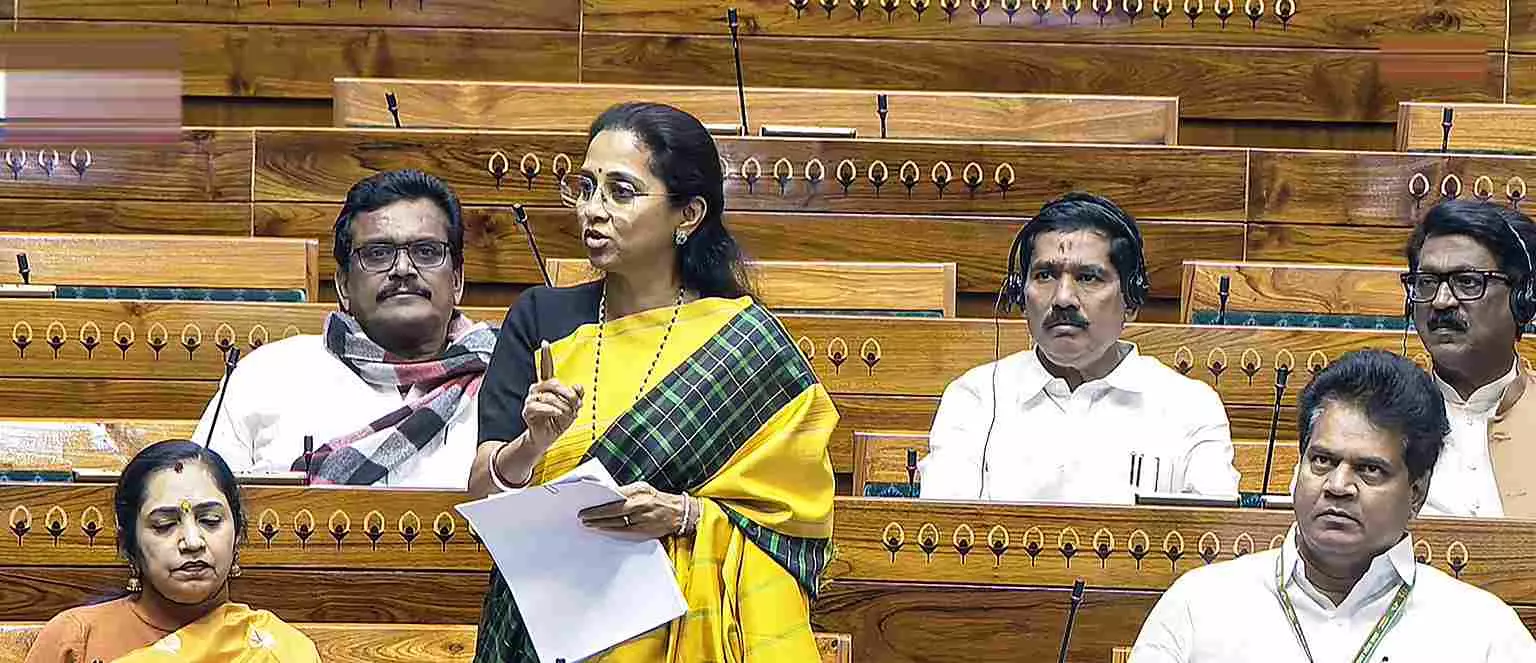
Supriya Sule introduces Bill to protect workers from after-hours work demands
The Bill aims to give employees the right to ignore after-hours work communications and penalises employers for violations, while promoting measures to curb digital burnout

In a significant step toward improving work–life balance for employees in India, NCP (SP) MP Supriya Sule has introduced a private member’s Bill in the Lok Sabha. The proposed legislation seeks to give employees the right to refuse work-related calls or emails outside designated working hours.
Also read | Centre pushes for 12-hour work as tycoons call for 70-90 hour workweeks
Titled “The Right to Disconnect Bill, 2025,” the Bill proposes penalties on companies or societies for violating its provisions, imposing sanctions amounting to 1 per cent of an employee’s total remuneration for any non-compliance.
Taking to social media platform X, Sule said, “It aims to foster a better quality of life and a healthier work-life balance by reducing the burnout caused by today’s digital culture.”
Blurred lines hurt workers
During the argument, the MP said that although digital and communication technology offer benefits in terms of work flexibility, it also carries a significant risk of eroding the boundaries between professional and personal life.
The statement of objects and reasons of the Bill further reads, "Studies have found that if an employee is expected to be available round the clock, they tend to exhibit risks of over-work like sleep deprivation, developing stress and being emotionally exhausted. This persistent urge to respond to calls and emails (termed as ‘telepressure’), constant checking of emails throughout the day, and even on weekends and holidays, is reported to have destroyed the work-life balance of employees.”
The Bill further argued that there's a need to respect the personal space of the employees by recognising their right to disconnect and not respond to their employer's calls, emails, etc., during out-of-work hours.
Safeguarding personal time rights
The MP went on to add that if the employee agrees to work when he is out of work hours, overtime pay at the same rate as his wage rate is also necessary to check the surge in unpaid overtime work, brought about by digital transformation.
Also read | Narayana Murthy renews call for 72-hour work week, cites China’s 9-9-6 model
The Bill also mentions the counselling services to increase awareness among employees and citizens, on the reasonable use of digital and communication tools, for professional and personal use.
Furthermore, to free an employee from digital distractions and enable him to truly connect with the people around him, the Bill provides for digital detox centres. The Bill concluded, “The Bill thus champions the rights and welfare of employees, by mandating individual entities to negotiate out-of-hour service conditions with their employees, and upholding the right of employees to disconnect. The Bill seeks to recognise the right to disconnect as a way to reduce stress and ease tension between an employee's personal and professional life.”