







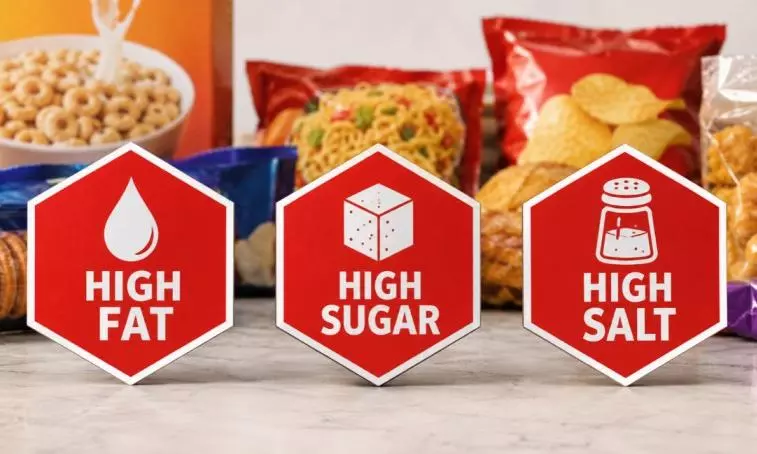
SC calls for separate warning labels on packaged foods high in fat, sugar or salt
The court wants separate pictorial warnings for each excess nutrient, asks FSSAI to revisit scientific thresholds and calls for better nutrition education in schools

The Supreme Court has directed the Food Safety and Standards Authority of India (FSSAI) to move towards a more explicit front-of-pack warning system for packaged foods high in fat, sugar and salt, requiring a distinct pictorial warning for each nutrient that exceeds the prescribed limit. The directions seek to make nutritional information more immediately recognisable to consumers, rather than leave them to interpret figures and ingredient declarations on the back of a packet.
A bench of Justices JB Pardiwala and K Vinod Chandran said each warning must carry a standard pictogram alongside the words “HIGH FAT”, “HIGH SUGAR” or “HIGH SALT”, as applicable. A product exceeding the threshold for more than one nutrient must display separate red hexagonal warnings. The court also directed that each hexagon occupy 4-5% of the package's principal display panel.
The directions, reported by LiveLaw, place the onus on FSSAI to revisit the scientific basis of its proposed thresholds and move towards implementing the labelling framework. The matter will return to the court after ten weeks, by which time the regulator must report progress on the draft regulations and file an affidavit.
Thresholds must reflect total sugar and saturated fat
An important aspect of the ruling concerns which nutritional measures should determine whether a product attracts a warning. The court has asked FSSAI to revisit the scientific basis of its proposed nutrient thresholds, including the choice of nutritional indicators such as total sugars and saturated fat.
Also read: Food safety drive: FSSAI issues 10,047 notices, seals 314 businesses in 2 months
It has also cautioned against setting limits at either extreme. Thresholds that are too restrictive could put warnings on nearly every packaged food product, eventually making consumers less attentive to them. Limits that are too permissive, on the other hand, could allow products with substantial levels of the nutrients to avoid scrutiny
The court has also turned its attention to children's understanding of food and nutrition. It has asked the Union Government to supplement changes to the school curriculum with practical learning opportunities, including interactive workshops and co-curricular activities, to help children make informed food choices.
How other countries regulate front-of-pack labelling
Approaches to front-of-pack nutrition labelling vary across jurisdictions. In the European Union, Regulation (EU) No. 1169/2011 requires most prepackaged foods to carry a nutrition declaration listing energy, fat, saturated fat, carbohydrates, sugars, protein and salt. While this information is generally displayed in a table on the back of the package, simplified front-of-pack formats are permitted on a voluntary basis. Schemes such as Nutri-Score, which uses a colour-coded grading system, operate in several member states, but there is no EU-wide mandatory warning-symbol regime for products high in sugar, fat or salt.
Chile has adopted a more prescriptive model. Under its Food Labelling and Advertising Law, packaged products exceeding prescribed nutritional thresholds must carry prominent black octagonal warnings on the front of the pack, bearing the words “HIGH IN” for nutrients such as sugars, saturated fats and sodium. Separate symbols are used for each nutrient that crosses the threshold. The law also forms part of wider restrictions on the marketing of such products to children and their sale in schools.
Also read: Bisleri says water is safe, questions FSSAI action over 2025 sample
Canada requires most prepackaged foods exceeding prescribed thresholds for saturated fat, sugars or sodium to carry a black-and-white front-of-pack symbol featuring a magnifying glass. Meanwhile, Mexico's NOM-051 standard requires black octagonal warning seals for packaged products exceeding thresholds for calories, sugars, saturated fats, trans fats and sodium.