



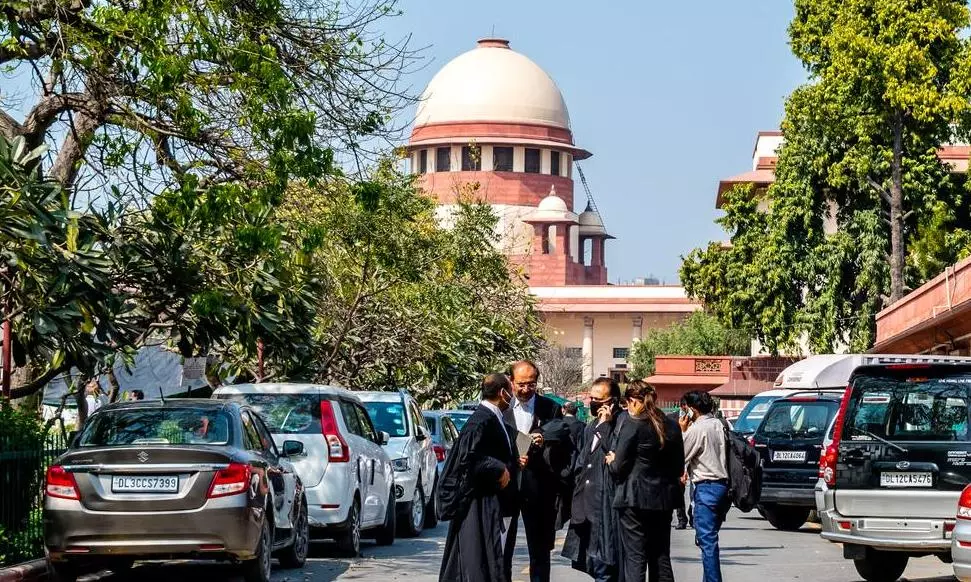
Supreme Court clarifies conversion alone does not remove Scheduled Tribe status
Supreme Court rules ST status isn’t lost by conversion alone; identity depends on tribal customs, community ties, and recognition

Within hours after stating that only individuals belonging to the Hindu, Sikh or Buddhist faiths claim Scheduled Caste (SC) status and conversion to any other faith will lead to automatic loss of the concerns person’s SC status, the Supreme Court has clarified that same will not apply to Scheduled Tribes (ST) as unlike the SC category caste is not a factor when it comes to the ST category.
The top court further stated that religious conversion will not be the sole criterion for determining whether a person has lost tribal membership, adding that “complete severance from the tribal way of life and loss of community recognition” would be sufficient to erode his or her ST status.
The clarification was given by the bench of Justice Prasant Kumar Mishra and Justice Manmohan during the hearing of a case of alleged assault on a pastor. Both the earlier observation and the subsequent clarification occurred on Tuesday (March 24).
No religion-based bar for ST status
“With respect to Scheduled Tribes, this Court clarifies that, unlike the Constitution (Scheduled Castes) Order, 1950, the Constitution (Scheduled Tribes) Order, 1950 does not prescribe religion-based exclusion. The determination of Scheduled Tribe status, therefore, cannot rest on conversion alone, but must turn on whether the claimant continues to possess and is recognised for the essential attributes of tribal identity, including customary practices, social organisation, community life, and acceptance by the concerned tribal community,” stated the bench.
Also Read: Conversion beyond Hinduism, Sikhism or Buddhism ends SC status, rules Supreme Court
“Where conversion or subsequent conduct results in a complete severance from the tribal way of life and loss of community recognition, the foundational basis for Scheduled Tribes status will stand eroded,” it added as quoted by Live Law.
Pastor assault case background
The pastor had lodged a complaint alleging assault against certain individuals invoking provisions of the Scheduled Caste, Scheduled Tribe (Prevention of Atrocities) Act. The Andhra Pradesh High Court, however, held that upon conversion to Christianity, he could not be treated as a member of a Scheduled Caste and therefore was not entitled to seek protection under the SC&ST Act in view of the Constitution (Scheduled Castes) Order, 1950.
Supreme Court draws distinction
This view was affirmed by the Supreme Court, which, while doing so, also set out certain distinctions governing the issue. The bench noted that although the Constitution (Scheduled Castes) Order, 1950, contains religion-based exclusion, no such requirement is found in the Constitution (Scheduled Tribes) Order, 1950.
Also Read: ‘Systemic bias’ led to denial of permanent commission to women officers in military: SC
It explained that a tribe is understood as a social group characterised by a shared dialect, a unified system of governance and collective functioning for common purposes, as recognised in State of Kerala vs. Chandramohan (2004).
Tribal identity and continuity
For this reason, the Constitutional framework relating to Scheduled Tribes does not refer to caste or race. Entitlement under the order is linked to continued affiliation with the tribe concerned. At the same time, where conversion or prolonged departure from tribal customs raises doubt about such identity, the issue becomes one of fact to be examined during trial.
Also Read: SC asks if ED can seek relief from state in case involving CM Mamata Banerjee
"From the above, it becomes clear, that once a person belonging to a Scheduled Tribe converts to another religion, ultimately through the passage of time, the customs, rituals and other traits of that particular tribe may fall into eclipse. If so, in such circumstance, it is proved that the person in question has completely renounced himself from the customs, rituals and other traits of his tribe, and has assimilated into the converted religion following the practices and customs of that particular religion, a reasonable inference can be drawn that such a person shall not be considered a part of the tribe."
The Court, therefore, stated that conversion by itself cannot be determinative of Scheduled Tribe status: "it must turn on whether the claimant continues to possess and is recognised for the essential attributes of tribal identity, including customary practices, social organisation, community life, and acceptance by the concerned tribal community."
Loss of ST status on severance
It further observed that where conversion or subsequent conduct leads to a complete break from the tribal way of life, accompanied by loss of recognition within the community, the basis for Scheduled Tribe status would stand eroded.
Also Read: Supreme Court pushes for wheelchair-friendly cabs for disabled
"Conversely, where such attributes demonstrably subsist or are genuinely re-established and accepted by the tribal community, the claim cannot be rejected mechanically. The assessment in such cases is necessarily fact-specific and is left to the competent authority to decide in accordance with Constitutional principles."
Both the Constitutional Orders have been issued by the President under Articles 341 and 342, respectively, identifying the castes and tribes that fall within their scope.