



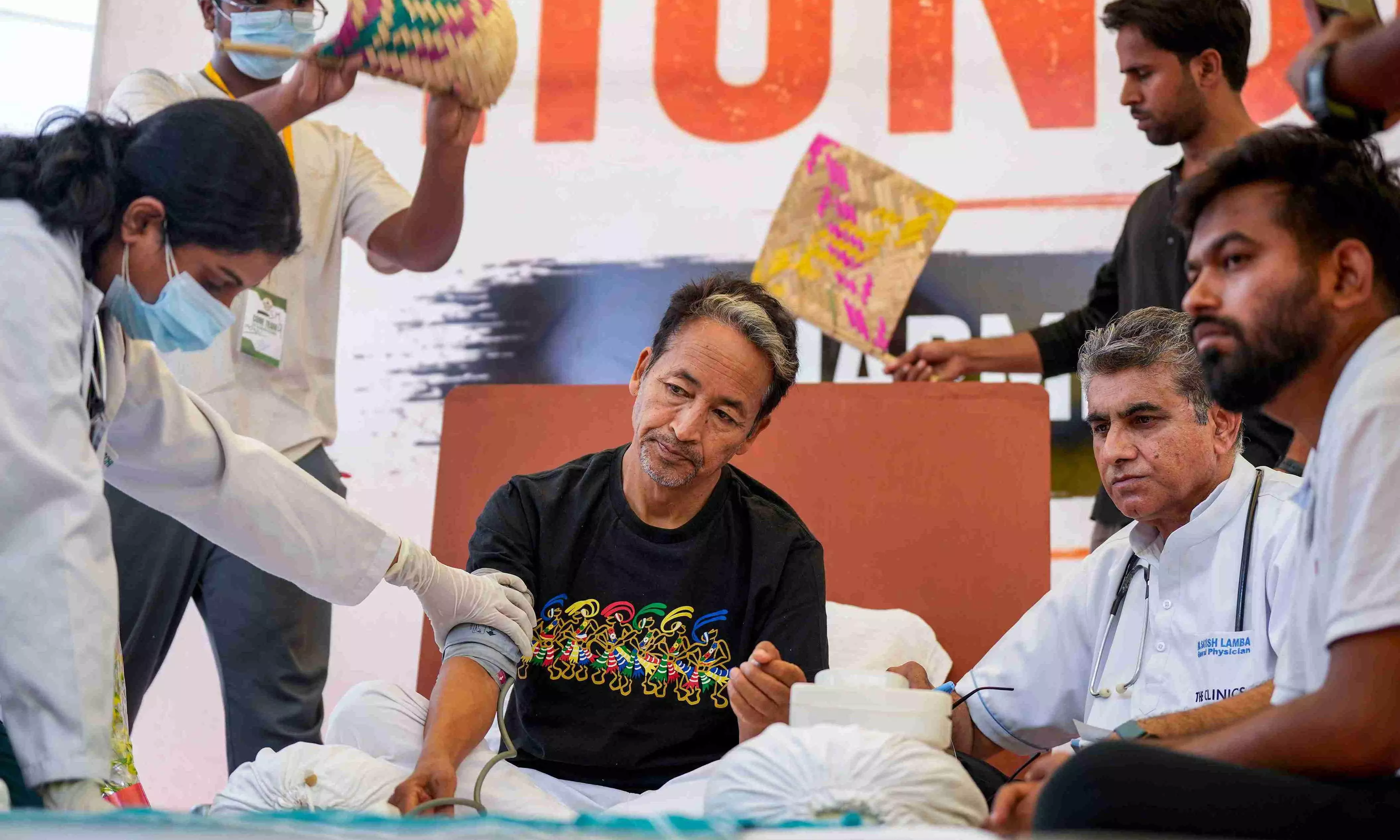
Long before his current strike, climate activist and educator Sonam Wangchuk had repeatedly used fasting to campaign for Ladakh's political and environmental future. Photo: PTI
Sonam Wangchuk's fast enters Day 20: Lessons learnt from earlier hunger strikes
Hunger strikes continue to shape public opinion, but they rarely compel governments to concede major policy or constitutional demands

As climate activist and educator Sonam Wangchuk's latest indefinite fast enters a critical phase, concerns over his deteriorating health have once again put the spotlight on one of India's oldest forms of political protest - the hunger strike.
From Mahatma Gandhi's freedom movement, Potti Sreeramulu's demand for Andhra statehood, Anna Hazare's anti-corruption campaign to Irom Sharmila's battle against the Armed Forces (Special Powers) Act (AFSPA), fasting has repeatedly shaped India's political discourse.
Also read: CJP Protest: I will stay alive till July 20 at any cost, says Wangchuk; Pawan Khera visits agitators
Yet, while hunger strikes are powerful tools for mobilising public opinion, they have become far less effective in forcing governments to concede major policy or constitutional demands.
Wangchuk's repeated fasts
Long before his current fast demanding the resignation of Union Education Minister Dharmendra Pradhan over examination paper leaks, Wangchuk had repeatedly used fasting to campaign for Ladakh's political and environmental future.
His first major fast came in January 2023, when he observed a five-day hunger strike in sub-zero temperatures at Leh's SECMOL campus. The protest highlighted the ecological risks facing Ladakh from unchecked mining, carbon emissions and large infrastructure projects. Although it did not produce immediate policy changes, it pushed Ladakh's environmental concerns into the national spotlight and prompted the Union Home Ministry to revive discussions on local tribal protections.
The movement gathered momentum in March 2024 when Wangchuk began a 21-day "Climate Fast" after talks between Ladakhi representatives and the Centre failed to produce a breakthrough. Surviving only on salt and water, he demanded full statehood for Ladakh and inclusion under the Sixth Schedule of the Constitution, which would grant constitutional safeguards to tribal communities and greater control over land and resources.
Also read: Ground Report: Why Wangchuk's fellow organisers can't convince him to stop
Longest fast lasted 35 days
Later that year, Wangchuk led the 1,000-kilometre "Delhi Chalo" march to the national capital. When Delhi Police detained the marchers at the city's border, he immediately began another hunger strike inside the detention facility. The move generated widespread political attention and ultimately led to the protesters' release, allowing them to submit their memorandum peacefully.
His longest campaign came in September 2025, when he joined the Leh Apex Body and the Kargil Democratic Alliance in a 35-day hunger strike reiterating four demands: statehood, Sixth Schedule status, a separate Public Service Commission and dedicated parliamentary representation for Ladakh.
The agitation was met with a stringent government response. Wangchuk was later detained under the National Security Act (NSA), internet restrictions were imposed in parts of Ladakh, and the movement entered a prolonged standoff with the Centre. After spending nearly 170 days in custody, Wangchuk secured a legal victory when the NSA order against him was revoked in March 2026. While that represented an important personal and legal milestone, Ladakh's core constitutional demands remain unresolved.
His ongoing fast, however, marks a departure from regional politics. This time, Wangchuk is fasting in solidarity with students, demanding accountability over alleged examination paper leaks and calling for the resignation of the Union Education Minister.
Hunger strike in political history
Wangchuk's campaign belongs to a long tradition stretching back nearly a century.
Among the earliest landmark hunger strikes was that of revolutionary Jatin Das’s death after a 63-day hunger strike in Lahore Jail in 1929, making him a symbol of India's freedom movement. Mahatma Gandhi later transformed fasting into a powerful political tool, with his 1932 fast leading to the Poona Pact and his 1948 Delhi fast helping restore communal peace after Partition.
Independent India witnessed another defining moment in 1952 when Potti Sreeramulu fasted for a separate Telugu-speaking state. The government remained unmoved for nearly two months, but his death after 58 days triggered widespread unrest, forcing then Prime Minister Jawaharlal Nehru to announce the formation of Andhra Pradesh.
Also read: Delhi HC orders daily monitoring by govt doctors for Sonam Wangchuk amid hunger strike
More recently, Anna Hazare's anti-corruption movement demonstrated how fasting could mobilise millions. His first fast in April 2011 compelled the Union government to establish a joint committee to draft the Jan Lokpal Bill. Although subsequent fasts kept the issue alive, the final Lokpal legislation emerged only years later and in a diluted form compared to the original demands.
Perhaps the starkest example of endurance remains Irom Sharmila, who fasted for nearly 16 years demanding the repeal of AFSPA in Manipur. Despite becoming the world's longest hunger striker and turning AFSPA into a national issue, the law remained in force for most of her campaign. She eventually ended her fast in 2016, acknowledging that the protest alone had failed to achieve its objective.
Have hunger strikes been effective?
A clear pattern emerges from India's history of fasting movements.
Hunger strikes have proved remarkably effective in transforming local grievances into national conversations. They attract media attention, create moral pressure on governments and often unify fragmented protest movements under a common cause.
However, their success in securing concrete policy outcomes has varied significantly.
The fastest victories have generally come when the demand was narrow, specific and administratively achievable. Gandhi's peace fast in 1948 and Anna Hazare's first anti-corruption fast in 2011 both sought immediate, negotiable concessions that governments could grant without changing the Constitution or passing complex legislation.
By contrast, demands requiring constitutional amendments, legislative approval or structural reforms have rarely been resolved through fasting alone. Ladakh's Sixth Schedule demand, AFSPA's repeal and comprehensive anti-corruption legislation all required prolonged political negotiations extending well beyond the protests themselves.
Also read: Aamir Khan clears the air: '3 Idiots' not based on Sonam Wangchuk, what 'Chatur' said is 'incorrect'
However, in modern times, courts’ intervention to medically monitor fasting protesters has reduced the possibility of deaths that historically generated enormous political pressure. Authorities often rely on detention, medical intervention and legal proceedings instead of direct negotiations.
More than a protest
Despite these limitations, the hunger strike remains one of the few forms of protest capable of turning a political dispute into a moral question, compelling governments to respond even when they refuse to concede.
For Wangchuk, the repeated return to fasting reflects both the enduring appeal and the diminishing effectiveness of the method. His protests have consistently drawn national attention, reopened negotiations and broadened public debate. But like many of the landmark hunger strikes before him, a fast can force the nation to listen, but it cannot always force the government to respond.