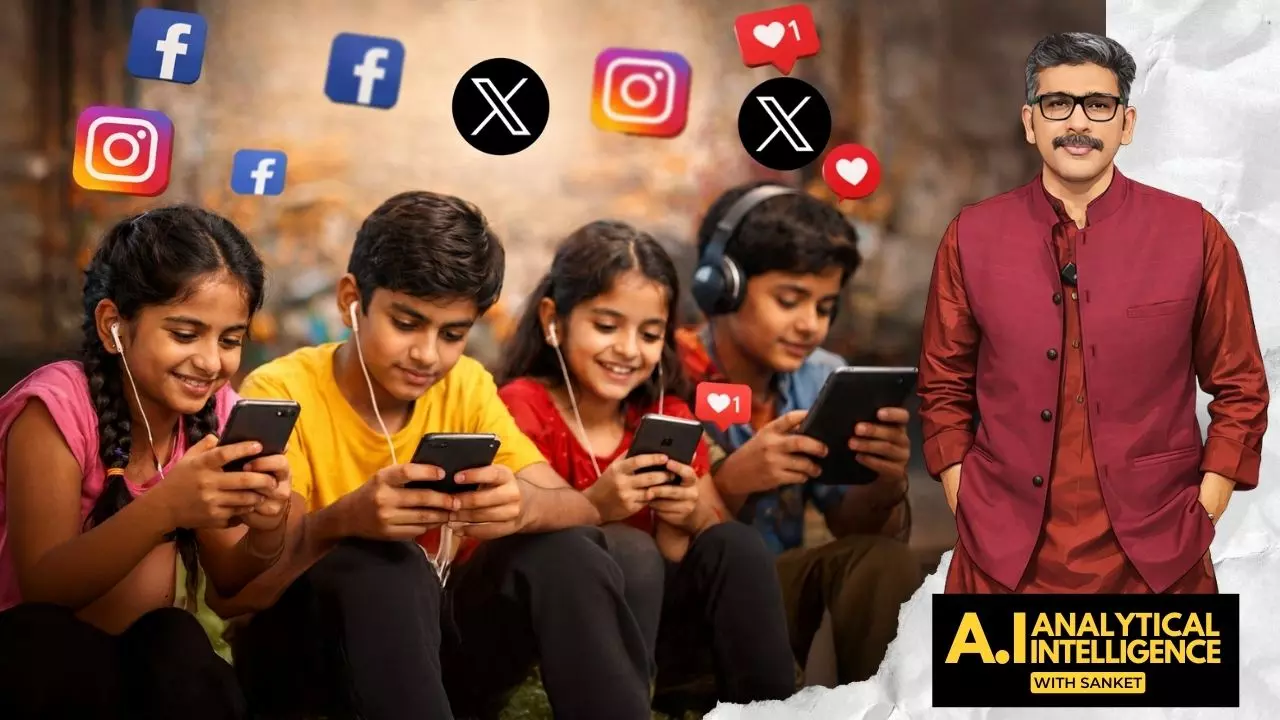
Banning social media for children will not solve problem: Psychologist | AI With Sanket
Australia, France, and Spain are moving towards restricting or banning social media use for kids. US is discussing time limits while China has implemented a “minor mode”

As countries across the world debate banning or restricting children’s access to social media, concerns over addiction, anxiety, and shrinking attention spans are intensifying. On AI With Sanket, The Federal spoke to Aarti C Rajaratnam, child psychologist, on whether India should consider a ban and what the real risks are for young minds.
Social media seems harmful even for adults. If there is a conversation around banning or restricting it for children, would you welcome that idea?
A ban in any way is not going to solve the problem. The moment you ban it, you are attracting more attention towards it. Children who don’t have accounts will want to know why. Without creating alternative behaviours, it wouldn’t really work out. The issue is not just social media itself, but the attention economy that drives it. That is what is very scary.
There was research I was reading which suggested that social media platforms were developed by people diagnosed with schizoid personality disorder — where the classical symptoms are difficulty socialising. So someone who doesn’t know how to socialise is creating a platform for you. That is sad and rather scary. AI, on the other hand, is being developed by people who could probably fall under narcissistic personality disorder.
Young children require a lot of everyday socialisation. Without knowing the normal range of social behaviours, expecting them to have healthy behaviours online is very tricky. This is where I raise an alarm.
In the human mind, there are two types of focus — default focus and spotlight focus. Spotlight focus helps me memorise and hold information in working memory. But default mode is the ability to daydream and make connections. That is where the greatest innovation happens.
The attention economy ensures that reels and online content mimic the default mode. Every couple of seconds, it shifts like a thought in the mind. If you take away the ability to daydream and allow your mind to wander, you are removing the ability to be human — to create solutions and innovate. Indoctrination becomes easier.”
Also read: Social media ban for Under-16s: Is Australia-style law feasible in India?
If banning creates problems and not banning also creates problems, what is the solution?
The solution has to start with relationships. If you are with your best friend or someone you really like spending time with, you will not look at your phone because that relationship is important.
Children are moving towards social media because many of them do not have healthy relationships with peers, family, or extended family. From that epidemic of loneliness, they rush into social media. They want to be seen. They want to be validated elsewhere.
If I have a healthy base somewhere, I can still have a social media account and use it judiciously. Building a strong basis in our relationships has to begin at home. That will translate into more responsible action online.
Also read: Australia’s social media ban leads to drop in followers, sparks mixed public response
Countries like Australia, France, Denmark and Spain have imposed bans. Does that indicate something serious?
It’s too early to say whether these bans are effective. Some of these things take years before danger becomes visible.
Screens appeared around 2009. By 2014, many of us had started flagging issues like ‘virtual autism’, though it was not yet published. We saw children with speech delays and autism-like features in practice.
Social media began in the early 2000s. The first platform was Orkut, which was quite harmless — people just posted photographs. But it evolved.
There’s a book called Careless People that talks about how if a girl posts a selfie without a filter and deletes it shortly after, AI immediately suggests cosmetic procedures, filters, or products to buy. It feeds her information implying she is somehow ugly. The same happens with boys — they are told they are not adequate.
This is creating an epidemic of anxiety.
We may know the true impact only by 2030, when we study a generation hooked to social media versus one without it. You need time to measure this properly.
What about alternatives to a ban, like time limits? The US has discussed a three-hour cap, and China has a ‘minor mode’ restricting usage by age. Are such measures effective?
The problem does not arise for someone who is just using social media. It becomes a problem when someone is addicted. We must differentiate between usage and addiction.
These are process addictions — like gambling, gaming, exercise addiction. They build slowly into your habits.
If you reduce usage to 40 minutes or 30 minutes, what happens next? The child will not have anything else to do and may go through withdrawal. Are we equipped to handle that?
The surgeon general’s three-hour limit is arbitrary. How do we decide that three hours is safe for the brain? Earlier, television research suggested that even 40 minutes of cartoons was long.
Without building healthy behaviours first, children will just move to gaming platforms or something potentially more dangerous.
You describe social media as a ‘mental toxin’. What do you mean by that?
In my book, I clearly call it a mental toxin. The difference between a toxin and a poison is that a toxin kills you slowly and you don’t know it’s there. A poison is obvious.
Social media and gaming are toxins. They slowly remove your ability to be human.
When you work through online games, you go from level to level and are rewarded for behaviours that are not acceptable — like shooting someone. Slowly, you lose the ability to discern right from wrong.
It’s not the usage per se but how it shapes your thinking, mental health, and personality. Without reflection, there is no behaviour change. Emotional experiences shrink. Out of 83 emotions you can feel, imagine having only excitement from reward mechanisms. What happens to intimacy? What happens to conversation? What happens to sadness, which you then mask?
This range of human experience will get stunted if we do not look at something extreme as a step.
But before anything else, I keep saying — build relationships, build alternate behaviours. Without that, bringing in restrictions may not really work.
(The content above has been transcribed from video using a fine-tuned AI model. To ensure accuracy, quality, and editorial integrity, we employ a Human-In-The-Loop (HITL) process. While AI assists in creating the initial draft, our experienced editorial team carefully reviews, edits, and refines the content before publication. At The Federal, we combine the efficiency of AI with the expertise of human editors to deliver reliable and insightful journalism)