







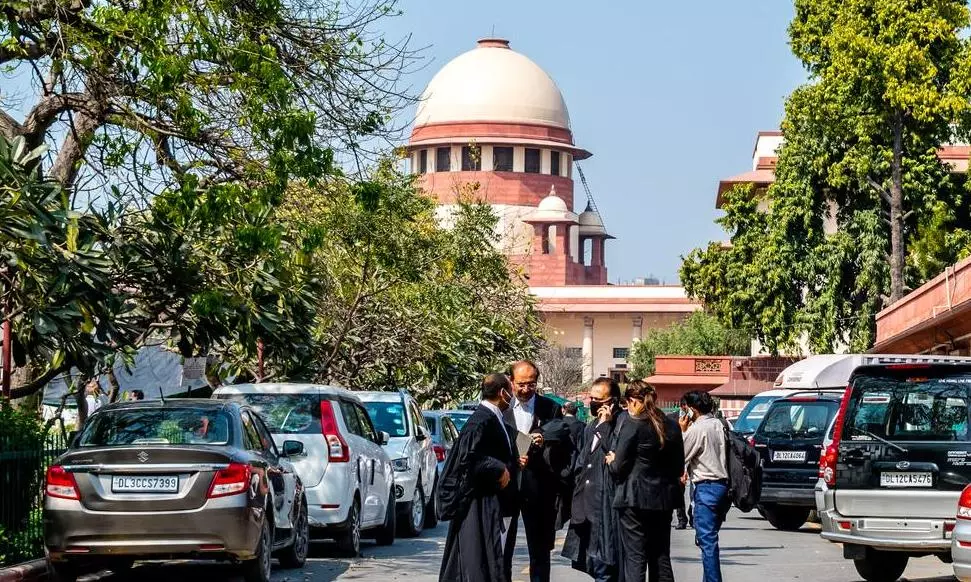
SC seeks Centre, EC's response on biometric verification at polling booths
Supreme Court issues notice to Centre and EC on plea seeking biometric voter ID at polling booths to prevent fraud; feasibility for future elections under review

The Supreme Court on Monday (April 13) issued notice to the Centre and the Election Commission (EC) following a public interest litigation which sought implementation of fingerprint and iris-based biometric identification at polling stations as a means of preventing electoral malpractices, including proxy voting and bribery.
The notice was issued by the bench of Chief Justice of India Surya Kant and Justice Joymalya Bagchi during the hearing of a petition filed by advocate Ashwini Kumar Upadhyay under Article 32 of the Constitution.
"Prima facie, the nature of reliefs cannot be considered for the ensuing elections in some of the states. However, whether such a recourse deserves to be followed for the next parliamentary elections and/or elections of state legislatures needs to be examined," stated the bench as quoted by Live Law.
Submissions and concerns
The petitioner argued that the proposed system could serve to prevent electoral fraud. However, he admitted that implementing it in the upcoming Assembly election might not be feasible, adding that it can be introduced in future elections.
Also Read: Bengal SIR: Supreme Court calls for robust appeal mechanism
The Chief Justice responded, stating that the introduction of such a system would require major changes in the rules governing elections, adding that there would also be a heavy financial burden.
"Anything which is for fairness of elections, power can be traced out," he added.
Reliefs and grounds in plea
In the petition, the applicant submitted that the plea had been instituted seeking the introduction of a Finger and Iris Biometric Identification System at polling stations for the forthcoming Assembly elections, with the stated objective of curbing practices such as bribery, undue influence, personation, duplicate voting and ghost voting, among other electoral irregularities.
Also Read: Land-for-jobs case: SC refuses to quash CBI FIR against Lalu Prasad Yadav, family members
It was further set out that the cause of action is stated to have arisen on March 20, 2026, when the petitioner claimed to have become aware that, notwithstanding measures already undertaken by the Election Commission, instances of bribery, undue influence, personation, duplicate voting, and ghost voting were continuing to occur, thereby eroding public confidence in the electoral process.
Legal basis and prior steps
According to the petitioner, the persistence of such practices results in widespread injury to the electorate by compromising the purity and integrity of elections.
Also Read: Right to vote, contest elections not fundamental rights: Supreme Court
The plea maintains that the introduction of biometric authentication at polling booths would reinforce the constitutional requirement of free and fair elections while ensuring that only genuine and duly registered electors can exercise their franchise.
The petitioner has further contended that biometric identifiers, being inherently unique and not susceptible to fabrication, would secure the principle of "One Citizen, One Vote" in its true sense.
‘EC is competent to put mechanism in place’
It was also argued that the Election Commission is competent to put such a mechanism in place by invoking its plenary powers under Article 324 of the Constitution. In this context, the plea notes that Aadhaar-based identification already stands recognised as a valid form of identity under Section 23(4) of the Representation of the People Act, 1950, and suggests that a comparable framework may be adopted for biometric verification at polling stations.
Also Read: Lower DR for pensioners than DA arbitrary, violates Article 14: SC
The petitioner additionally stated that a representation dated March 28, 2026, had been addressed to the Chief Election Commissioner and the Election Commissioners seeking implementation of finger and iris-based biometric identification at polling booths.
However, in the absence of any response or action, the present public interest litigation has been instituted, it is stated, in the interest of justice and to safeguard the conduct of free and fair elections.