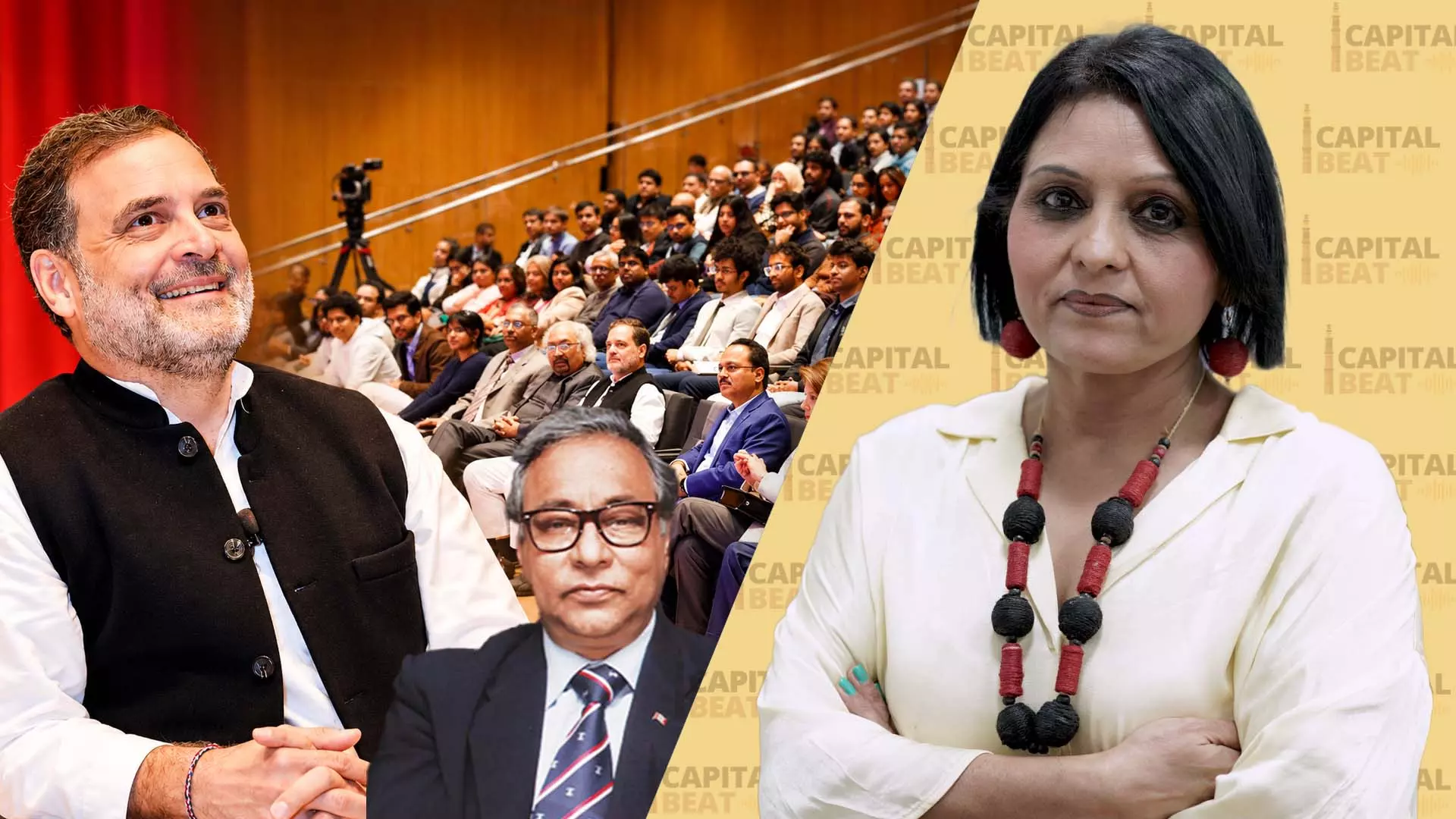
Jawhar Sircar, Ex-Rajya Sabha MP decoding Rahul's Chicago address
'He is taking the bull by the horns': Jawhar Sircar on why Rahul is revisiting 2014 election
Ex-Rajya Sabha MP says big capital engineered Modi's rise, defends EC whistleblowers and cautions Supreme Court over SIR as Parliament’s winter session nears

Leader of the Opposition in the Lok Sabha Rahul Gandhi addressed students at the University of Chicago, stating that boycotting elections would end the structure of Indian democracy and claiming that insiders within the Election Commission (EC) are passing information to the opposition.
His remarks come amid ongoing debates over electoral roll revisions, opposition unity, and India's foreign policy stance on West Asia.
In the latest episode of daily YouTube show Capital Beat, The Federal spoke to Jawhar Sircar, ex-Rajya Sabha MP, author, and retired bureaucrat, to decode the political and institutional implications of Rahul Gandhi's statements.
Edited excerpts:
How do you decode Rahul Gandhi’s statement that democracy is sacred, and that abandoning elections would mean ending India's democratic structure?
You see, Rahul Gandhi is basically a politician, and he has to be in the thick of it. You have to interpret the statement as an anticipatory one. There is some pressure, mainly from the BJP side, suggesting that if you do not believe in our electoral system, then why do you not quit? That is a very puerile statement to make, yet they keep making it through their spokespersons.
He has indirectly put it on record that he cannot be stopped, and that this fight will go on until the election. If people thought someone would walk away saying, "I am not participating because you are playing unfair," he is making it clear that as long as they contest elections, they will be contesting the unfairness of the system as well.
We must remember that this is a signature that he has arrived—more than arrived. The BJP spent hundreds of crores of crony money right from 2014 to demolish the Gandhi family through a sustained campaign and by "Pappu-izing" Rahul Gandhi. For the first six to seven years, they made life miserable for him through a multimedia assault—from satire and cartoons to false reels and videos targeting Jawaharlal Nehru and Rahul Gandhi. For some reason, Rajiv Gandhi was spared, though Sonia Gandhi was also attacked.
This three-pronged attack meant the central target was Rahul Gandhi, who was dismissed as no match for Narendra Modi. He has completely upset that narrative. The younger generation that was once sceptical of him is now with him, and even the revolutionary fringe—Gen Z—has come around to saying that in India's political setup, if there is anyone who can stand with them, it is Rahul Gandhi, as shown by the numbers at Ramlila Maidan.
At the Bharat Summit in Hyderabad, an Italian delegate raised the slogan "vote chor, gaddi chhod," prompting the BJP ecosystem to brand the event anti-national and accuse Rahul Gandhi of humiliating India on foreign soil. Did his remarks in Chicago and New York set the record straight on that?
You have to understand that Mr Modi began his unprecedented number of foreign trips by going to America and saying it was his bad luck that he was born in India. If you can show me a stronger anti-Indian statement made by a sitting Prime Minister, do so. Yet he went on making such comments and was applauded.
As for foreigners participating or supporting the cause of Indian democracy, one has to understand that this is part of a universal system of liberalism, values, secularism, pluralism, and the global fight against the extreme right—there is a brotherhood there. The right wing does not have such a brotherhood; they operate in fighting mode.
Aside from Prime Minister Modi’s shocking visit to Israel to hug Benjamin Netanyahu—for reasons that remain unclear, as he does not spend that kind of time and effort without a reason—right-wing populist leaders are constantly clashing with each other. Donald Trump speaks against Modi without caring, Boris Johnson opposed Trump, and so it goes, because their existence depends on hostility rather than brotherhood, whereas the left-liberal democratic surge rests on solidarity. They cannot stand that internationalists and universalists are making statements in favor of Indian democracy, so they immediately brand it anti-national.
Opposition parties have never endorsed boycotting elections, so Rahul Gandhi's statement brings clarity there. However, could it create fissures within civil society groups backing him, many of whom argue that contesting amid alleged large-scale vote theft is pointless?
A small section of civil society has always held that view, going back to 1952 when a section of the Communists said, "Yeh azadi jhoothi hai, jis desh mein log bhookhe hain" (This freedom is false in a country where people are hungry). That sentiment of non-participation has always existed as one of the choices.
Part of that choice was later institutionalised into the system through NOTA (None of the Above), which is also an expression of disgust at the existing political setup. That viewpoint will always remain, but that small percentage does not determine the fate of electoral democracy in India, which is firmly established.
Rahul Gandhi also looked back at the 2014 general election, saying the victory margins for Narendra Modi were unexplainable even though the opposition lacked proof at the time. Why is he choosing to revisit the 2014 mandate now?
He is taking the bull by the horns. For the same reason the BJP decided to target Rahul Gandhi's grandfather—attacking the grandfather to get to the grandson—here too, they have gone back to the roots of where the trouble began in 2014.
In fact, 2014 remained an unexplained phenomenon—not centered solely on the elections, but on a conspiracy that began immediately after big capital failed to dislodge Dr Manmohan Singh in 2009. I saw it unfold before my eyes in 2010. There was a canard around the Commonwealth Games, portrayed as the worst corruption ever seen in India—even though the scale of alleged corruption back then is less than what a single MLA reportedly handles nowadays. That narrative was built around visuals of a leaking ceiling or a basin in the Commonwealth Games Village, made easier by provocative figures like Suresh Kalmadi, even though 2010 was the finest conduct of international games India has ever had, far better than the mistakes made in recent international events.
Then in 2011, an obscure figure wearing a Gandhi cap—Anna Hazare—was plucked from obscurity and placed at the centre of Delhi for the India Against Corruption movement. The very Lokpal that took five years to establish has existed for the last eight years and has done nothing—not even a Block Development Officer (BDO) has been found corrupt by that Lokpal. Still, that Lokpal agitation generated tremendous momentum; we were all taken in by it, and as a Secretary to the Government of India, I even went to observe it and was reported on by the Intelligence Bureau.
That was followed by Baba Ramdev's agitation, and then the tragic Nirbhaya incident, which was capitalised upon completely out of proportion. As several people including Ram Madhav have written, by 2012 big capital had edged out LK Advani and decided to back Narendra Modi, giving him a two-year head start while the Congress was still getting its act together. So it is not just 2014; we must draw attention to the entire period from 2010 to 2014. We cannot simply let bygones be bygones.
Does this indicate that Rahul Gandhi will increasingly challenge the legitimacy of the 2014 mandate itself?
Yes, he is going to do it, because this issue was flagged 10 years ago when SY Quraishi and the Centre for Media Studies (CMS) brought out a report showing that roughly ₹70,000 crore was spent in the 2014 election—three to four times higher than previous elections—and that half of it was spent by a single party. That one party spent more in the 2014 election than all parties combined had spent in the previous two elections.
That marked the arrival of big capital with massive stakes. Compare the wealth of two major business tycoons in India from 2014 to 2026, and you will see they have reaped extraordinary returns. This story needs to come out—how it played out in connivance with big capital, much like how Krupp and major German industrialists decided to back an upcoming autocrat after the Munich Putsch, or how major American arms manufacturers financed Donald Trump and expect repayment through conflicts despite his anti-war campaign rhetoric. The mechanics of right-wing autocracy are quite transparent once you trace the money.
If Rahul Gandhi insists on contesting elections rather than boycotting them, and if the Supreme Court moves slowly on petitions regarding electoral rolls and the Special Intensive Revision (SIR), what will the anti-SIR campaign actually achieve?
The prime reason the SIR process has not been struck down as illegal and illicit is the benign indulgence of the Chief Justice. His indulgence has brought us to this point, and people are no longer mincing words. Despite facing a litany of allegations in the public domain—including reports published in The Caravan—he has reacted sharply to a single NCERT textbook reference on judicial corruption rather than clearing his name or taking action against those making the allegations. As a citizen, I feel he should have cleared his name.
Be that as it may, he is biding his time, though his tenure is not permanent—he retires around the 20th or 25th of February. After that, other Chief Justices will take office between Justice Surya Kant’s retirement and the upcoming elections, leaving scope to undo much of this and hold the guilty accountable through constitutional methods. Otherwise, history will remember him as a Chief Justice against whom popular agitation began, and it pains my heart to see the highest court dragged to such depths.
This reflects the current mood of the nation. Abroad, in places like Albania, we have seen courts attacked when perceived as pro-autocratic—God forbid anything like that ever happens in India, as even thinking of it is seditious, but it shows what happens elsewhere when institutions lose public faith. The Supreme Court must wake up to the criticism triggered by decisions such as releasing convicted murderers and gang rapists, failing to hear cases like Umar Khalid's for six years, or convening a special bench to grant relief to Arnab Goswami while delaying matters of grave public concern.
Rahul Gandhi stated bluntly in Chicago that senior officials inside the Election Commission are passing information to the opposition because they can no longer go along with what is happening. What should we make of that claim?
The Election Commission of India has a sterling historical record. I have worked under it as Chief Electoral Officer and conducted two parliamentary elections in a difficult state like West Bengal, so I know the institution is made of stern stuff. However, the top leadership—the three Election Commissioners—matters greatly. I have watched the Commission evolve from T. N. Seshan, when it was a single-member body, to MS Gill, under whom I served. I have never blamed the broader cadre of officers; most of them are officials of high integrity and capability.
As for who would pass on information, that always happens in an authoritarian system—just as leaks emerge from within the American administration. There are righteous individuals within the government administration who feel pained and consider it their duty to let the public know. That is not a breach of the Official Secrets Act. When someone is damaging the constitutional system and an insider exposes it, they are benefiting the nation; such whistleblowing should be constitutionally protected.
We see similar conscience-driven officials even in West Bengal, where many within the administration feel strongly when minorities are targeted or constitutional norms are breached. Violating official secrets requires mala fide intent. I consider Election Commission officials who reveal wrongdoing to be far more aligned with constitutional principles than those leading the Commission down an unconstitutional path.
With Rahul Gandhi returning ahead of the winter session of Parliament, do you expect Prime Minister Modi and Home Minister Amit Shah to remain elusive as they were during the monsoon session?
They are not accustomed to this kind of assertive batting from the opposition; if they swing wildly, they will hit their own wickets. First of all, technically it is not even being convened as a fresh winter session, but as a continuation of the monsoon session—perhaps because they want to push through their delimitation bill.
However, I do not think pushing that through will be easy at all. The opposition will not accept any such move lying down. Having watched Parliament closely, I see an opposition that has moved past intimidation to take a firm stand—a stand strong enough to deter even the most assertive Home Minister India has seen from regularly facing Parliament. Let us see how Indian democracy unfolds from here.
Watch the full interview here.