What Bharat Summit means for Congress at home and abroad
Before delegates from 70 countries, Rahul frames India’s democratic concerns as part of a global decline; is he right?

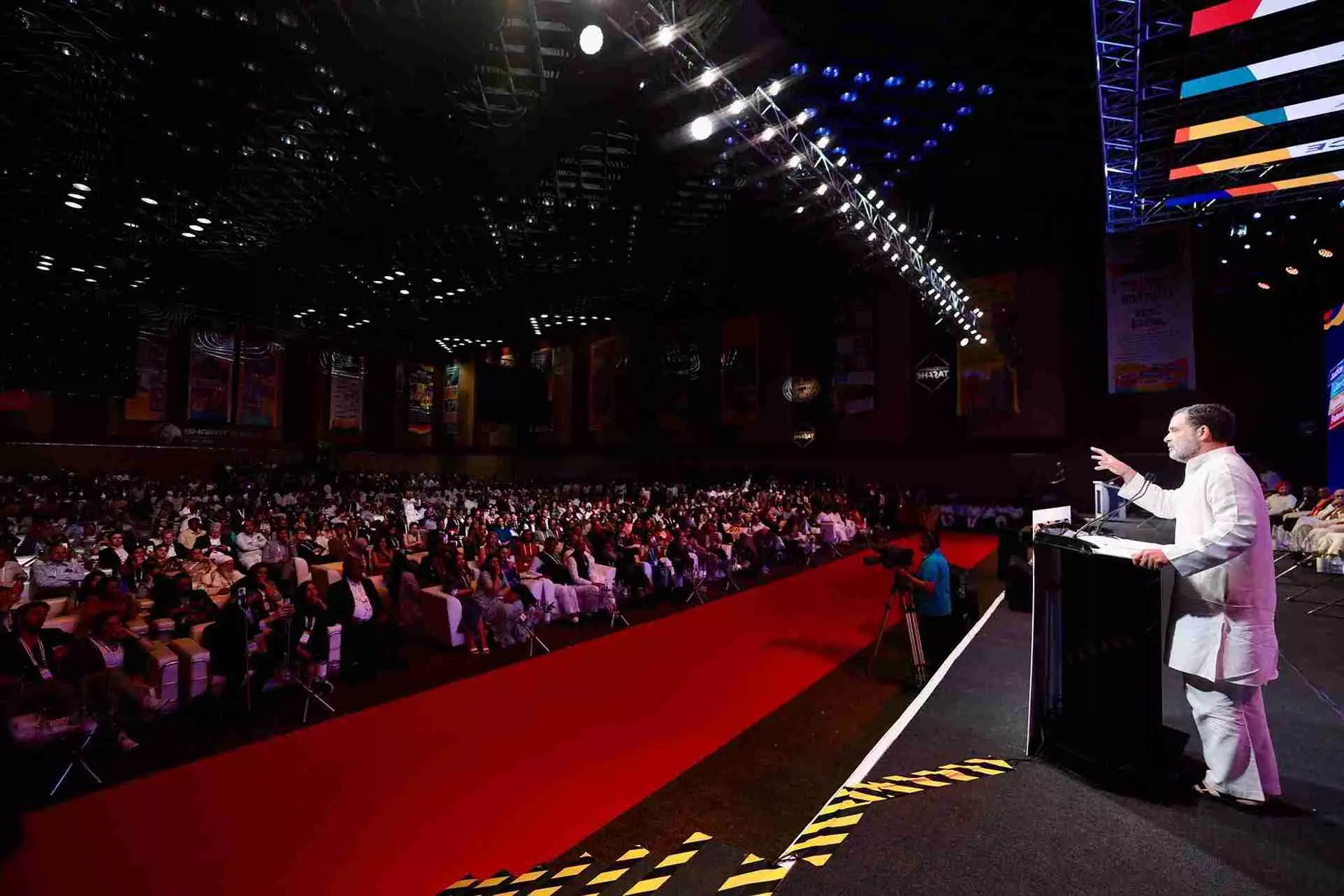
Congress leader Rahul Gandhi on Saturday (November 14) used his valedictory address at the Bharat Summit in Hyderabad to raise questions about India's electoral process, democratic institutions, political financing, and the growing nexus between business and political power.
Speaking before representatives from around 70 countries, he also called for a peaceful political struggle and expressed confidence that the Congress and its allies would defeat the BJP in 2029.
Also read: Democracy, Adani, Soros: Bharat Summit ignites fresh Congress-BJP clash
On the latest episode of Capital Beat, S Srinivasan, The Federal's Editor-in-Chief, analyses the political messaging behind Rahul's speech, its international implications, the BJP's likely response, and what the two-day summit means for the Congress's domestic and global ambitions.
Edited excerpts:
Rahul Gandhi told the summit that India is no longer a democracy. What were the broad contours of his speech, and what was he trying to convey to representatives from around 70 countries?
Rahul Gandhi ended his speech with a call, saying, "It's a done deal." He asserted that the Congress and its partners were determined to come to power in 2029 and that they would get rid of this government.
Most of the statements in his speech had been made before, either in Parliament, outside Parliament or at agitations and rallies. But today, the audience was different. Representatives of political parties from around 70 countries were present.
Several Opposition leaders were among them. The European Union Bloc was represented, as were African nations, Latin American countries, and Asian nations. There was also a Japanese delegation. Taiwan's leadership was represented as well. Leaders from different parts of the world had gathered here.
In that setting, Rahul Gandhi made these statements. Naturally, the Opposition will defend his position, while the BJP will once again accuse him of spreading lies. However, I think Rahul Gandhi was attempting to build an alliance not just among people within India but also to associate India with similar movements across the world.
The Congress's understanding of the situation, which Salman Khurshid also explained earlier during a press briefing, is that democracy and democratic forces are declining not just in India but across the world. This worldwide phenomenon affects India, the world's largest democracy, as well as several other democracies.
References were also made to the United States, the world's oldest democracy, and the global decline of democracy.
Authoritarian forces and other elements, particularly those on the right, are gaining ground. That was the larger theme of the summit.
The gathering largely consisted of progressive elements, including people from the Left, moderates, socialists and even those on the extreme Left of the political spectrum. That was the audience Rahul Gandhi was addressing.
In that context, he said that India was no longer a democracy. It was a striking statement to make about a country known as the world's largest democracy. However, he also explained why he was making that argument and provided the context.
Earlier, during Salman Khurshid's press briefing, a journalist had asked whether all the people gathered at the summit intended to overthrow their respective governments. Khurshid clarified that this was not the objective. The discussion was about the democratic decline taking place across countries, how people's voices were not being heard, how power was becoming concentrated, and how a nexus was emerging between business and powerful political interests.
There was also concern about whether the electoral and democratic processes through which leaders are chosen were functioning as they should. Technology was increasingly being used to drive propaganda, the world was becoming more unequal, and large sections of the population were not progressing financially or otherwise, while a small section continued accumulating wealth and power.
That was the central theme. Khurshid also clarified that these issues were for individual countries and their leaders to address. The summit was not intended to interfere in the internal affairs of any country.
We were here to exchange ideas, understand what was happening in different countries and learn from one another. In his valedictory address, Rahul Gandhi attempted to connect these discussions and position India within the larger argument for greater democracy, openness and equality.
It was about solidarity. Nobody was proposing anything undemocratic or outside the constitutional framework of their respective countries.
He also made one point very emphatically: the struggle must be peaceful. He repeatedly used the word "love" and said that they would not hate anybody.
He said they would not hate even Opposition leaders or members who might have done things that were not particularly good. They would not hate anybody.
I think this was important, particularly because questions had been raised earlier during the press briefing about developments in Nepal, Sri Lanka and Bangladesh.
The response was that, although these developments had been discussed, what was happening in India, including the voices of its youth, was not connected to those events. The situation in India was peaceful and non-violent, and the movement was based on issues.
The younger generation in India understands that this is Gandhi's land and that ideas must be expressed and pursued peacefully. I think these clarifications were important because the BJP has accused the Congress of wanting to spread anarchy. There have also been allegations that the Opposition wants to unseat the government through unconstitutional means.
To counter such allegations, Salman Khurshid included these caveats in his briefing, and Rahul Gandhi repeatedly referred to similar points in his speech.
The important thing to understand is that this was a global forum, even though it was hosted by Telangana.
Also read: Sam Pitroda differs with Rahul Gandhi: ‘PM Modi doesn’t tap phones’
The BJP is likely to argue that Rahul Gandhi should not have raised India's internal political issues before an international audience. It may accuse him of embarrassing the government and speaking against India. How do you see these likely reactions?
Of course, the BJP will make these arguments. After this, Rahul is going to the United States; they will say he is going abroad and spreading hatred against India.
But I think we need to remember that we are living in an information age. People across the world know what is happening in different countries.
It is no longer possible to suggest that developments in the United States or India are unknown to people elsewhere. For instance, American midterm elections are followed very closely in India.
Also read: Is Bharat Summit Congress bid for a broad coalition against Modi govt?
Rahul Gandhi ended his speech by saying that getting rid of the government was a done deal. While 'Vote Chori' was connected to his argument about democratic backsliding, has he now given the BJP another political handle to attack him with? Will the BJP use this to allege that the Congress is seeking regime change?
I am sure the BJP will get into this rhetoric now. However, there are two elements to consider.
First, he was addressing a summit attended by a large number of foreign delegates. But at the end of the day, he was also addressing a domestic audience. He is still doing politics.
I think it is now a no-holds-barred approach because he has realised that his fight with this government will not happen within the normal boundaries of politics we have known so far.
He is saying that the country is now facing a regime that is doing several things which do not provide the Opposition with a level playing field.
For instance, the entire media is out of hand. Institutions are also out of hand. He did not name specific institutions, but he indicated that everything had changed and that money power was now closely associated with political power.
He also gave the example of Adani. A businessman who was once ranked around 600th on the richest list is now the world's second-richest person.
He cited these examples to explain the new boundaries he is drawing in politics.
Therefore, this is also a new kind of politics that he is preparing to pursue. It is direct, confrontational and very much in the face of the government. There may be a punch or two, but the government will have to take it.
You have been present throughout the two days of the Bharat Summit and attended several sessions involving important deliberations. How would you assess the outcome of the summit? Where does it leave the Congress and Rahul Gandhi, both internationally and in terms of domestic politics? Has the party achieved something politically or globally through this initiative?
There are two elements to this. The first concerns the question of India's leadership in the world. In the past, India provided leadership largely in a moral sense. There is a feeling within the Congress that this moral leadership, which was reflected in our foreign policy, has been lost.
For instance, we did not take a clear stand on what happened in Palestine, where so many people were killed in Gaza.
There are also questions about what we did in the case of Iran and the Russia-Ukraine war, which is still continuing.
Similarly, in a world where Donald Trump has literally trampled upon established trade policies and moved away from multilateral arrangements towards unilateral bilateral policies, India has not taken the initiative that the Congress believes it should have.
A country like India did not take the kind of initiative expected of it in response to several such developments.
I think the Congress is trying to say that India has lost these initiatives and the moral authority it once exercised.
During Jawaharlal Nehru's time, there was a saying that India was such a poor country and had so little to offer, yet it kept jumping into discussions on every international issue.
Nehru apparently responded by saying that India might be poor, but it had a voice.
I think the Congress is trying to re-establish that moral position before the international leaders who gathered here.
Many of them also appeared to suggest that the Congress, particularly in India, should provide leadership. That is one aspect, as far as the foreign delegates and international policy are concerned.
The second element is domestic.
Here, Rahul Gandhi was addressing a Telangana audience and projecting Telangana as the next Davos.
His idea is that at Davos, rich people rub shoulders with powerful people. Perhaps the paradigm being proposed here is different. It is about bringing together people who are at the receiving end, those fighting for equality and those seeking a level playing field.
These are the kinds of people who could come together to create a new paradigm. They have also established a new world institute for a progressive world.
The attempt is to convey that the time has come for progressive forces to come together. After living in a state of shock and confusion, these forces must unite and attempt to bring about change.
That, I think, is the larger message they are trying to send.
Watch the full interview: