



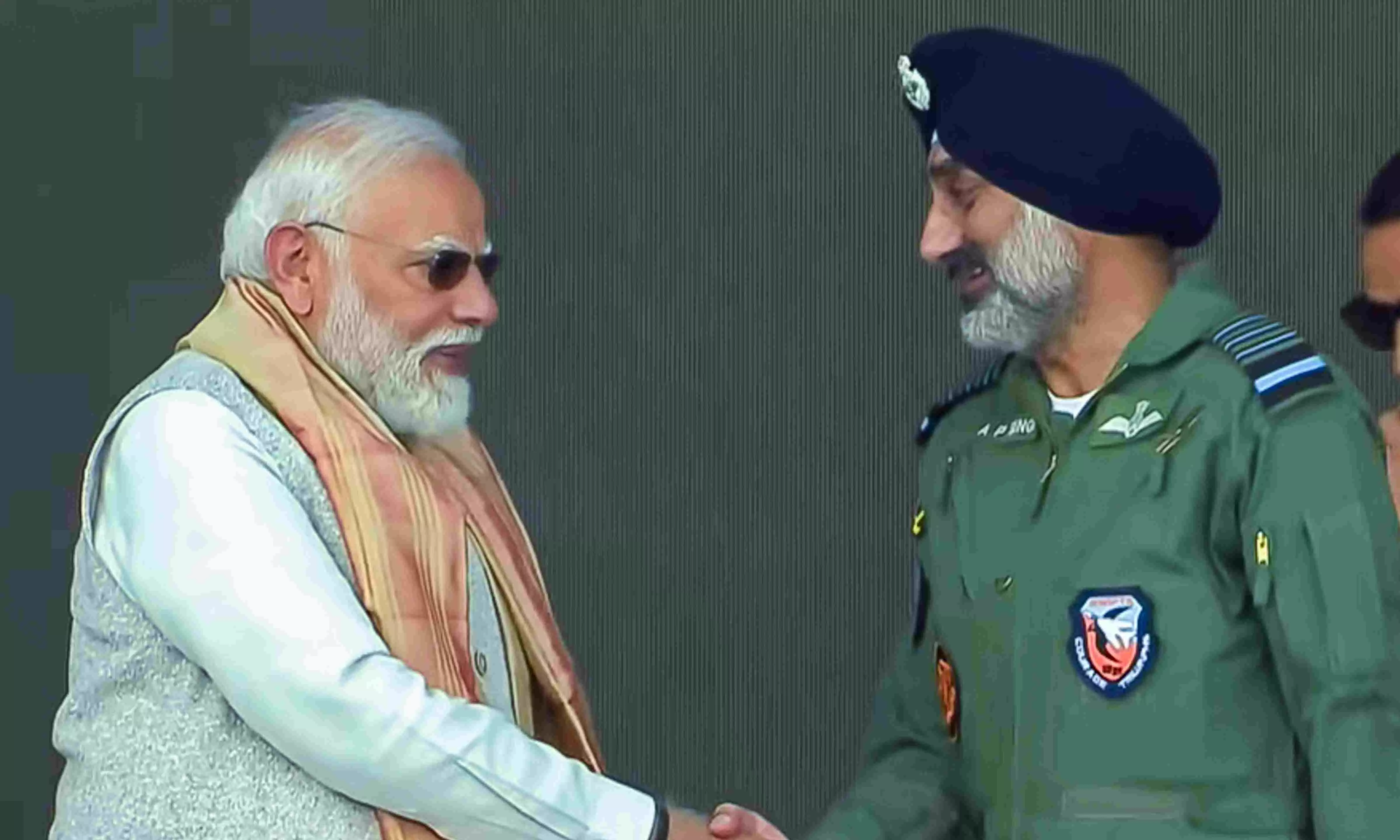
PM Modi with Air Chief Marshal Amar Preet Singh during an aerial show featuring IAF's fighter jets and transport helicopters at the Emergency Landing Facility, in Dibrugarh , Assam, on February 14 (Saturday). Photo: PTI
Why the new Emergency Landing Facility in Assam is a big boost for Indian defence
India strengthens operational infrastructure in the Northeast defence as PM Modi launches a strategic Emergency Landing Facility in Assam near the China border

The first Emergency Landing Facility (ELF) in the North East, inaugurated by Prime Minister Narendra Modi on Saturday (February 14) at Moran in Assam's Dibrugarh district, will be a key strategic asset boosting defence, logistics and disaster response in the region, government officials said.
Located fewer than 300 kilometres from the Line of Actual Control with China, the Rs 100-crore landing facility will serve as a key strategic, multi-functional runway for Indian Air Force (IAF) fighter jets and transport aircraft.
Alternative to Dibrugarh airport
Designed for both civilian and military use, the ELF serves as an alternative to Dibrugarh Airport during emergencies. According to a PTI report, quoting officials, the ELF has been specially designed and constructed in coordination with the IAF to support the landing and take-off of military and civil aircraft.
Also Read: Northeast's first 'extradosed' bridge to boost urban mobility in Assam
Envisioned as dual-use infrastructure, the ELF is capable of handling fighter aircraft up to 40 tonnes and transport aircraft up to 74 tonnes maximum take-off weight. India's first ELF was inaugurated in 2021 in Rajasthan's Barmer district.
Strategic boost to Indian military
According to reports, the ELF is seen as a major boost to the Indian military's strategic infrastructure in North East. The report further stated that the landing facility provides the IAF with greater operational flexibility in the region.
Also Read: New Delhi’s Manipur script: Is administrative trifurcation the endgame?
The ELF is purpose-built to serve as an alternative landing option if Dibrugarh Airport or Chabua Air Force Station becomes non-functional due to operational or emergency reasons. It provides the Indian Air Force greater operational flexibility, ensuring swift responses to developments near sensitive border areas.
ELF’s advantages over conventional airbases
The 4.2-kilometre reinforced concrete corridor has been developed to function as an emergency landing strip for both military and civilian aircraft.
Unlike conventional airbases that may be vulnerable or rendered inoperable during a conflict, highway-based landing facilities provide strategic redundancy and the element of operational surprise.
There is no central median along this segment, enabling unobstructed aircraft movement. Protective fencing has been erected on either side, and temporary roadside installations have been removed to maintain operational safety.
The China factor
Beyond being the first Emergency Landing Facility of its kind in the North East, its location near the China border positions it as a critical component of India’s strategic infrastructure. At present, India’s ELFs are situated in the western, northern and central parts of the country. The facility at Moran represents a notable geographic extension of such infrastructure toward the China-facing frontier.
Also Read: Indian army chief rejects China’s Shaksgam Valley claim, calls 1963 pact illegal
PM Modi made a historic landing at the first Emergency Landing Facility (ELF) of the northeast aboard the C-130J aircraft in Assam's Dibrugarh district.
The Prime Minister had taken off from the Chabua airfield after his arrival, and landed at the ELF in Moran on a stretch of National Highway-37. Assam Chief Minister Himanta Biswa Sarma and Air Chief Marshal A P Singh were also present on the occasion.
(With Agency inputs)