







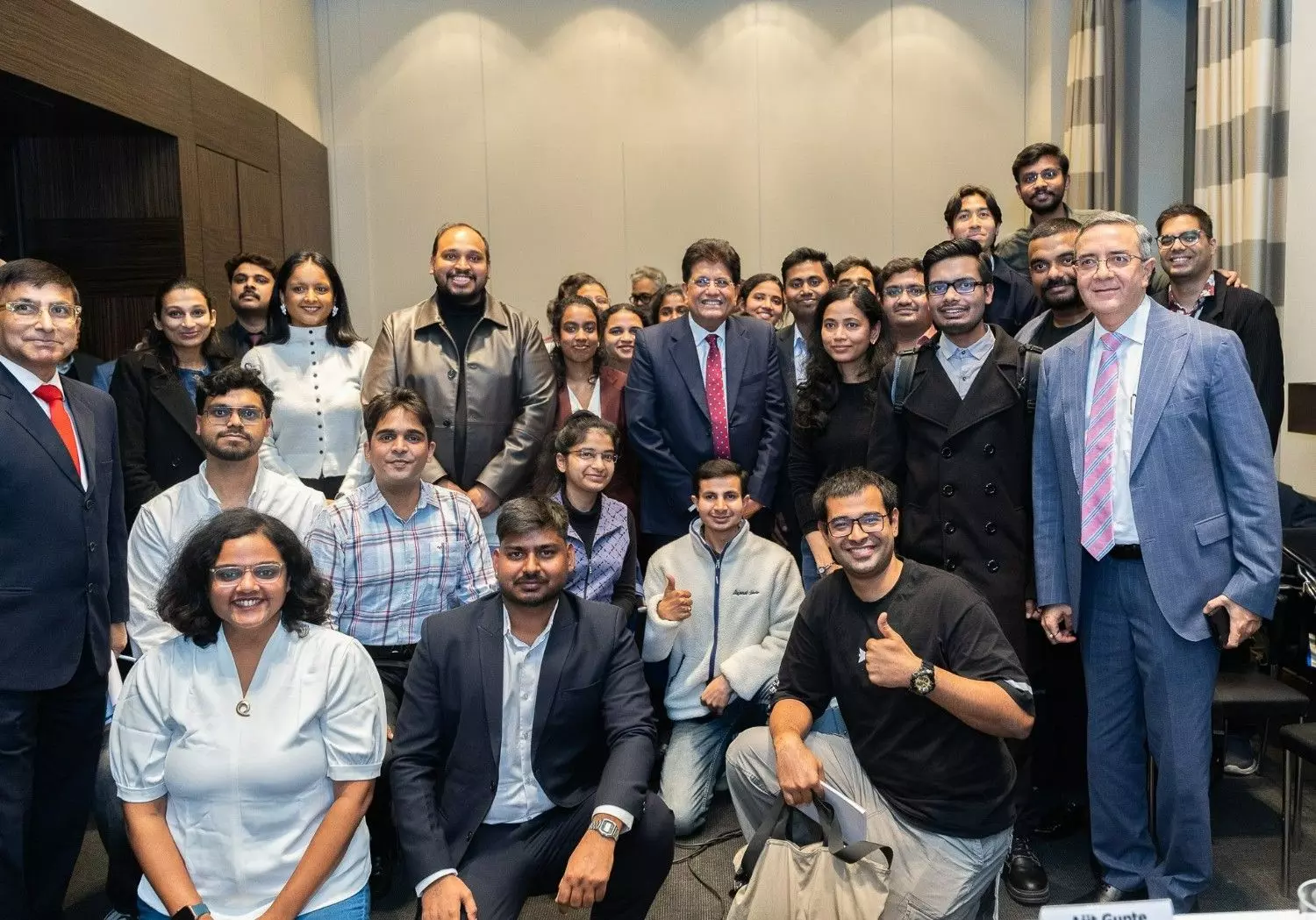
Union Minister Piyush Goyal with the participants after interacting with Indian science and technology researchers and students in Berlin, on Friday (October 23). Photo: X/@PiyushGoyal
Piyush Goyal takes a dig at Abhijeet Dipke in Berlin, invokes China
The Union minister, speaking to Indian researchers and students in Berlin, said India must find ways to bring back its global talent while ensuring that policies are suited to a democratic system.

Union Commerce and Industry Minister Piyush Goyal has taken a swipe at Cockroach Janta Party (CJP) founder Abhijeet Dipke while discussing China’s efforts to attract skilled professionals back to the country and the challenges India faces in reversing its brain drain.
Interacting with Indian science and technology researchers and students in Berlin, Germany, Goyal referred to China’s state-backed efforts to recruit scientists, researchers and technology experts from abroad.
'Such elements will come and mess with our heads'
Asked whether India could introduce a similar initiative, the minister acknowledged the merits of the approach but argued that India’s democratic system presented a different set of considerations.
Also read: 'Asked ministry to identify AI-proof professions', says Piyush Goyal
“It’s a good initiative but then comes the difference between dictatorship and democracy,” Goyal said.
He then brought Dipke into the discussion, suggesting that government-funded programmes to attract Indian talent could invite criticism over the state’s responsibility to finance education and scholarships.
“...If we do this, then people like Abhijeet Dipke will come and say that it was the government's job to fund the students, grant scholarships so why should we do it on our own. Am I right or wrong? Unfortunately, such elements will come and mess with our heads. So we have to calibrate our policies from the point of view of our democracy,” Goyal said.
He added that India would have to calibrate its policies in keeping with the requirements of a democracy.
The remarks came during his interaction with Indian students and researchers on the sidelines of his official visit to Germany and the Netherlands.
China’s talent recruitment model and India’s brain drain
Goyal’s comments placed the question of India’s brain drain at the centre of a broader debate on how governments can attract highly skilled professionals working overseas.
China has used state-supported programmes to draw researchers and scientists from abroad, particularly overseas Chinese academics, as part of its efforts to strengthen domestic research and innovation. Such initiatives offer a potential reference point for India as it seeks to expand its scientific capabilities and retain or bring back skilled professionals.
Goyal, however, cautioned that policies adopted in China could not simply be replicated in India without accounting for differences in political systems and public accountability.
The minister also referred to the risks associated with misuse of authority in China.
“Wherever you go in the world, you find huge Indian talent. But how do we attract them back to India? But we have to also be careful that there is no misuse. In China, people are afraid of misuse. They can just disappear. If someone misuses it in India, I will disappear,” he said.
Goyal urges Indian students to return home
Goyal also used the Berlin interaction to encourage Indian researchers and students to consider contributing to the country’s scientific and economic development.
“You also think about ideas and tell us. We want to get you back; we want to attract talent back. How do we get all of you to come back?” he said.
Acknowledging that financial incentives alone might not persuade professionals to return, he appealed to their connection with India.
“It’s not always entirely economic... it’s your motherland after all. We have to give back. Maybe sometime ahead in life, keep some space for homeland too,” Goyal said.
Goyal is visiting Germany and the Netherlands from October 22 to 27, accompanied by a delegation of around 100 Indian businesses and startups.