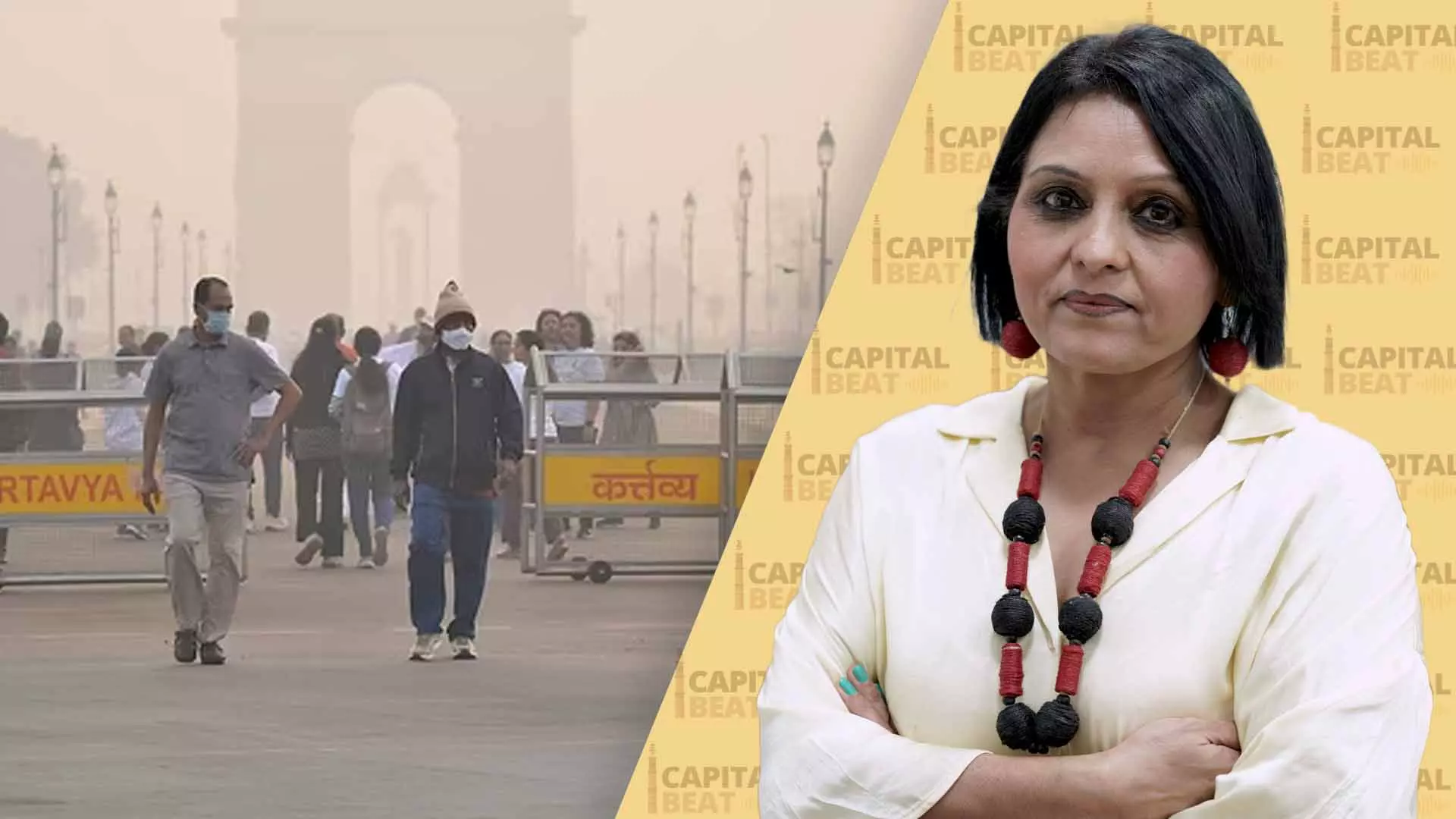
Pollution debate in Parliament
Why isn’t Delhi’s air pollution a Lok Sabha priority?
Opposition protests derail a planned debate on Delhi’s worsening air quality as Parliament wraps up the day’s business. Are our politicians serious about pollution?

A Capital Beat episode featuring senior journalist T K Rajalakshmi, environmental activist Jeevesh Gupta, and Samajwadi Party spokesperson Sarvesh Tripathi focused on the adjournment of the Lok Sabha after the passage of the VB-G RAM G Bill and the absence of a scheduled discussion on air pollution in Delhi-NCR. The panel examined the political handling of worsening air quality as the Air Quality Index (AQI) slipped into the ‘severe’ category and emergency measures were enforced in the national capital.
The Lok Sabha was adjourned for the day following sustained Opposition protests over the VB-G RAM G Bill, resulting in the postponement of a planned discussion on air pollution. The discussion was expected to be initiated by Congress MP Priyanka Gandhi, but did not take place due to repeated adjournments.
With Parliament nearing the end of its session and Delhi enforcing measures such as the ‘No PUCC, No Fuel’ rule and a ban on non-BS6 vehicles, the panel raised questions about legislative priorities amid a public health crisis.
Pollution debate deferred
The adjournment came at a time when air quality in Delhi-NCR had deteriorated sharply. The panel noted that despite the severity of pollution levels, the House could not take up the issue, raising concerns about whether political urgency matched the scale of the crisis.
Gupta stated, “The Opposition demanded a discussion, but the government, which controls the House agenda, is responsible for allowing it.” He said the issue required sustained attention rather than annual emergency responses.
Short-term measures were repeatedly criticised during the discussion. Gupta said steps such as banning certain vehicles or restricting construction activity were insufficient. “Short-term solutions every year have been many… all that will not help,” he said.
Short-term measures questioned
Gupta said the measures currently being implemented had limited impact due to weak enforcement. “These measures in 60–70% of the places don’t get implemented. People still keep moving the way they move,” he said.
Drawing a comparison with Beijing, he highlighted how dust management had been addressed there. “Dust is one of the biggest contributors to air pollution, particularly from construction sites and roadside sources,” he said.
He also referred to loss of green cover in the capital, stating, “Seven GPRA colonies lost around 1 lakh trees in the heart of Delhi.” He argued that without addressing structural causes such as deforestation and dust control, pollution levels would not decline.
Opposition’s position
Tripathi said the Opposition had consistently sought a discussion on air pollution from the first day of the session. “Leader of Opposition Rahul Gandhi made it very clear that we are ready for a constructive discussion,” he said.
Tripathi stated that pollution was affecting children across major cities. He cited Rahul's statement that cities were enveloped in “a blanket of poisonous gases” and said the issue required long-term planning.
He also criticised the absence of a structured roadmap. “We need a strategic, constructive deadline,” he said, adding that the government had not clarified its long-term plan.
Legislative priorities questioned
Tripathi questioned why major bills were scheduled close to the end of the session. He said discussions on air pollution could have been accommodated if legislation had been introduced earlier.
“Pollution was the first thing we should have discussed,” he said. He described the lack of debate as a deliberate decision, stating, “They were very clear that they were not going to discuss it.”
He also referred to the Delhi government’s earlier commitments, saying pollution-free Delhi had been part of the BJP’s election manifesto.
Public health and politics
Rajalakshmi said air pollution debates were often perceived as political criticism rather than public health concerns. “Any issue that concerns the public is perceived by the government as criticism of their functioning,” she said. She questioned why a discussion was avoided, stating that legislators were equally affected. “They also breathe the same polluted air,” she said.
She noted that pollution worsened during winter due to atmospheric conditions and required planning. She described current actions as “adhoc” and “knee-jerk reactions”.
Livelihood concerns
Rajalakshmi raised concerns about construction bans and their impact on workers. “Construction is one of the few areas where employment is happening,” she said.
She questioned whether workers would be compensated for lost wages. She said enforcement tools such as PUCC checks risked becoming instruments of harassment rather than solutions.
According to her, blanket bans and abrupt restrictions reflected a lack of planning. “They actually do not have an idea on how to really tackle this,” she said.
Fear of scrutiny
Rajalakshmi linked the reluctance to discuss pollution to political sensitivity. “It’s a fear of being criticised and of adverse publicity,” she said.
She referred to Delhi Environment Minister Manjinder Singh Sirsa’s statement that pollution was a legacy issue and not solvable within months, saying it reflected the government’s lack of preparedness despite prior promises.
She recalled election-time rhetoric on pollution and said the contrast with current inaction was evident.
Opposition plans ahead
Tripathi said the Opposition intended to keep the issue alive even after the session ended. “To garner votes, we need living people,” he said.
He said the Opposition was open to cooperation. “We are ready to cooperate in any way possible,” he said, including protests if required.
Tripathi said pollution was not limited to Delhi. “It is the problem of all the major cities in the country,” he said, describing it as an emergency requiring a long-term plan.
Session ends, pollution remains
The episode concluded with the observation that while Parliament sessions conclude, the problem of air pollution persists.
With the final day of the session approaching, uncertainty remained over whether a dedicated discussion would take place.
The content above has been transcribed from video using a fine-tuned AI model. To ensure accuracy, quality, and editorial integrity, we employ a Human-In-The-Loop (HITL) process. While AI assists in creating the initial draft, our experienced editorial team carefully reviews, edits, and refines the content before publication. At The Federal, we combine the efficiency of AI with the expertise of human editors to deliver reliable and insightful journalism.