







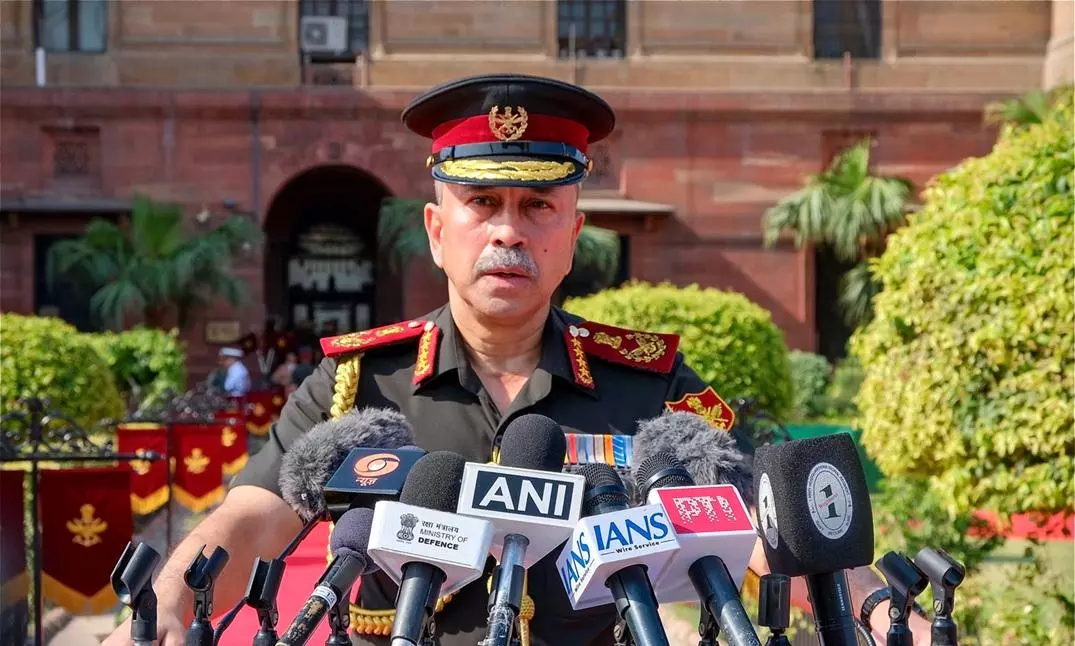
General Subramani cautioned that deepening defence ties among Beijing, Islamabad, and Ankara means Chinese satellite networks will directly benefit Pakistan. Photo: X | @SpokespersonMoD
Pak's space alliance with China, Türkiye calls for urgent upgrade by India: CDS Subramani
General Raja Subramani calls for faster military satellite deployment, warning that Islamabad could benefit from Chinese surveillance and navigation networks, with Turkish support adding to the challenge

Pakistan’s rapidly-advancing space programme, bolstered by strategic backing from China and Turkiye, has introduced a critical new variable to India’s national security matrix, Chief of Defence Staff (CDS) General NS Raja Subramani warned on Friday (November 27), according to a report by Hindustan Times.
Addressing a session on future warfare at the Vivekananda International Foundation in Delhi — moderated by former CDS General Anil Chauhan (retd) — Subramani underscored that Islamabad’s growing orbital reach demands an urgent upgrade to New Delhi's own space-based military infrastructure.
"Pakistan's space capability is improving with Chinese help. Also, Pakistan's Suparco (Space and Upper Atmosphere Research Commission) is working to develop its own capability. Now we also have to take for granted that it will be aided by the Turkish too," he said.
Orbital intelligence stakes rise
Subramani cautioned that deepening defence ties among Beijing, Islamabad, and Ankara — which became increasingly visible during last year’s Operation Sindoor — means Chinese satellite networks will directly benefit Pakistan.
Watch | 'India, China unlikely to end row unless they overcome competing ambitions in Asia'
"And whatever capability is available with the Chinese in terms of ISR (intelligence, surveillance, and reconnaissance), positioning, navigation, and timing... will be available to the Pakistanis. We will have to factor it into our calculus," he noted.
He added that India must counter this by accelerating Phase III of its Space Based Surveillance (SBS-III) mission. Spearheaded by the Defence Space Agency, the Rs 26,968-crore initiative aims to deploy 52 dedicated military satellites over three years through a joint effort between ISRO and private-sector firms.
Evolving threats demand indigenous strategic approach
Beyond orbital security, the CDS observed that the boundary separating conflict from peacetime is steadily eroding, leaving nations in a "continuous state of contestation". Without naming specific actors, he warned that adversaries are actively targeting India through "cognitive warfare" in an "insidious way".
Also Read: China-Pakistan military ties could pose two-front challenge for India, US commission warns
Citing the second phase of Operation Sindoor as a benchmark for integrated multi-domain combat that secured India a "decisive victory", Subramani emphasised that technological superiority remains "only transitory". To sustain readiness without relying on foreign blueprints, he called for an indigenous strategic approach.
"We need not look at a prescribed template. We need to have our own template," said General Subramani.