







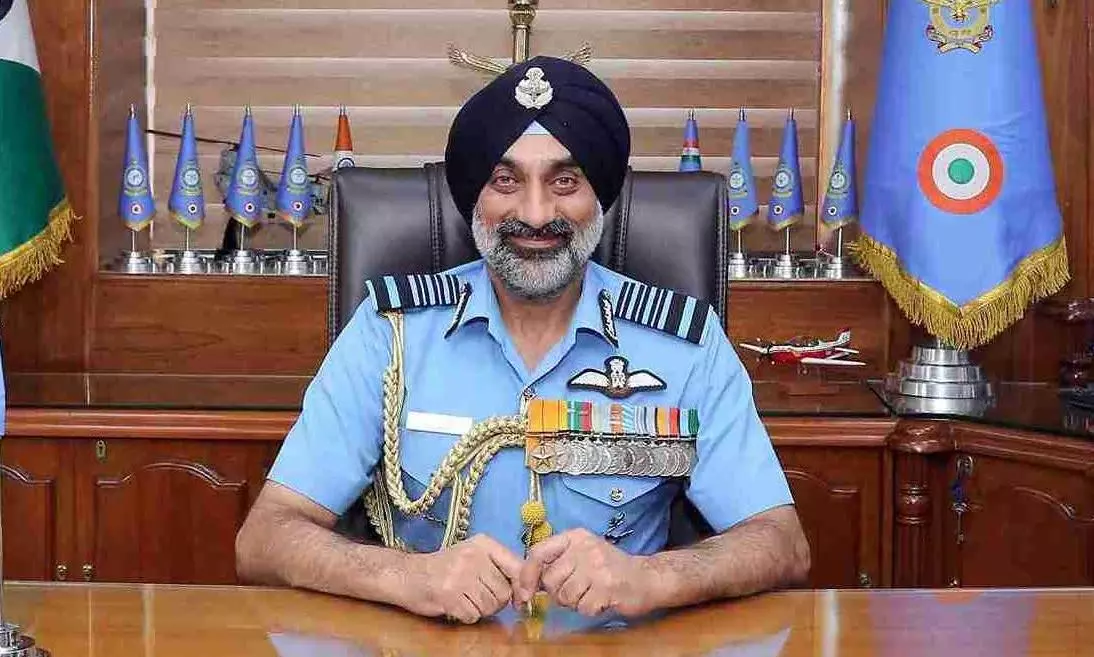
Outgoing IAF chief calls for phased theaterisation, warns against copying foreign models
Outgoing IAF chief AP Singh backs phased theaterisation, saying Operation Sindoor showed the value of centralised control and rapid deployment of assets

The Indian Air Force’s approach to theatre commands should focus on India’s unique security requirements rather than replicating military structures adopted elsewhere, Chief of Air Staff Air Chief Marshal AP Singh has said, while arguing that air power must retain the flexibility to be concentrated swiftly across theatres during conflict.
In his most detailed remarks so far on the government’s theaterisation initiative, the outgoing Air Chief told news agency PTI that the IAF does not view the proposed restructuring as a process of permanently dividing fighter assets along geographical lines. Instead, he advocated a model based on “centralised control” and “decentralised execution”, allowing air assets to be deployed wherever they are most needed.
The theaterisation plan, announced in 2019 as India’s biggest military reform since Independence, seeks to integrate the Army, Navy and Air Force under unified theatre commands. The proposed structure includes a Northern Theatre Command focused on China, a Western Theatre Command for the Pakistan front and a Maritime Theatre Command for maritime security challenges.
Also read: After over 2 decades of debate, is India's theatre command plan close to reality?
Progress on the reform, however, has been slowed by differences among the three services, with the IAF repeatedly cautioning against a rushed implementation and expressing concerns over the division of fighter squadrons under the proposed command structure.
‘Air power must remain flexible’
“Recent conflicts around the world have once again underlined how decisively air power can shape military outcomes,” Air Chief Marshal Singh said, stressing that the debate was not about resisting integration but about ensuring the optimal employment of air assets within a joint structure.
He argued that air power’s core strengths lie in its speed, reach, flexibility and ability to mass combat power rapidly. Modern capabilities such as aerial refuelling, long-range weapons and networked sensors allow aircraft to influence battlefields far beyond the geographical area where they are based, he noted.
“The guiding principle should, therefore, be centralised control where necessary, and decentralised execution where appropriate,” he said, adding that such an approach would enable commanders to respond quickly while ensuring critical resources are concentrated in priority sectors.
Also read: Lessons from Ukraine to Op Sindoor: How the new CDS must rebuild India’s war machine
The Air Chief also warned against designing future military structures based on rigid assumptions about warfare, saying future conflicts are likely to be faster, increasingly autonomous, heavily network-dependent and marked by both precision and mass.
Operation Sindoor as example
Backing his case for flexibility, the Air Chief pointed to Operation Sindoor, India’s precision military response after the Pahalgam terror attack, saying the operation demonstrated the effectiveness of joint planning and centralised allocation of resources.
According to Singh, the operation was conducted under a joint framework established by the Chief of Defence Staff and the three service chiefs, allowing critical assets to be allocated and reallocated rapidly as operational requirements evolved.
The IAF’s calibrated strikes covered a front spanning nearly 1,200 km in width and up to 200 km in depth, underscoring the force’s ability to reach targets deep inside adversary territory. “No place is beyond the IAF’s reach,” Singh said, in remarks seen as a message to Pakistan.
He described Operation Sindoor as a validation of the IAF’s capability-centric strategy, which integrates aircraft, sensors, weapons systems and networks into a unified combat architecture. The operation, he said, reaffirmed the importance of speed, precision, adaptability and integration in modern warfare.
Indigenous systems performed effectively
The Air Chief said a number of indigenous weapon systems performed exceptionally during the operation, delivering strikes deep inside enemy territory while maintaining the IAF’s commitment to zero collateral damage.
Also read: Air Marshal Ashutosh Dixit named next Chief of Air Staff
He also highlighted the performance of India’s networked air defence architecture, which successfully countered drones and stand-off weapons launched by Pakistan. Offensive and defensive capabilities, he said, worked together as part of a single integrated system.
The operation further demonstrated the value of multi-domain warfare, bringing together air, land, maritime, space, cyber and electromagnetic capabilities to accelerate decision-making and enhance operational effectiveness.
At the same time, Singh cautioned that the success of Operation Sindoor should not lead to complacency. The IAF, he said, must continue strengthening combat mass, intelligence, surveillance and reconnaissance capabilities, electronic warfare systems, counter-drone technologies, resilient communications networks and AI-enabled decision support systems.
Vision for 2047
Looking ahead, the Air Chief linked the IAF’s long-term transformation with the national vision of Viksit Bharat 2047. He said the force aims to evolve into a technologically advanced, multi-domain aerospace service capable of protecting India’s expanding economic and strategic interests.
The IAF’s Capability Perspective Plan-2047 and Space Vision 2047 are guiding investments in advanced aerospace technologies, artificial intelligence, autonomous systems, cyber capabilities, precision weapons and domestic defence manufacturing, he said.
Also read: IAF chief AP Singh flies final sortie in iconic Kiran aircraft near Hyderabad
Singh emphasised that theaterisation should proceed in phases to ensure operational readiness is not affected during the transition. Reiterating the force’s commitment to integration, he said the IAF would work closely with the Army and Navy to build command structures that preserve the inherent flexibility of air power while enabling India to fight future wars as a fully integrated force.
“Future conflicts will be multi-domain by their very nature,” he said, adding that the services would increasingly plan and operate together as India seeks to build one of the world’s most capable and self-reliant aerospace forces by 2047.
Air Marshal Ashutosh Dixit will take over as the 29th Chief of the Air Staff from the afternoon of October 31 as Singh retires.
(With agency inputs)